Thursday, February 22

+inload: Arcturus +

+ The Arcturus Campaign +


+ The invaders of Arcturus – the orks of the Von Kurtz stars – proved to be a resilient and hardy foe; hardly surprising for a force of greenskins and their assorted mercenaries. The dispirited and demoralised Arcturan PDF were capable of holding actions against the invigorated and aggressive foe, but the counter-attack fell to the supporting Naval fleet and, of course, the Blood Angels Third Company. +


+ Contemporary pict-captures show the force's livery. While broadly similar to the Angels' 41st Millennium heraldry, a number of variations can be drawn out. In fact, given the five millennia difference, it is a mark of the Imperium's jealously conservative nature that the forces appear as similarly as they do. +

+ The era of the Nova Terra Interregnum was a period of intense self-reflection for many Imperial groups and factions, particularly the military. The Blood Angels remained studiedly neutral, and were careful to remove markings that could be interpreted as pro-Terra or in favour of Nova Terra, instead adopting sigils that venerated the Emperor directly, or spoke of their own heritage and history as steadfast, constant defenders of humanity. Of note at this period is the removal of the chest-mounted Aquila – the double-headed eagles that had been borne by the Astartes at large since the Scouring; as it had become a rallying symbol for Terran loyalists. +


+ The chestplate was commonly left blank, though many amongst the Blood Angels retained similar devices, such as the winged skull of the Imperialis (seen here on the combat squad leader's bannertop), or other winged devices, such as precious gems or grails, as on the sergeant's banner. +

+ Keen-eyed observers will also note the archaic uncoloured backpacks. At this period of religious resurgence, it was common for power packs to remain unpainted as a mark of honour to the Machine Spirit of the armour, and to differentiate the human Astartes from their equipment; though this varied hugely from Chapter to Chapter. The Sons of Spectra, for example, painted their power packs in Chapter livery to honour the Spirits as protective penates – a practise that became near-universal after the Moirae Schism. +

+ The Third Company's activity in the Arcturus Campaign lasted two local months (ca. forty-three standard days) until their immediate strategic goals were met – specifically, the systematic destruction of surface gargant factories – at which point the Third were cycled out and limited reserves from the Sixth and Eighth hosts deployed in support of Legio Madoxes, a Titan Legion that had translated in-system. +

Wednesday, February 21

+ inload: Textural painting +

+ Texture, impact and effect +
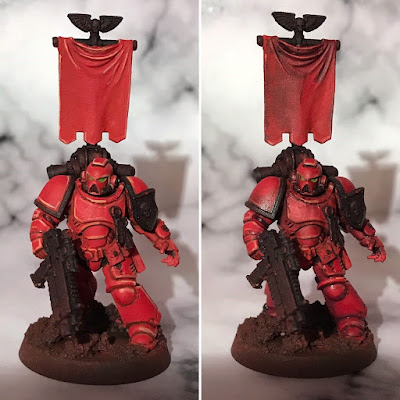
+ Working on these Blood Angels has given me a good illustration of a technique that I use a great deal in my painting. Have a look at the pict-capture here, which shows the same marine before and after what I call 'pre-shading'. +

+ Here, I used a mix of Liche Purple, sepia ink and flow improver medium; laying it onto the model before swabbing it off the raised areas using various tools – a clean brush, a bit of kitchen paper, and my bare thumb. +

+ The purpose of this stage is two-fold. Firstly, it enhances the tonal contrast. Squint at the image and you'll see that the armour plates on the pre-shaded marine (right-hand side) remain visually distinct as those on the earlier stage start to bleed together. This eventually helps to give the figure more impact, though it does rely on you working back in once the pre-shade is dry to develop the highlights and shades further. +

+ Secondly, and more importantly, it adds visual texture. You'll probably be familiar with greebling, which is covered nicely here: [+noosphreicexloadlink embedded+] and digital effects like bump-mapping. The second purpose of this painting effect is serving a similar duty as the 'time-damage' type of greebling covered in the False Machine blog entry: creating imperfection and suggesting teture. +

+ This visual texture is appealing because it implies greater complexity, holding the viewer's attention; helps to further push the illusion of scale; and also implies that there's something going on beyond the base of the model, giving it a sense of belonging in a scene, rather than being a model figure. It is a painter's story-telling tool. +

+ When to use it +

+ Once applied, you may well need to re-establish your highlights, and further deepen the shading proper; hence why I call it a pre-shade. It's a technique for the middle stages of painting. I establish my initial highlights and shading fairly quickly, apply the pre-shade, then use the effect of that to inform the remaining tonal work. +

+ Pre-shading works very well as a complementary technique to battle damage and weathering – in fact, it can very easily be used selectively (rather than over the whole model) to add grime or oil marks. The latter is particularly effective if you use a glossy chromatic black for a sheen. +

+ The ability to create visual texture on smooth surfaces, without creating physical texture, is also useful during the mid-stages of painting. It means that you can later apply overlaying washes and glazes without the paints pooling or gathering. A good example of this is on the banner of the marine:


+ On the left-hand side, it is clean, smooth and dull. The initial highlights and shading are stark and flat, giving an odd cel-shaded look. After the pre-shading has gone on, there is a sense of texture which helps to 'sell' the piece as fabric. There's subtle mottling, which suggests age and staining, and there's generally more for the eye to see. The highlights are softened (but not eliminated), and the shading deepened and enriched. It's worth pointing out that this technique works best when applied topically – that is, in particular places – and then drawn out and blended away with your brush, rather than applied over the whole area. +

+ Of course, as with every technique, pre-shading needs to be a tool to use when you want the effect. Using a pre-shade will flatten highlights, mute colours, and create visual complexity – compare the initial highlights on the stages above. Those effects are precisely why I use pre-shades, but if your taste is more for cleaner lines, smooth panels and vibrancy, it's not a useful tool. In 40k terms, I'd suggest that it's better suited to more grimy figures – Imperial, Chaos and orks – than to armies like Eldar, Tau and so forth. It would also work well for Tyranids, going a long way to getting an organic, natural feel. +

+ What colour? +

+ The precise colour of the pre-shade is irrelevant – for yellow I use a red-brown, for example; for blue I use a purple – it's more important that the tone is darker than the midtone. +

+ With that said, I tend to use harmonious colours (those close to the original colour on the colour wheel), as using complementaries – those opposite it on the colour wheel – will neutralise the hue. Since the effect is already dulling, this can make your models look too gloomy and murky. +

+ The complementaries of red are orange and purple. I used purple here because it gave a cooler effect, enhancing the idea of distance (owing to aerial perspective) and creating a low-key effect. +


+ The result +

+ Here's a before and after of the whole squad, which shows the effect more strikingly, as it's closer to how the unit will be seen; smaller, at tabletop distance. +


+ The cleaner, crisper effect here is appealing visually. The red is warm, the smooth texture is restful. Here, the Blood Angels look like noble figures, straight off the parade ground, or out of a propaganda film. It's nice, but not what I'm after. +


+ After the pre-shade is applied, the colour is cooled and muted. Details around the helms, torsos and knees start to pop more, creating areas of interest and complexity. There's more of a sense that the Angels are in battle; picking up a slight griminess without overt damage. +

Friday, February 16

+ inload: Blood Angels for the Alien Wars +

+ Blood Angels reinforcements inbound +


+ A quick scale shot of the belligerents of the Arcturus campaign: Deocritic Guardsman, Astartes, greenskin (dominant ork designate), greenskin (slave caste). +

+ I'd dug out the Blood Angel as reference for painting the others in his squad, and thought I'd pop him up with some other figures. Thrugg Bullneck here is a Nob, which goes to show quite how tall the Primaris models are. +

+ The other half of 'The Wards of Furiel under Lord Dahavauron, Prince of the Erelim; 3rd Strateia of the Host of the Angels of the Blood' +

(or Squad Raphael, Third Company to their friends)

+ As mentioned, I've been painting. Minor update, really, but might be of interest. +


+ There's also a couple of loose Devastators (below) alongside Brother Engel. I'm looking forward to tackling the blue helms. How will I get them to fit the Blanchian palette? Might have to take some inspiration from Anders Zorn, an artist who used a very limited palette to great effect [+noosphericexloadlink embedded+]. +


Thursday, February 15

+ inload: sneaky Gretchin +

+ The Alien Wars – Xenos +

As the eyes of the Imperium turned inwards, mutual support fell away, leaving each planet fending for itself. As a result, xenos of all stripes began to colonise and conquer regions of the galaxy that had been in Imperial hands since the closing of the Great Crusade. Perhaps the most widely-known of these aliens to the mass of humanity were the orks.

Orks, of course, have likely troubled mankind since first contact, presumed to be during the Dark Age of Technology, or even before. The Nova Terra Interregnum, however, was marked by the resurgence or emergence of thousands of orkoid petty empires, most consisting of a scattered system or two, but some – like Charadon or the Gemini Region – eclipsing the size of Imperial sectors. From the infamous attack on Rynn's World by Luggub's Drop Legion, to the Massacre of Karad Kar, this period of the Imperium's troubled history history is rife with greenskin aggression

+++

+ 'Orrible little runts +

+ Between Iron Warriors, dwarfs and robots, I've been painting far too much metal recently. I needed a bit of a break, and what better to pick up than my orks? These poor buggers have been lurking unpainted since around 2014: always the bridesmaid and never the bride. +


+ Four little runts were what leapt out of the box. Simple, relatively quick, and allowing me a chance to play around with some green (a colour that rarely troubles my palette), these were just the project I needed for a quiet Monday night. +

+ They're pictured above with Thrugg Bullneck [+noosphericinloadlink embedded+], and will shortly be joined by some boyz who will be converted to have more of a Rogue-Trader aesthetic, to fit in with my Alien Wars project – basically a retro setting that's an excuse to convert new models to look like the older ones. If you think 'what would the Rogue Trader version of hte 40k universe have looked like if it had come out now?' +


+ Painting up the grots let me scratch another entry from my Wargame Hobby Bingo card, too. They were a gift from a pal of mine, who very kindly gave them to me as an incentive to get my ork army on the go. While they were nicely painted, I wanted to give them my own stamp. +

Friday, January 26

+ inload: Rad-toting, gunslinging, habitat-burning Destroyers +

+  Iron Warrior Destroyers +


+ It's Australia day today, so what better way to celebrate the nearest thing we've got to Catachan than the deadly toxic Destroyers? (I kid! I kid!) +

+ We had a look at the first Psiloi (my 'in-universe' name for Destroyers) a earlier in the week-cycle [+noosphericinloadlink embedded+], with Aftrokratori, a relatively new member of the corps in Mark IV armour. +

+ I had decided that the Iron Warriors would share none of the other Legions' reluctance to deploy the Destoyer's semi-forbidden weaponry, so I don't want to pick them out with a unique paint job or something similar – I want them to look like just another unit in the army. However, as I learned with the Basilikoi (my volkite-toting veterans), this anonymous approach can mean that they end up looking a little underwhelming; so the challenge is to find a balance between standing out and looking part of the group. +

+ The jump-pack bearing, pistol-wielding nature of Destroyers gives them a unique silhouette in my army, so that already distinguishes them from existing stuff. However, to 'future-proof' them from looking too similar to a potential jump-pack equipped assault squad, I want to make them slightly different without going completely off-piste. +

+ My solution was to dig into the background. I thought the Destroyers were an opportunity to explore some parts of the Horus Heresy that I've always liked, but have never found a good excuse to do – namely heavy battle damage and Mark V 'Heresy' plate. +

+Bolt pistol-armed Destroyer with bionic arm (rear of shot) +

+ The brutal appearance of this armour type marks them out visually, and fits perfectly with the background: the Destroyers' rad-weaponry and tactical application makes them particularly vulnerable to damage and degradation, so it seemed fitting to give them the low-tech but functional Mark V, which in the background is a stop-gap mongrel suit, with plates issued to replace the higher-tech and hard to repair Mark IV. +

+ Having the newer members of the unit (such as Aftrokratori) in Mark IV, and their older, more battleworn comrades in increasingly complete Mark V, is therefore a nice way to segue the visuals from the rest of the army (mostly in Mark IV) and give them a distinctive look. +

+ Destroyer with suspensor-assisted missile launcher. One of the few models in the game who can have both a jump pack and a heavy weapon! Note the bionic leg; a standard part of the Iron Tyrant kit +
+ You'll also notice that there's some battle damage on the armour – a detail made easier by Master Crafted Miniatures, who (after a little pleading!) have produced some awesome battle-damaged pauldrons. I've also included some exposed bionics. Generally, I prefer to keep bionics in this army relatively subtle and hidden, as it leaves 'design space' for my Iron Hands [+noosphericinloadlink embedded+], who have a much stronger association with augmetics. However, given the Psiloi Destroyers' elite status, I thought it'd be fun to add some exposed bionic limbs. In addition to providing some visual flavour, it also hints more broadly at the Iron Warriors' genetic proclivity for accepting bionics, something that could be lost if I had none in the army. +


+ Here's a shot of the four members awaiting paint. I'm not sure if I'll expand them or not just yet, but they were fun to do. Relatively quick, too, as the arms for the dual pistols required much less chopping and reposing than is typical for the boltgun-armed marines. +

Thursday, January 25

+ inload: Personalities of the Iron Warriors' 242nd +

+ Dramatis Personae +


What price victory?

Victory is priceless.

Motto of the Officio Monstrosa

+ Kolossos Kalamatas +

+ A traditional Olympian term for standard bearer, Kolossos is mostly reserved with the IVth legion to describe the Legion's heralds, rather than the more commonplace Company standards. +


+ As with other Legions, the Heralds of the Iron Warriors were highly-skilled warriors and diplomats both: exemplars of the Legion. By the later stages of the Siege of Terra, honour came to mean less than raw strength, and many of the later Kolossi, Kalamatas included, were elevated to their position for little more than their aggression and fearlessness than any of their less belligerent traits. +

+ So it was in those later stages that as the surface of the Iron Warriors was abraded, a darker alloy was revealed beneath. +

+++

+ Corpsemarker +

+ The grinding nature of Legion campaigns often left Apothecaries splitting their duties between battlefield first aid, geneseed retrieval and implantation. In many Legions, more onerous duties were often leavened by scheduled meditations or less draining combat training. +

+ The typical efficiencies of the IVth, however, streamlined this, cycling apothecaries through punishing tours of monotasking; leaving an individual on extended front-line tour; before being cycled immediately back to sort the geneseed of his fallen brethren for weeks on end. Such an approach doubtless had a brutalising effect on the Iron Warriors' Apothekarion as a whole. +

+ In addition, the Iron Warriors' unusual affinity for, and ready acceptance of, bionics meant that Iron Warriors casualties tended to be either quickly treated and pressed back into service, or dead. There was little post-injury care; with the pressure on the apothecaries resulting in their wards being viewed as tools to be repaired, or equations to resolve. +


+ Perhaps surprisingly then, the haunted, drawn visage of Apothecary-ordinary Constantine was a regular attendant at Lodge meetings of the Dodekatheon. Was he attempting to grasp at what slivers of brotherhood he could find amidst the gore; or had he become so inured to pain and injury that he felt no compunction to remain beside his charges? +

+ Constantine's honorific 'Corpsemaker' was equally cryptic – respect from the 242nd for his skill at arms and willingness to fight on the frontlines; or merely a veiled reference to the number of their dead he gathered? +

+++

+ Palatarch Oneomaster +

+ Honoured of the Basilikoi; a true 'Iron Warrior'; Oneomaster was nevertheless not Olympian-born. +


Monday, January 22

+ Iron Warrior Legionaries: Tactical, Tactical Support and Destroyers +

+ Psiloi Aftrokratori +

We weren't just infantry in there, of course. You don't hunt down a Primarch by fighting on his own turf. The Psiloi were there, too; the dedicated eradicators. The Destroyer corps. I'd seen their deployment by other Legions, and had always been surprised. 

They seemed hesitant; almost embarrassed by their use – at least, before the schism. It was a marked contrast with us. The Fourth had always done what was necessary, without hesitation or concerns of the thoughts of others. Our Destroyers were thus neither honoured nor abhorred; they were just warriors, the same as the rest of us.


Aftrokratori had a thick accent. He wasn't Olympian, but he fought like one. I never found out where he was from; and since he's been dead for years now, I have little inclination to find out.


His skin, like most Destroyers, was near-black as his melanchrome struggled to protect his organs from cooking within his Mark IV plate, as he was bathed in the baleful miasma of his ilk's rad-weaponry. The Psiloi suffered a great deal of attrition in terms of both men and equipment. The Warsmith's answer to this was simple: assign a permanent member of the apothekarion to the destroyer's Muster, and give them arming privileges.


That last point backfired on the Psiloi during the Siege. The rest of us scavenged from the battlefield or maintained our reliable Crusade-era plate. Certainly the Destroyers got first pick of replacement equipment; but owing to the rate of failure they endured, that simply meant they picked up the bulky, inefficient mongrel plate that was all the Legion could provide during those days. 


+++

+ The Muster continues +


+ Quite a burst of painting over the last few days. I've completed eight new marines for the Iron Warriors. The first five, shown above, are more Tactical Legionaries. I rarely tire of building and painting these; they're the iconic 'Astartes', in a way that more specialised or stylised squads aren't. +


+ These two are Basilikoi, my own cadre of veterans. Played in-game as Tactical Support Legionaries, it was fun to build a Mark V marine. The distinctive studded armour and brutal faceplate was a breath of fresh air. I like a non-uniform look in squads, as it helps to keep things interesting when painting. +

+ In addition, since I've included very little in the way of personal heraldry on my Iron Warriors, it's useful to have some different armour styles in an other uniform scheme, as it adds some visual interest to the mass of troops. +


+ I took the opportunity to revisit the volkite chargers these marines are equipped with. I'd left them with a very dull red glow. While a bit more realistic, it left the Basilikoi looking too similar to the others in the army, even taking their spiky shoulderpads and distinctive helms into account. +

+ Owning your hobby +

+ The other reason I don't tend to paint much specialist stuff, like this Destroyer, is that I always get a nagging feeling that I 'ought' to be painting more basic stuff. The stories and artwork are full of archetypal Marines with boltguns; the specialist are very much secondary. +

+ I've read that lots of people regard painting the basic troops as a chore, or a 'tax' to get the interesting stuff; so I guess that's the other side of the same coin. Both such opinions are, at heart, a bit silly – there's no way to have fun wrong: as soon as you start to feel that you're being directed to do something, you can lose that spark of enthusiasm, and things start to feel like work. +

+ For this reason, I'd encourage you to go with where your enthusiasm lies; and build and paint the models that you really want to make. Any ideas of what should be included can come in later. +

+ Bubbling under are another four Psiloi Destroyers (see below), two more Heavy Support marines with multimeltas, the Basilikoi's Palatarch (sergeant), and an Apothecary. Whether any of all of these get completed before the weekend is up in the air. +


Tuesday, January 16

+ inload: Orcs and the 'Footsore' 242nd +

+ Painting progress +

+ Out of nowhere, a band of orcs. I picked up a pack of the orc cards for Shadespire in a trade, and decided to dig through my box of bits to build my own version of Gurzag Ironskull's warband. Should work out quite handily, as the PCRC have picked up quite heavily on orcs! A few alternate sculpts should help to avoid duplication. +

From left to right: Not-Hakka; Not-Ironskull, Not-Bonekutta, Not-Basha
+ The orcs in the official warband are essentially what I know as Black Orcs; and I had a pile of those I bought for my much-delayed ork army (destined to be Skarboyz). However, I'd built and painted one or two as stock, just for the pleasure of painting them (they're great models), so these two provided the basis for Bonekutta and Basha, who are simply orcs with a double-handed axe and a pair of mauls respectively. The model on the right (Basha) needs a second maul to replace his cutlass, but is otherwise complete. The model second from right (Bonekutta) just needed a round base. +

+ The remaining two I built from scratch specifically. Hakka is a Black Orc with two axes, and a head swap from the new Age of Sigmar orc Brutes. Ironskull was the donor for that head, his own coming from the boarboyz set, which is oddly slightly larger than the standard brute one. Not wanting to have the leader as a stock model, I've swapped his rather crude-looking weapons for slightly less crude Black Orc ones, and left his armour off. THis necessitated a bit of sculpting work on the chest and back. +


+ Elsewhere on the painting table are these Iron Warriors, who have their basecoats complete, taking them to midway through part I of this tutorial [+noosphericinloadlink embedded+]. The next stage is developing the metal work and basically brightening them up a little. +

+ The five on the left are standard Tactical legionaries, the one on the right a Destroyer. +

Friday, January 12

+ inload: February's goals +

+ February's goals +

+ Not yet halfway through January, but I want to keep these goals realistic – enthusiasm ebbs and flows; but nothing stifles creativity like a deadline. Anyway, I've cracked the Iron Circle and Blood Bowl teams that were my main January painting goals; and have dug out some sprues for the Alien Wars building. With two weeks before the end of January, I'll be able  to work on them at my leisure, and have fun recreating the iconic Blood Angels army from White Dwarf. +

+ What next, however? Well, I managed to pick up the orc cards for Shadespire for a song. I've got a handful of Black Orcs painted up that fit the henchmen of the orc gang well; and I have a fun plan to convert the leader. That's element I of the goal. +

+ Secondly, I'd like to clear up my painting backlog. The five Iron Warriors below will go a long way to 'tidying up' my gaming – at the moment, I've got awkwardly-sized squads, and no way of fielding Rapiers. These five will fill some gaps and let me play more easily. +


+ Thirdly? I think I'll keep that open. +

Thursday, January 11

+ inload: Chaunterwick Unathletic ready for play +

+ First drive +


The team's moving out onto the pitch. After a push last night, I've got the squad ready for gaming. I hesitate to say absolutely finished – I'd like to punch up the red with some glazes, and I'm umming and ahhing about weathering – but they're certainly at a stage I'm happy with for a few games.


Numbering on both the front and the back helps with identification during gaming, so I've added high contrast flashes with the player's number on. These also look nice, of course! A few little details like this work wonders for making them appear like a sports team.


You won't have missed the names on the front of the base, either. These are visually distracting, but these are gaming pieces first and foremost, so I think they're worthwhile here. In the past, I've always found it adds hugely to the enjoyment of the game if I can think in terms of individuals rather than abstract pieces – and that applies to both sides. Victories are sweeter when 'such-and-such' scores a sweeping touchdown; and setbacks are softened if you can think in sports terms – 'so-and-so' stealing an interception from your pass is a more immersive result.


Distinguishing positional players is important, and I like to make it as easy for the other coach as possible. In addition to the differences in sculpt and pose, my blitzers all have a white frontpiece to their helm. This is the sort of decision you can make that doesn't compromise the uniformity of the team strip, but does avoid confusion, which is the bane of Blood Bowl. No-one likes seeing a critical play fail because you mistook the stormvermin for a gutter runner.


Fortunately, the sculpts of this team make distinguishing positionals relatively easy; the catcher and thrower here are good examples of how a change in pose and a few select details can help a sculpt to tell a story – in addition to having a ball sculpted on, the throwers share open-faced helms (in contrast with the barred helms of the linemen and blitzers), and their poses make them look lighter on their feet without charging (as with the blitzers). Similarly, the catcher is much more lightly armoured, and has an oven glove catcher's mitt that further emphasises his pose.


Here's the team photo. The throwers are my favourite sculpts; probably because their faces are more visible. You'll notice the ball on Jimmy Turnpike's base – it's easy to forget the other bits and bobs you need for the game; and I think it's a shame to have a pair of lovely teams playing with unpainted reroll counters, turn markers etc. As a result, I started painted those at the same time; though I'm afraid my eyelids drooped before finishing the re-roll marker!