Friday, July 25

+ inload: Space Marine Armour Marks at Calth +

As the Great Crusade wore on and the bounds of the Imperium increased, supply lines for the whole of humanity's fighting force became attenuated. Simultaneously, novel STC discoveries were routed back to node worlds such as Cypria Mundi, Hydraphur, and – of course – Mars; where the Astartes' armour and weapons were refined and improved. 

These circumstances meant that the uniformity of Mark II Crusade armour, used by all Astartes at the commencement of the Great Crusade, was diluted further and further. As more Forgeworlds and STCs were brought to light, they were set to work producing materiel for the Legions at various staging posts throughout the Imperium. The inherent difficulty and delays of communication created by the size and speed of the Imperium's expansion, coupled with most forgeworld's jealous hoarding of their secrets, meant that from an early stage in the Great Crusade Space Marines wore subtly different armour.

While all information was fed back to Mars and then sent back out to the Mechanicum across the galaxy, some refinements made by individual forgeworlds were lost in interstellar communication, or were superceded at node worlds by more effective measures received from elsewhere. As a result, local variants of armour emerged which were termed patterns, based upon the forgeworld of manufacture. The original Mark II plate issued to all the legions was retroactively named Mars-pattern. The phrase 'Crusade Armour' became a common term, used interchangeably with Mark II, to describe all compatible power armour suits, regardless of their planet of manufacture.

Despite its flexibility and versatility, Crusade Armour eventually reached a point that further refinements were largely cosmetic and counter-productive as the number of patterns soared. Mars-pattern Mark III and Mark IV – Iron Armour and Maximus Plate respectively  – were issued in relatively quick succession; the first a culmination of existing technology into a definitive final point, and the latter a genuine evolution of Astartes armour made possible by the Martian Mechanicum's discoveries during the Great Crusade.

By the outbreak of the Horus Heresy, no Legion remaining could be categorically stated to have all their forces in the same patterns of power armour, and most of them used a variety of marks. The Primarchs' and Legions' preferences also influenced and complicated this issue. Some favoured newer armour for veterans, while others issued the latest armour to recruits. Individuals often added, or were issued, updated or artificer-crafted elements as replacements to their existing armour; creating mongrel suits – retroactively grouped into the loosely-defined Mark V 'Heresy suit' – that demonstrate the STC system's inherent compatibility to great effect.

+ Armour of the XIII Legion +

It might be expected that the Ultramarines' organisational nous would mean the Legion could assemble in identical gleaming ranks, each line warrior a mirror of the next; but in truth the sheer size and widely-scattered disposition of the legion made uniformity a vain hope. In any case, the culture of the 31st Millennium placed more emphasis on battlefield efficacy and reliability than on an obsessive and fruitless need to 'count rivets'. 

Nevertheless, the Ultramarines attempted to maintain internal consistency within individual Expeditionary Fleets, for ease of maintenance if little else. However, ongoing field replacement, resupply delays and, most of all, the yawning gulfs of isolation inherent to warp travel meant that Ultramarines Legionaries in different Expeditionary Fleets wore a huge variety of armour variants and marks drawn from all over the galaxy. 

Prior to the Calth Atrocity, Ultramarines were most commonly armoured with Mars-pattern Mark II plate, because Konor – a forgeworld protectorate of the legion situated in the Macragge system – was a relative backwater. Situated on the Imperium's frontier, Konor was isolated by sheer distance from communiques from Mars, and as a result was still manufacturing relatively unsophisticated suits of power armour even as Mark III and IV were being distributed to other Legions. Even so, Mars-pattern was issued across little more than circa sixty per cent of the Ultramarines. The remainder of the XIII Legion – 100,000 or more warriors, a number that rivalled other entire Legions in in number – wore a disparate collection of Mark II variants. Notable amongst those used by the Ultramarines were Port Caros-pattern; Calth-pattern (the famed 'Praetor Armour'); Incaladion-pattern and Phaeton-pattern, all of which differed in subtle ways from Mars-pattern, but were broadly built on similiar tolerances and the parts of which were inter-compatible. 

The precise choice of pattern an Expeditionary Fleet's complement of Ultramarines Astartes wore was mainly dependent on the individual fleet's galactic placement, with the Legion officers requisitioning sufficient armour to resupply his whole force in one fell swoop. As a result, a significant minority of the Ultramarines Legion – mainly those operating in the core of the Imperium – were lucky enough to be issued with the newer Iron and Maximus armour suits; by the time they were recalled to Calth. A small proportion were even operating with the experimental Mark VI 'Corvus' suits, though difficulty of repair meant that these were rarely complete, with individual components being replaced with inferior earlier parts following damage.

+ Armour of the XVII Legion +

Given the Ultramarines' disparate appearance, those with a low opinion of the Word Bearers – the only extant Legion to be reproved personally by the Emperor of mankind – might conversely expect their wargear to be more rag-tag and non-uniform. Indeed, this prejudice might be strengthened by the XVII's isolated nature on the edge of the galaxy, far from resupply; and their apparent desperate zeal in expanding the Imperium that meant their speed of redeployment outstripped supply lines. 

However, quite the opposite was the case. While the Word Bearers were indeed fighting hard on the fringes and enjoying huge success in their crusade of fire and blood, the Warmaster had ordered huge quantities of Mark IV armour to be sent to the XVII as a mark of his favour. These advanced suits meant the Word Bearers suffered fewer casualties and damage even as they expanded massively. In addition, the Warmaster's patronage of Lorgar's legion was supported by the nascent Munitorum. Naively believing the Word Bearers' sincerity in their drive to demonstrate their worth to the Emperor, Munitorum officials were keen to further encourage the Word Bearer's apparent change of heart and prioritised the XVII's resupply over other Legions – sending both more and better, more advanced, armour marks. 

As a result, prior to the Battle of Calth, the Word Bearer saw extended life expectancy and battle experience for their veteran forces, even as they saw a huge influx of recruits. The Legion blossomed, growing in size to be second only to the Ultramarines themselves; and with virtually every legionary resplendent in gleaming Maximus or Corvus plate.

It is rumoured that the Word Bearer forces sent to Calth were secretly selected by Lorgar from those he considered most consumed by hatred of the Ultramarines; those whose zeal to bring down the XIII eclipsed almost all other considerations. This included a disparate array of troops: those who saw their chastisement on Monarchia as an unbearable humiliation; those who saw Guilliman's legion as exemplars of the despised Imperium's values; and petty bitter brethren who could not see beyond the jealousy of the Ultramarine's reputation. These warriors ranged from new recruits raised in hatred, to veterans battle-hardened by the whole of the Great Crusade. 

While the Word Bearers had already largely purged their ranks of Terrans, Lorgar also saw Calth as  a chance to dispose of those unwitting few from the throneworld who had escaped both the secret massacres and survived the fires of Isstvan. These legionaries and officers included some of the oldest and most obedient Word Bearers of all. Tragically, some of these surviving Terrans were amongst the group taken into the inner lodges, who had earlier helped to plan and execute the destruction of the other Word Bearers who shared their world of birth. Some were amongst the most experienced and highly-connected Chapters, almost completely comprised of legionaries honoured with cutting-edge Mark VI plate.

Despite proving their loyalty to Lorgar beyond all reasonable doubt; following him in preference to the Emperor who had personally led them during the early battles of the Unification Wars, the Primarch of the XVII consigned these unhappy, unwitting few to Calth. Perhaps he was gripped by remorse, secretly hoping they would triumph and survive; perhaps he wanted to excise any surviving connection to the throneworld; perhaps he was already gripped by the madness of Chaos. The truth will likely never be known.

+ Assembly at Calth +

Owing to the treachery of Lorgar and the Warmaster Horus, the majority of the Ultramarines legion was gathered on the surface of Calth immediately prior to the Atrocity. While the bulk of the Legion had been stationed relatively nearby – prosecuting the Great Crusade on the expanding Eastern Fringe from staging points on the Five Hundred Worlds – this huge undertaking involved recalling Chapters, Companies, and even individual squads from as far afield as the Adrantis system in the distant galactic west, and the newly conquered territories rimwards of Cypra Mundi.

As explained above, while the gleaming cobalt blue and gold of the Legion's heraldry tied together all of the XIII, it was a common sight for two Companies to be bedecked in perfect uniformity internally, but to be wearing completely different armour patterns. 

+ The Calth Atrocity +

Immediately following the initial attack, the reeling Ultramarines were forced into undignified retreat. Whole Chapters were slaughtered without firing a shot; and few Companies survived completely unscathed. So widespread and well co-ordinated was the attack, and so tightly-packed were the Ultramarines' forces, that the hours following the Campanile's destructive crash-landing saw the XIII legionaries rallying uncertainly into makeshift and hotch-potch battlegroups. Some were made up of Companies or battlegroups that had largely escaped the initial slaughter, and so their armour remained uniform; while others were battle forged groups made up of individual survivors who had managed to band together. 

In the latter instance, the groups could look hugely disparate, with temporary squads marshalled from remnants. In these cases, each Ultramarine in a squad might be wearing different armour and clutching different weaponry – an impression reinforced by the need to scavenge weaponry as the Word Bearers and their allies methodically targeted and destroyed armouries, warehouses and stockpiles. However, it was more common for survivors to be found by, or attracted to, Companies that had been ravaged. In these instances, the core of the force might be wearing largely uniform armour, with a few individuals in a different pattern or mark bulking up understrength squads.

In contrast, the Word Bearers ground forces remained relatively uniform, at least in the overground theatre. With little to no effective response from the Ultramarines, the Word Bearers advanced largely unchallenged, conquering and despoiling Calth's townships, cities and barracks. Until the Calth Orbital Defence Array came back into loyalist hands, Word Bearer casualties were scattered and light, and as a result, their armour remained for the most part inviolate and uniform. 

However, once the Ultramarine's automated and manned defences were restored, the triumphant Word Bearers found themselves embroiled in bitter counterstrikes, where forces loyal to Ultramar came surging forward in hastily-applied ambushes. Despite the lack of a reliable central command and control, the Ultramarines and Army units were on home ground, and were justifiably enraged. In turn, their excellent and well-prepared counter-assaults were met head-on by the bloodied edge of legionaries who had already fought that unthinkable fight: that of inter-legion warfare. The Word Bearers' experiences on Isstvan more than matched the Ultramarines' prepared practical drills, and the two forces were evenly matched.

+ The Underworld War +

Even as the Ultramarines rallied and began to fight back, the next step of the XVII Legion's plan came to fruition. Veridias, the system's star, was poisoned, driving the combatants – Ultramarines and Word Bearers alike – to seek shelter. During this period, surviving elements were often isolated, and forced to scavenge weapons and armour. The period following the Calth Atrocity saw many interesting jury-rigged armour changes and inventive temporary solutions; not to mention the peculiar patchwork appearance of red and blue marines forced to use elements of their dead enemies' armour in the desperate tunnel-fighting of the Underworld War; but that is beyond the scope of today's missive.

Monday, July 21

+ inload: Painting faces +


+ I really enjoy painting faces. There's nothing quite so expressive, and it's a great way to get a particular feeling across. 

+ I thought I'd put together a look at a head being painted. However, one thing I do want to point out is that this is just an example. Everyone looks different; and that means you need to paint each model individually. Any and all of the colours used here can be substituted, it's the general advice that's important. +

+++

+ I've used a Games Workshop standard size brush for all of this. The brush size, type and price is largely irrelevant to me (as I've written about elsewhere), as long as it comes to a good point. I wanted to demonstrate that a GW brush is perfectly fine.

+ 1: Prime the model. I've used Halford's grey primer (and painted some of the rest; sorry, though I'd use this model as an opportunity to do the face, rather than build one specifically):


+ 2: Add some acrylic medium (I use Daler Rowney's flow extender, but lahmian medium would do) to a underskin mix (I used Orkhide Shade and Liche Purple, but any dark mix will do) and paint the head. 

+ 3: Add a little Blood Red to Golden Yellow. While the previous layer is still a bit wet (hence the medium), paint the head, working down from the top. The orange colour will bleed into the purply-green and give a nice deep colour (this mix is great for African skintones, incidentally). Let the paint run out on the brush once you've painted the cheeks and nose, so the bottom of the head is a bit darker. 

+ 4: Add Mordian Blue to one side of the mix on the palette, and use this to paint the stubble area. Ideally, look in a mirror, or find a stubbly friend for reference on placement. If you're really stuck for reference, paint the whole jaw, the area under the nose, over the ears and down the side of the jaw; but leave the area directly below the cheeks clean.

 + 5: Add a little golden yellow and plenty of white to the remaining 'main mix' (i.e. the bit you haven't put blue in). Use this to paint the head again, working from top to bottom, and again letting the paint run out as you get towards the lower part of the face. Use the paint with a damp brush so it has good flow. This is the basecoat.

+ 6: Add a touch of Mordian Blue to one side of the mix on your palette and re-establish the stubble area wet in wet. Add a tiny touch of Blood Red to the other side and use this mix to paint the cheeks, tip and nostrils of the nose and the lower lip. Do not paint the sides of the mouth or upper lip.


+ Here's a pic of my palette at this point. It's a hot night, so the paint has dried up, but I usually like to keep this all fluid so I can dip in to different areas all the way through the process:

+ 7: Add some more white and Golden Yellow to the main mix and highlight the forehead, brows (leaving some dark areas as shown), ears, top of the nose, and two touches below the lip, either side of a central bit of stubble that touches the lip.

+ 8: Make a dark mix of Orkhide Shade, Liche Purple, Blood Red and Necron Abyss. Do not use black as this will 'kill' the colour – you want an organic dark. Use it to paint the eye sockets and mouth.

+ 9: Once completely dry, pick up a touch of Devlan Mud on your brush and use it like a pin wash; adding specific points of darkness at critical spots to draw the eye: the brows, the mouth, the eyes, below the nose and in the ears. Allow to dry completely before continuing.

+ 10: Argh the eyes! :D 
Make a pale cream mix by adding a little Golden Yellow to Vallejo White, and dot in the eyes. Don't worry too much about going over the lower lids at this point, but keep the upper eyelids clean.

+ 11: Using the dark mix (Orkhide Shade, Liche Purple, Blood Red and Necron Abyss), paint the pupils of the eyes. You can dot this if you're careful, but it's easier to use a single downwards stroke from the top of the eye to the bottom. Next, paint the lower eyelid in (you can cover up the bottom of the pupil here if you went too far) with the same mix. Add a little of the dark mix to the base mix (a little Orkhide Shade, Liche Purple along with a touch of Blood Red, more Golden Yellow and plenty of Vallejo White) and pick out the lower lids. This gives little blue-based bags under the eyes; very fitting for a combat soldier.

Tip: If the paint has dried at this point, mix White with a little Golden Yellow and tiny (tiny!) touches of both Blood Red and Mordian Blue for a good approximation. You can use this mix for touching up stubble, too.

+ 12: The face tends to tan differently to the skin on the rest of the head, so add more white and a little Golden Yellow to the mix. Use this to paint the sides of the head, the bridge of the nose; to highlight the brow and draw some worry lines across the head. The point of bits like this is to add some freehand texture, rather than relying on the sculpted detail. (I added a little Blood Red to the mix and painted the ear at this point, making it a bit pink to show he's in a cold environment.)

+13: You can stop at this point, but if you want an older, weatherbeaten look, you can accentuate the lines a little by applying tiny touches of the mix on your palette. A touch of very dilute purple or red washed over the eyes can give a subtly bloodshot look, and more Devlan Mud applied with the tip of the brush here and there can help give a dirty appearance. The key to this weathering and characterisation is to be subtle. Don't go over the top. If you change your mind, quickly rinse your brush and wet the area. You can generally brush away these later marks as long as the paint remains wet.


+14: Finished! 

Thursday, July 17

+ conceptinload: Ultramarines 190th +

+ conceptinload: Ultramarines 190th +

+ I've recently teamed up for a joint project log on the Bolter and Chainsword forum [+noospheric inloadlink embedded+]


+ The idea is to build towards an Ultramarine vs. Word Bearer battle; with both of us using our 'true-scale' Marine armies. 

+ Something I like to do for my modelling/painting projects is a little abstract, which helps make sure I stay on track with what enthused me about the project in the first place. Now the project is up and running, I wanted to put down my thoughts and start working out what I want to do with the 190th.
  • My best work
  • Strong sense of cohesion and uniformity
  • Links to Epic Space Marine and classic Rogue Trader touches
    • Lexicanium Elisar Trask (Codex Titanicus)
    • Helmet stripes
    • Rapier assault guns
  • Links to Know No Fear and modern Horus Heresy material
  • Different from, but related to my older Ultramarines
  • Useable in Great Crusade-era gaming.
  • Interesting and distinctive
  • Typical of the Ultramarines on Calth – not a 'special group'
+ With those in mind, the 190th will be based on Calth when the Word Bearers attack. I'll need a location for them to be occupying on Calth while they wait to be loaded up to the fleet attacking the greenskins. It makes sense that they're near to a city or port; and I'd like it to be an icy place (to go with the bases).

+ Macragge has polar fortresses, so it makes sense to me to have Calth also having polar defences. None of the new literature mentions polar locations on Calth, so I'm free to use the areas creatively. 

+ I quite like the idea of the Captain being one of the Librarians who no longer uses his powers (as a result of the Edict of Nikea). The Librarians were returned to the ranks, but I see no reason why one couldn't have proven himself capable enough to lead a Company (1000 marines, in the Heresy era). It'd also make a nice differentiation; a self-doubting commander who is always tempted to use his psychic power in order to help his men survive ... will he follow orders? +

Wednesday, July 16

+ inload: Rebasing continues +


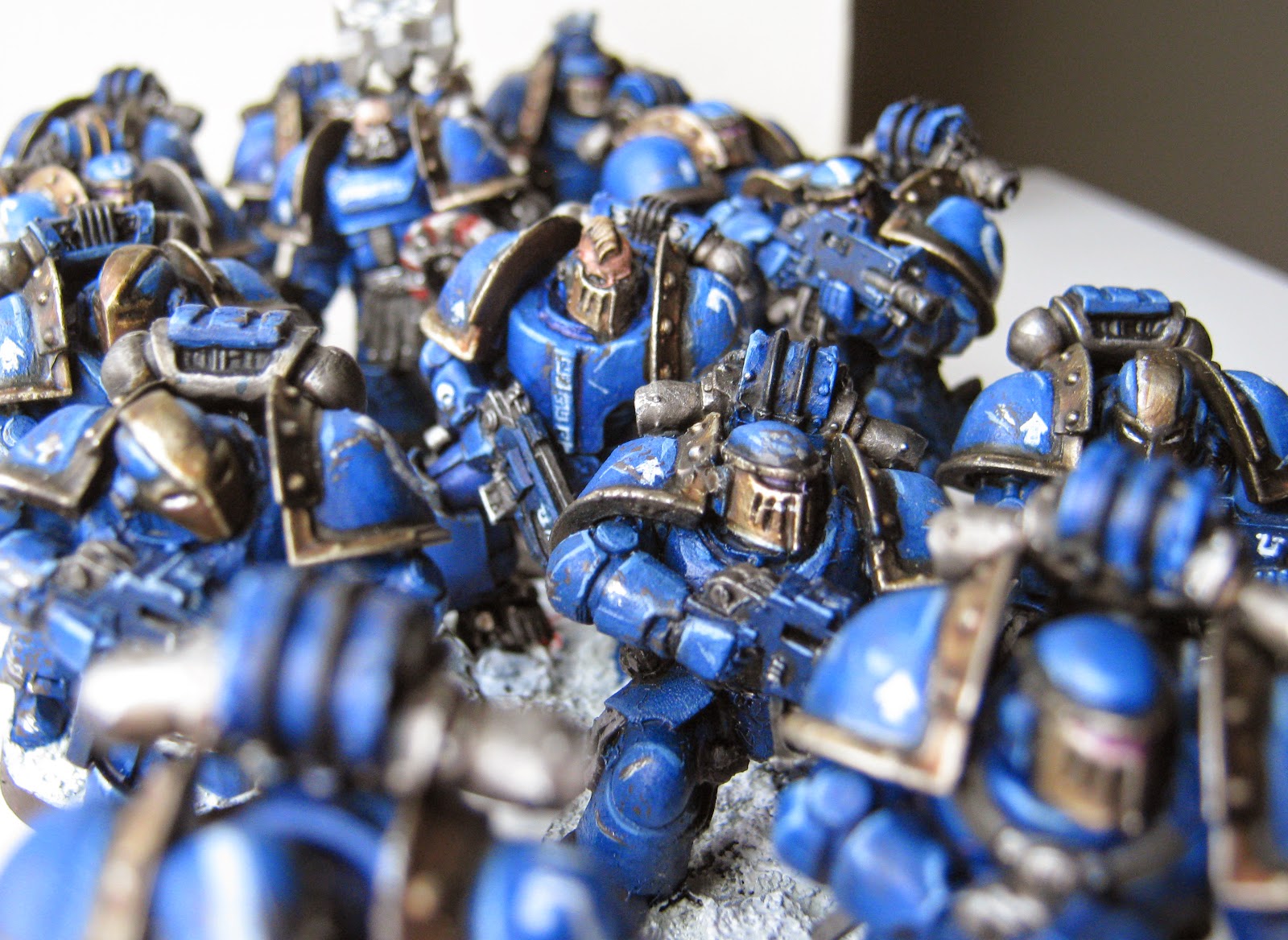
+ This shot shows around a dozen Ultramarines that I'm working upon in order to have them ready for the game on Sunday. Whether I get them all complete is not clear, but I'm hoping to have them at least based, washed, and with the gold complete.

+ It's also, funnily enough, the first shot on my blog (at least that I can remember) of my workspace, an old bureau I picked up second-hand. A great purchase; it keep all my paints, brushes and materials stowed safely but readily to hand. It also folds up to keep everything neat, tidy and dust-free.

+ If you look closely at the front left-hand side, you'll see a couple of the more recent Praetors. I wasn't so happy with these, so they're getting a spruce-up to fit into the new combined force. +

+ Rebasing +

+ The rebasing continues. In retrospect, I ought to have primed the bases before gluing the marines on. Instead, I'm layering the top with Graveyard Earth to give the eventual snow bases a bit of depth and to help it stick properly. +

+ One thing that was slightly concerning me was the characters on base toppers (one from GW's Marneus Calgar, one a resin topper from Fenris), but they came away easily and look good. A little spruce of snow to tie them in and they'll look right as rain. Quite pleased with the effect, actually:


+ The second concern was the marines with jump packs. Originally, a couple of these were posed jumping from scenery; something that worked well because of the weight of the larger 40mm resin bases. Now they've come down to 30mm, I've dropped the two down. Luckily, I still think they work:


Tuesday, July 15

+ inload: Rebasing the Ultramarines +

+ inload: Mustering the 190th +


+ Rebasing an army is a relatively quick way of completely changing how they appear; particularly if you alter the size or type of base. The base of a model is a bit like the frame of a painting. It's not an integral part of the figure, but helps to present it well and show it off to best effect. Good bases help to give the figure a sense of being an artwork rather than a model.

+ It also offers the opportunity to ground the figure; both literally in helping it to stand, and figuratively, in the sense that you can choose an environment in which to stand your figure. This immediately gives a little bit of a story – whether parched earth, lush jungle or rubbish-strewn street. +


+ My marines didn't fit well on 25mm round bases because of the stances of GW's terminator legs, so when I came to base the Praetors of Calth I chose 40mm round bases with rolled shoulders and an urban paint scheme in order to accommodate them. A lot of these were resin bases from companies like Fenris game and Dragonforge. The size gives the models presence and plenty of room to suggest the world around them. +

It also offers the opportunity for mini-dioramas, like this one of Young Holion and Cassie the refugee.

+ These bases look good for display purposes, but my models sit in their cases rather than out on a shelf; and these large bases are rather impractical for gaming – they're too big and cause gaming headaches. In addition, over the years I've come to the view that they make the models look slightly over-large. The idea behind the 'true-scale' approach for me was to slightly alter the proportions (making the legs and torso proportionally bigger and hands and heads smaller), rather than simply have 'big marines'. 

+ For these reasons, I switched to 30mm rounds for my marines; testing the idea with my Novamarines. These bases are large enough to accommodate the Terminator leg poses comfortably, without drawing the eye away from the figure itself.

Novamarine on scrubby desert.

+ Liking the result, I extended the idea to the new 190th Company who have benefitted from various lessons learned from earlier models.  I think they fit a lot more comfortably, and will be easier to store, more standard to play with (30mm's a lot closer to the 25mm 'official' base size than 40mm), and look better. +

I chose a snow scheme to contrast better with the deep blue than the Praetors of Calth's urban rubble.

+ I was a bit nervous about rebasing the Praetors of Calth – they're probably my favourite army, so changing them always feels a bit risky; as though I'll break their juju(!) by altering them. Nevertheless, I've got stuck in; and it seems to be working well. The only slight fly in the ointment is that I ordered fifty bases from eBay, and a package arrived with only thirty. Hopefully the seller will sort it out promptly; as the whole army is being gathered to take the fight to the orks this weekend! +

Monday, July 14

+ inload: Basic training +

More troops are being fed through as supply lines strengthen throughout the 500 Worlds...


Some WIP marines, including a sergeant and heavy weapon trooper.

I have used some Cataphract legs for the Ultramarine on the far right. I trimmed the decoration on the front down, and think it makes a very effective set of Mark II legs:


I've also got a new Company banner bearer with which I'm pretty pleased; pictured here alongside another standard trooper and a squad banner bearer.


He's based loosely on this statue of the Emperor Augustus; which I thought would be a fun link to the Romans.
+ noospheric inloadlink: http://en.wikipedia.org/wiki/Augustus#mediaviewer/File:Statue-Augustus.jpg +

Friday, July 11

+ inload; Repurposing models +

+ inload: New jobs for old models +

+ The sun sets on the Primarch and his Honour Guard outside the walls of Macragge. +

+ Re-using or repurposing models from one army to another is something I do quite a bit. A fresh paintjob can work wonders in livening up a figure, and is – obviously – considerably cheaper and quicker than making another. 

+ The three Honour Guard figures above are a good example of figures that are good candidates for re-use. They received quick paintjobs for a specific campaign weekend, and don't quite fit anywhere in the way I now see the Ultramarines. +

+ The three started out life as Imperial Fists (see left), a short-lived project that eventually got swept under the carpet. They were pressed into service for the Ultramarines when I was hard-pushed for time, but have languished, virtually unused, in my army case since that campaign weekend. 

+ I can't get too excited about elite troops; I much prefer the down-and-dirty line infantry. For this reason, I decided that the Honour Guard would be re-used to help integrate the new Ultramarines (the 190th) with the old Ultramarines (the Praetors of Calth. +

+ The Praetors of Calth are an army of which I'm very proud, but the later models didn't quite fit with the original image I had for the army for one reason or another. With the thirty core troops in place, I flitted from expansion to expansion; adding five Vanguard or Recon troops... and then pulling them apart and repainting them when they didn't quite fit. + 

+ The 190th are an attempt to breathe new life into the army as a whole. With the release of the Forgeworld Horus Heresy range of bits, it's become a real possibility to create the army that I wanted. The first step was to build a relatively substantial force of the new models; I have a bad habit of breaking apart perfectly useable old models with the intention of updating them, then getting distracted by other projects; leaving me with fewer than I had before! +

+ So, with a large squad of new marines complete:


+ ... it was time to look at updating the older models, with the intention of creating a mixed squad of Breachers that would bridge the visual gaps between the older models and the newer ones. I started by creating some completely new models, being sure to add visual links to the newer models like updated FW helmets, equipment, and legs (taken from Tartaros Terminators). +


+ I then broke up the Honour Guard and rebuilt them with a mix of the older and newer elements:


+ Notice that the focal points of the Breacher marines (weaponry, helmets) are updated – this is relatively quick work that really changes the feel of the models. I also updated the backpacks (as these are a strong visual identifier for the period, but the majority of the work was removing the excess decoration on the originals. +

+ I like to think that these are perhaps the same marines; simply at an earlier stage of their careers. By the time of the outbreak of the Horus Heresy, the rest of the squad must have been killed or promoted away, leaving just these three grizzled survivors. +

+ As a group, I hope the newer and older models fit together well. In particular, the mix of newer and older shoulder pads in the squad (probably the most distinctive visual part of my particular method of making larger marines) links the unit both to the older and newer models. With a quick spruce-up of the paintjob – I think they deserve my best efforts –  I think they'll work well. +


+ While talking about the Breachers, note the additional marine in the back left of the image above. He's a 'transition' marine that combines elements of the older and newer aesthetics in unique ways: his backpack and shoulder pads are neither the new style nor the standard old style; instead being a unique mix that combines elements of both to assist with the unit blending together.

+ He required a bit of reposing. Here's the original construction (he's at the front):


+ While it's a pose I liked, it didn't fit with the squad. I'm being very careful with the 190th to make sure that they look good en masse; and that means occasionally sacrificing individual poses for the good of the group. With the new poses (and bits – his legs and right arm have been removed and are already the start of a new marine), the squad looks much more cohesive. +

+ This concentration on the group rather than the whole also makes the most of limited resources. I only have eight Breacher shields and seven of the gladius-style shortswords. By planning ahead and scattering appropriate-looking chainswords (see the fifth picture from the top for an example) in the squad as it's built, I'll gradually work in these divergent bits of equipment on models that otherwise stick closely to the group aesthetic; further building on the integration of the squad as a whole. +

+ On this note, it's part of the reason why one having something special (a bare head, a cool pose, a weird bit of equipment) often looks best on a model if it's set off by a group of standard marines – then the divergent bit becomes a point of interest in the overall arrangement as well as the individual figure. +

+ Anyway, enough pontification! To end this post, here's a final shot of the Breacher squad from the front. +


Tuesday, July 8

+ [mark: -136.57.07] +


+ Dug out the Ultramarines again, and got highlighting. This group is near complete now. The following bits to be done:

  • Weathering and scratching
  • Eye lenses
  • Base drybrush
  • Base rims
  • Final check
+ Not much at all. That'll bring them to the same stage as these chaps:


+ It all seems a long way from 2008; and hopefully that shows in the painting. +

+ Long live the 190th! +


Tuesday, July 1

+ inload: Brother Veridias +


Opening the helmet's grille, he exhaled raggedly. A mist of aerosolised blood hung briefly in the hot still air under the void shields.


Blinking to clear his head, he chewed the side of his tongue thoughtfully; a childhood habit that hypno-docrination had not removed.


He took a tighter grip on his boltgun and looked down at the counter on the back. Seven rounds remaining. Sufficient.


Scarred and pitted, his armour wheezed and creaked as he turned to move out; its slick motions reduced in parts to juddering, squealing protest.


Still. The walls must be held. Sacrifices must be made. He chewed the side of his tongue.