Tuesday, March 31

+ inload: The Throng of Nog +

+ The Throng of Nog +


Draw close, manling, and pass that well-water your brewer flatters with the name of ale.

Hm. 

Passable, after all. Perhaps I misjudge the children of Sigmar.

At the least, my throat is not so dry as it was. While the fire burns still, let me tell you a little. You have been hospitable to my sister in her illness, and my kin do not soon forget kindness. 

Of the Tallowlands, it is said the Star Giants drew their plough across these lands long ago; before even the raising of the Hold. The land buckled and melted in the heat, and the bones of the earth themselves grew soft and flowing. For two wholemoons the skies rained ash and fire as the plough drew slowly through the groaning ground. All who stayed on the surface perished. As the Giants passed, the land grew cold once more, and the mountains set into the soft rolling hills you see now.

Ages passed – of war and terror; long since passed into the myth of man. Then it was that our honoured ancestor, the first lord of the Nog, came into this land. It was hard, then, and bare: naught but thin grasses and heathers stretched across the moorlands, and the wind was chill.

Nog and his household found the great Scars; open still after all those years. Such deep chasms... They glittered with wealth undreamed of – before or since. Striking camp, the First Families staked their claims, and raised Nog to Cyng. An outpost was raised, that became a town, that became a great hold. And none too soon...

Then came the greenskin, and the silver-tongued infidious elves – and with them they brought their war...

+++


+ A little bit of painting last night allowed me to polish off ten more dwarfs for the long-in-preparation Throng. The annual tide of enthusiasm for Warhammer has risen in the PCRC of late – Lucifer216 has polished up a new undead army in the time it's taken me to do these, but dwarfs aren't fazed! +

+ The scheme's a bit of a random construction – suggested as much by the red undercoat I used as by anything else. In between Legio Sumer-Nikator, my Blood Angels and Word Bearers, I've been on a bit of red kick recently. +

+ In that lies a lot of the appeal of a Warhammer army: the chance for variety. These red-coated fellas can happily be a particular minor lord's retinue – The Scarlet Few of the Weartling Cwichelm, for example – without tieing me into painting the whole army this way. While you'd expect a sci-fi army like a Space Marine legion to demonstrate some form of uniformity, the same doesn't apply to a pseudo-dark ages force. Even if the lord dictates his men must wear red, then you'll likely have different hues due to different fabrics and batches of dyes, and even different interpretations of how to show this  from full custom plate armour to a simple scrap of cloth ties to a spearshaft. +

+++


'Who would tend the flocks? Who would nurture and harvest the barley? Answer that, and tell me what sort of dwarf would live wearing only ragarin, or worse, live without meat and bread and ale?

'No, of course not all dawi live in the holds – but nor again are all we hill-dwellers farmers. From the vorns and kazid of the Barrow Hills, the Throng of Nog draws many of its warriors. I am one such. Thrungling, I was; trained in axe and shield, as was my father and his father and his father before him, to the time of the Throngfounding.

'I served proudly besides my comrades. Firstly, as a road-guard for the caravans to the manling city of Yeld – for the plains and woodlands are full of brigands, aye; brigands and worse – all greedy for the ore and craftings of the Nog-folk. That is how I learned my craft for a five-year. Latterly, then, it was as mariner; on the trading route between kazid-Eo and kazid-Narya.

'Like many of my folk, I was a reluctant – though obedient – sailor, at first. Soon, though, I grew fond of the salt air, and the clear skies, and the many folk I met. It kindled a desire in me to see more. After my five-year was up, my lord the Weartling Cwichelm knew my mind and granted me therefore an akrak-baraz – a bond, that is – to enable me to travel.

'I have wandered since, my baraz a security and a provisioner for my household. I explore, I seek; I write to the Weartling of my encounters; and thus the map of our ancestors is expanded.'


Thursday, March 12

+ inload: Ork Dreadnought +

+ Clanking Destroyer +


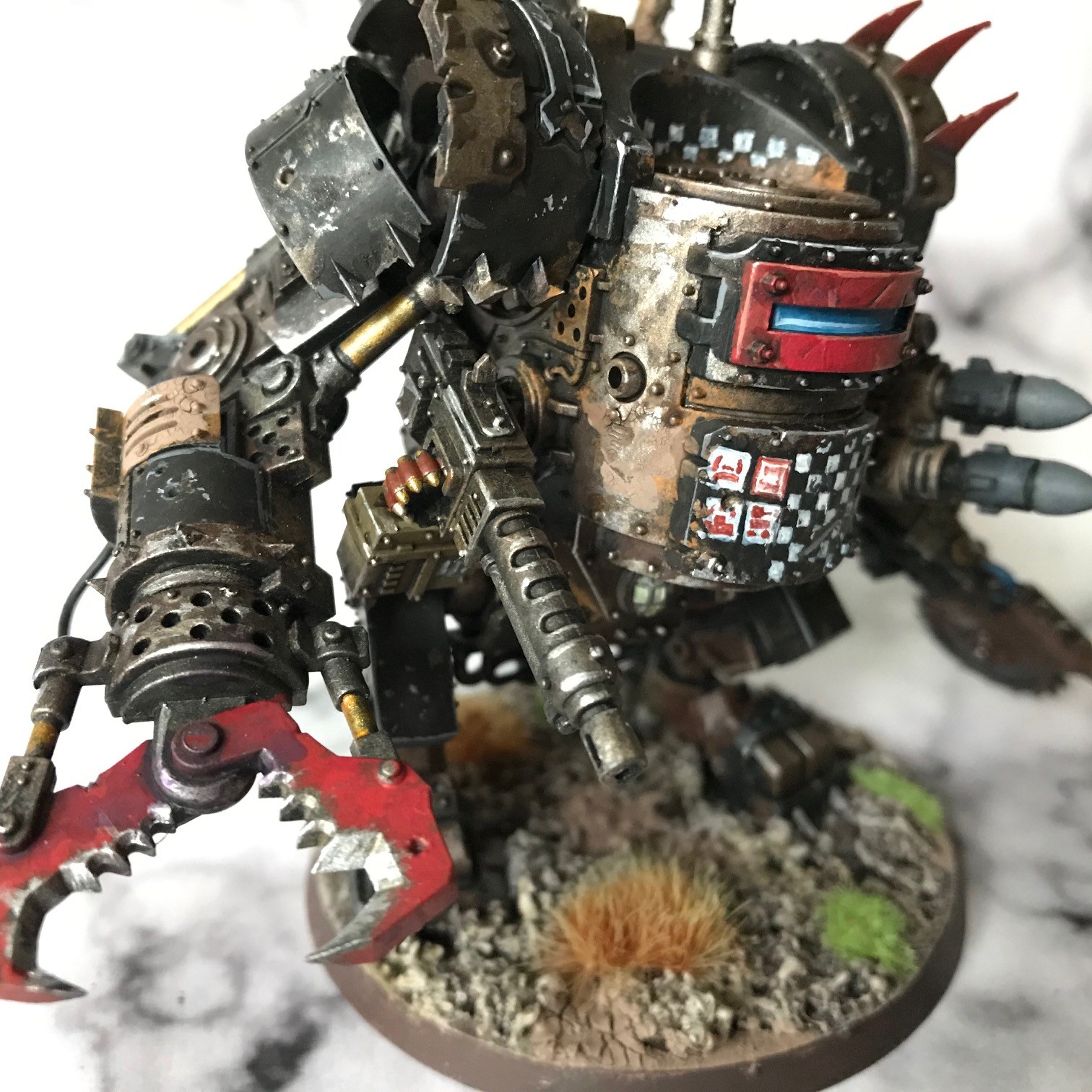
+ When this model came out, I remember thinking that it was about the best thing since sliced bread. And with the super-killy buzzsaw, it could also slice bread! +

+ Okay, so the second part might not strictly be accurate (unless...), but this really was one of those model kits that niggle at the back of your head. Eventually I crumbled and bought one, and it's been a fun build and paint.


+ As part of The Alien Wars project, I took my inspiration from the card dreadnought that came with the second edition boxed set. Just as with my Blood Angels [+noosphericinloadlink embedded+], it's an homage rather than an exact match. I hope enough of the details are present to give retrohammerers a grin. +


+ Lacking a banner, I replicated the glyphs on the front armour plate, for example. Similarly, I've retained some of the red detailing, though not quite so much as the original – it has to fit in with my very muted army, after all. +


+ The kit's absolutely awash with great little details, like the functional-looking pistons, heat-sink plates and pressure dials. When tackling complex metal areas like this, it's easy for them to get lost in a mass of similar tones, so I aimed to break up the shapes by treating each main part separately. Some are oily bare metal, others rusted, and the top plates are painted black. Rather than starting from a black underlayer and weathering with metallics, I painted them all metal, then painted the black on top, using a stippling technique. This is a quick and easy way to get a sense of wear and tear – you've just got to be careful to work the paint into the recesses away from the edges (such as the 'lee' of the spikes). +


+ The concept of heavy wear was extended to the weapons – note the shearing claw has lost its red paint from the working surfaces, and one of the plates near the elbow is particularly old and worn: I used Agrellan Earth to give a heavily textured craquelure effect. +

+ As with the armour plates, some variety on the weapons helps give a sense of scale and realism – the ammo feed on the heavy shoota, for example, is painted with the same green (and regimental number) as my Lamb's World force, suggesting it's looted from a previous battle. +


+ I used the same conceit on the back, with a military drab green used for the petrol tank, and decorated with an Imperialis (the winged skull used as one of the Imperial Guard symbols). The trick to this sort of model, if there is one, is to ensure similar parts are treated differently. Having really rusty, battered exhausts nearer newer-looking ones suggests the model is a working warmachine, with a history. +

 + What's on the blocks? +


+ As in the background, so in real life. Gretchin don't seem to get much of a look-in when it comes to gaming, and so I'm making a concerted effort to get enough of these characterful little creeps painted and based to re-play the 2nd edition introductory games. I think I need thirty... +


+ The finished grots above were tackled in smaller groups, but I really want to get a motor on before I lose impetus. As a result, these are just a simple coat of Gretchin Green (who would have thought?) and washes of either Seraphim Sepia or Leviathan Purple. To get some variety in skintones, I used the washes in different proportions, both alone and mixed wet-in-wet on the model. Just 'cause you're batch-painting, it doesn't mean you can't add some variety, after all. +


Tuesday, March 10

+ inload: Anatomy of the enemy V: Goranhuwl's Guttaz +


+ Ork Raiders of M36 +

As described in the general overview [+noospheric inloadlink embedded+] Orks are rarely sedentary. Perfectly capable of constructing vessels of their own, greenskins also frequently 'hitch rides' on passing space hulks – using their precociously advanced field emitter technology both to seal in a habitable atmosphere and to direct the hulk. The main impediment, then, to ork expansion and exploration, is their own nature. Their interstellar capability requires a leader capable of motivating their followers to co-operate – or at least stop fighting – long enough for their technicians to create void-craft.

Goranhuwl is one such ork, and typical of the opportunistic commanders that plagued the borders of the Imperium during the Nova Terra Interregnum. Arising on the wartorn worlds of the Galactic Core, Goranhuwl united the forces of the local region during a series of brutal decapitation campaigns he led against his rivals. During the Nova Terra Interregnum, he and his warband, the Guttaz – named after their leader's unpleasant predilection for tortuously disembowelling his enemies – have conducted numerous raiding and reaving assaults on Imperial and non-Imperial shipping and planets alike. 


+ The Guttaz' warleaders +

Goranhuwl (centre), is pictured here with two of his retinue, the one-eyed totem-bearer Skabby, and his able second-in-command Whitetusk. Typical of the Goff clan, decoration is no-nonsense, restricted to black and white. Only looted trophies provide a flash of colour. 


+ Structure and organisation +

Ork raiding tribes are rarely made up of a single clan – such monocultural warbands work against the manner in which orks breed, and rob the broader tribe of the expertise and particular skills of the orks' clan system. Goffs, for example, produce relatively few oddboyz – instead generating a larger proportion of larger nobz – and a cunning warlord will therefore promote from within other clans to fill in specialisms they feel their force is lacking.

The Guttaz have a number of fiefdoms across their small territory near the galactic Core, but draw most of their warriors from the sprawling ork townships on the planet of Breccia – known to the orks as Deepkut. Each urban centre houses hundreds of orks and countless gretchin servants, all under the gimlet eyes of one of Goranhuwl's lieutenants.

+ Goranhuwl's Bigmob +

Orks cluster in clan-based groups called households. Ruled over by an experienced Nob and his cronies, households tend to number between a dozen and three dozen bull orks – beyond this, an ambitious would-be nob will tend to challenge the incumbent. The loser will leave and form a new household, typically from a core of their closest drinking mates. 

The Warboss' household is invariably the best-equipped – and also the largest, as few are able to challenge the Warboss himself. It will also attract the more promising ork juveniles – Wildboyz – as they learn the skills of warfare, swelling its size beyond others. Such household groups are usually referred to as a variation on 'the big mob'. Acting as an adjunct to the warboss' personal retinue (each a Nob or Oddboy with his own household), the Bigmob serves to give steel to the Warboss' word, enforcing his will and leading the charge in battle.


+ Auxiliary Household group +
Orks don't suffer authority well, and mercenaries – known as freebooters – are common. Households will occasionally strike out on their own, the Nob declaring himself a pirate Kaptin (or similar title). During the Nova Terra Interregnum, many orks fought alongside increasingly desperate populations of both sides of the divided Imperium. Demanding ruinous payment – generally in the form of slaves, weapons or equipment – such mercenaries became increasingly common. 

While they were happy to fight for loot, freebooter groups were most frequently used as auxilia by the orks themselves, slotting into the battle line of a paying warboss as another (often particularly flamboyant and exotic) mob of greenskinned warriors.

+ Specialists and slaves + 

+ Ork shock troops +
Regardless of which world you pick from the multifarious cultures of the Twin Imperium, there are certain common traits to all human warfare. The same is true for greenskins, and like humanity, they are infinitely adaptable, developing technologies, strategies and tactics as new challenges arise. 

Ork power armour shares much in common with Imperial power armour. What it lacks in sophistication and reliability, it compensates for in raw protection. Many technologically-advanced ork groups utilise these 'mega-armoured' shock troops as linebreakers; as much reliant on the veteran orks within as the technology. Goranhuwl's Guttaz often field such mobs against Imperial foes, their thunderous tread and seeming invincibility calculated to break the morale of their foes. The Nova Terran stormtrooper-equivalents, the vaunted NVA were particularly badly affected by this, their elite status proving of little consequence against the orks' crude mirror to Astartes. 

Goranhuwl showed a willingness to learn, and demonstrated adaptive tactics against the Chapters Astartes. Having lost a number of battles against the indomitable Star Leopards on their fief world of Odun Stellar, where the Astartes executed layered retreats to funnel the mega-armoured mobs into deadly crossfires, Goranhuwl redeployed his elites, holding them back as counter-chargers.

While the Guttaz were successfully driven off Odun Stellar, the Gatebreakers Chapter later reported the loss with all hands of two of their frigates around Fortis Binary. Boarded by mega-armoured foes held back from warfare on the surface, the Gatebreakers were beset by the bulk of the Guttaz as the Marines struggled to disengage to scramble back to their fleet, resulting in heavy losses.


+ Mine clearance +
Orks are never found without gretchin. This slave species has a commensual relationship with their larger greenskins, and ape their larger masters. Their small stature belies their inventive cruelty. Despite their physical similarities, gretchin are undifferentiated, generating neither individual nor clan specialism. They are however often swift learners, and many become valued and capable (if ultimately disposable) servants to the warband's orks, particularly the Oddboyz. 

While there are no physical differences between Goff or Snakebite or Bad Moon gretchin, their scavenging and creative nature often sees them scraping together patchwork cloth and leftover equipment from the orks with which they associate. As a result, their allegiance is often clear.


+ Ork Dreadnought +
Orks may not demonstrate much in the way of artistic talent – indeed their banners and trophy-poles are almost invariably rendered by gretchin or slaves who are able to successfully translate the boss' gruff instructions in a way that pleases the master – but they are both excellent mimics and inventive engineers. On seeing a particularly impressive war machine, ork bosses will order their Oddboyz to replicate it – a challenge that usually sees results. Ork mekaniaks rarely back-engineer a creation, and instead rely on their abilities to create a functional – and sometimes superior – copy. 

Dreadnoughts of many species, from Eldar Wraithlords to Q'orl Warforms and even including Astartes Dreadnoughts, function in dual roles. They are both warmachine and spiritual demonstration of service beyond death. In all cases, its form is drawn from the physical structure of the biological being: it seems that some from of physical familiarity is a near-universal psychological requirement for the pilots of such engines. Not so with the orks. 

Resilient both in mind and body, orks frequently practise body modification, and seem peculiarly well-suited to adaptation. Being encased in a dreadnought holds no fear or trepidation for an ork – he will quickly regard it not as an external suit, but an integral part of himself. Indeed, he will almost certainly become convinced of his new giant metal body's prowess as a sensible upgrade. For similar reasons, ork dreadnoughts are varied, and nearly always include more than two arms – an ork will quickly adapt.


+++

Friday, March 6

+ inload: Regimental Review I: 88-2219ers +

+ Regimental Review: 88th/2219th Lamb's World/Port Bromwic Consolidated +

'War-orphans. Klottin's Mongrels. Remnant Regiment. Any number of names for us, they had – none of them nice. Clumsy as it was, you can see why we stuck with the 88-2219ers. Nothing fancy, see? There. Done. Finished. Get on with the job. That was enough for us.'
Corporal Larrod Atkin – 88th/2219th Lamb's World/Port Bromwic Consolidated Regiment

+++


Remember the past, but remember it has passed. 
+ Credo of the 88-2219ers +

+++

+ Abstract +

One of the refounded Regiments forged in the wake of the disastrous Yranus Landings [+noosphericinloadlink embedded+], the badly-mauled 88th Lamb's World Light Infantry Rifles were combined with the 2219th Port Bromwic Mechanised Regiment to form one of Lord General Klottin's so-called 'mongrel regiments'.

+ Roots: two planets, one force +

The bulk of the Regiment was made up from the 2219th Port Bromwic Mechanised, a force newly-founded specifically for Augustus' Crusade. Port Bromwic is a brooding fortress world. Owing to the planet's classification, it contributed a relatively paltry number to the Crusade's senior staff, as the local government forbade recruitment from posts with access to privileged classified information relating to the world's security or its status as Naval port. In contrast, the bustling underclasses of this hive world was drawn upon heavily for the Crusade, supplying forces to both the Navy and the Guard.

+ Port Bromwic +

The soldiers and sailors drawn from Port Bromwic gained a reputation for being generally dutiful and reliable, though the Commissariat noted that many nurtured a subversive streak, generally restricted to a black, fatalistic sense of humour. 'Brommics', as they became known, became familiar to many in the Crusade, filling vital posts across the war effort. Part of this was their sheer number – of the 500-odd Imperial Guard regiments that formed the Crusade, more than ten per cent were from Port Bromwic; and the proportion was even higher in the Navy. Secondly, Brommics had a peculiarly narrow phenotype register, making them physically very distinctive and recognisable.


The Port Bromwic 2219th saw their first deployment during the Yranus Landings, and – like all the forces there – were badly mauled. Their vehicle pool was heavily used to escort the stretched but vital fuel and ammunition supplies between Imperial encampments, a duty which saw significant degradation of the regiment's capabilities. The casualties sustained here were particularly sore, as Red Hand forces (both Cardinal Qi's own Yranian Volunteer Corps and the off-world Vrag-Rana elite) proved ruthlessly efficient at assassinating officers – leaving the already bottom-heavy regiment dangerously light in experienced commanders.


In contrast, the survivors of the Lamb's World 88th were light infantry specialists, and veterans of a number of wars within their home Sector Anton Australis – a world in the distant Segmentum Ultima. The regiment had originally been seconded to a local war, but mis-translation left them emerging in Wilderness space. Unable to effect their return, the flotilla limped towards Imperial space, emerging near Sector Cetus-Scorpii, where – as Imperial efficiencies demanded – they found themselves reporting to Warmaster Augustus and seconded to the Third Army Group of his Crusade.


+ Armour units from Port Promwic protect 88th infantry during the Ushen Moros retreat. +

The Regiment was made part of the initial pathfinder deployment on Yranus, and found themselves tasked with capturing the city of Ushen Moros. Over the course of the campaign, the 88th were all but annihilated during the struggles for the city. Evacuated with three casualties to every soldier fit for active duty, it was clear the Lamb's Worlders would never serve as a meaningful independent force again.


+++

+ Rebirth +

+ Manor-general Jil (dec.) +
[Pictcapture: Kordhal]
With his underling Major-General Jil's body still to grow cold, Lord General Klottin – commander of the Crusade's Third Army Group – acted quickly. Placing the Yndrine system under blockade, he took personal command of the reintegration of such forces as could be salvaged, even while the Army Group pressed deeper into the Red Hand Region.

After a temporary light posting on the Crusade's staging post worlds, Mu-Scorpii and Slav-Mundi, Klottin made plans for a Regimental Re-founding, in an attempt to make the best of a bad situation. Taking pains to invest the event with pomp and circumstance, the soldiers were treated to a parade that was heavily reported in the Cetus-Scorpii Clarion, a hard-copy propaganda paper issued to all ranks across the Crusade (and, where possible, made available to the inhabitants of the Cetus-Scorpii).

The refounding was a success, though a qualified one. Alongside three fresh regiments press-ganged from Mu-Scorpii itself, five new regiments were created from the twelve that had been deployed to Yranus:
  • Galvinax/Elirian Combined
  • Mu-Scorpii 149ers
  • 88th/2219th Lamb's World/Port Bromwic Consolidated
  • Ha'quari Combined Infantry
  • Baltan Reinforced Artillery 'The 8s and 11s'
Of these, the Ha'quari found their three depleted regiments simply combined into a single force. The cream of three Baltan Artillery regiments (the 8th, 10th and 11th) were similarly rendered into an over-sized Regiment – the so-called 'New Artillery', with the overspill integrated into the infamous Mu-Scorpii 149ers, a regiment of cut-throats and ne'er-do-wells that were widely rumoured to be made up of the worst of the soldiery from the Termeran IVth, Jedder's Rim Own, and Baltan 9th Artillery.

+++

+Integration +

+ Lamb's World 88th vox-specialist +
Discipline within the Imperial Guard is paramount, and the Commissariat pays particular attention to the behaviour of combined regiments. Particular attention was raised by Commissar Brand regarding the cultural mix between the uniform Brommics – nearly all of them stocky and well-built, with thick features, coarse hair and dark eyes – and the Lamb's Worlders. Most inhabitants of this distant world are short – the average height being just 5'8", and the 88th were particularly slight, being made up of soldiery hand-picked for their skills at infiltration. Not only that, but they were drawn from across the diverse range of ethnicities and cultures of the planet.

Discipline Officers brought in to ensure cooperation between the combined regiments paid attention to the cynical Brand's doom-saying, but the resulting force alloyed surprisingly smoothly in training. The Commanding Officers put this down to a strict training regimen that mixed the regiment at all levels from squad upwards; while the attached Ecclesiarchical representatives attributed it to a shared form of strictly-enforced orthodox worship. For their part, the soldiery's own views are not known, though a excerpted phrase from a marching song that sprang up shortly after the Regimental Refounding perhaps shines a more intimate light on their attitude: 
'S**t on by the Bobbs*//and shovelled up by Tunts**//We'll never know a peace as deep//as rest in bunks//Oh sergeant-at-arms//Rock me to sleep//I'm knackered from the Runs//We don't get no stops except for treens***//where Auggy's Blaster**** don't clean, it rubs//[...]'
* Lamb's World term for discipline officers. Unknown derivation.
** Port Bromwic vulgar slang for the priesthood.*** Latrines**** 'Auggy's Blaster' was a common name across the Guard and Navy for the Cetus-Scorpii Clarion


+++


+ Command staff +

+ Undercaef Whittaker and Fidelis +
What remained of the 88th Command staff was wiped out during the Yndrine campaign, while the 2219th were seen as having too little combat experience for command.

Klottin was nevertheless reluctant to bring in extra-regimental forces to oversee the combined regiment, instead opting for promotion from within. Iacobus Whittaker, a lief – a Lamb's World terms for a junior officer roughly equivalent to first lieutenant – was thus granted a brevet rank of Lieutenant-Colonel; or Undercaef, to use the Lamb's Worlder's own terms 

The regiment was fortunate to have such a capable officer, as Whittaker quickly proved himself to be resourceful and authoritative while self-aware enough to prevent bad blood arising within the regiment.


He was notable for a particularly sardonic sense of humour, sallow complexion and his ever-present wardog cum mascot, Fidelis, who accompanied Whittaker both on and off the battlefield.


+++


+ Commissar Brand +
The Ordo Prefectus also deployed a significant number of Commissars to the regiment, all of whom operated under the purview of Commissar Rodolf Brand, a native of Tenstar who had been assigned as liaison officer to the 88th on their arrival in the Cetus-Scorpii system.

An archetypal, by-the-book Commissar, Brand was bleak, heartless and ready with a pistol. He was widely loathed and feared by both Brommics and Lamb's Worlders – a fact which served to bind the two very different regiments together.


While his methods were strict to the point of wilful cruelty, he served a vital counterpoint to Whittaker's more adaptive and lenient command. 


+ Primary deployment during the Early Crusade period +

After redeployment, the combined Regiment resumed service in the Third Army Group, taking part in the Odessus and Orison Campaigns that served as Klottin's primary objectives in the Early Crusade period.

With a secure foothold in place on the primary targets, three companies of the 88-2219ers remained on Odessus, while the bulk of the regiment formed part of the combined effort to invade the Bract, Polyandros and Ardent systems, alongside elements of the First Army Group.


+ Guardsmen of the 88-2219ers +


Holby ap Acre, a native of one of Lamb's World's primary settlements, Pant Y Gyrdl, is pictured with standard equipment intact. Cold-desert patten fatigues are overlaid with battle-green flak armour, manufactured directly on the Forge World of Braun.


Ostin Ostin, appears unhelmeted during the Bendaphur Campaign – this may be as a result of battlefield loss, or through lack of supplies. Certain elements of Lamb's Worlders' equipment, being sourced from a different Segmentum, was impossible to procure in Sector Cetus-Scorpii, let alone in the Red Hand Region. Fabric patterns were relatively simple to recreate, but hard materials, such as the recon-specialists' vox-integrated helms could not easily be replaced. As a result, the reformed 88/2219th Regiment quickly began to look hotch-potch.


Local replacements quickly began to flood in, as Cetus-Scorpii's Forgeworld Nares Serpentine and its licensed manufactories across the Sector began to source potential replacements. By the time of the Orison Campaign, the troops of the former 2219th were mostly armed and equipped as per their seniors from the Lamb's World 88th, though variations – such as those shown above on Turny Damas, a Port Bromwic native – remained common with reserve forces. His battledress is a mix of cold desert camouflage and a simpler tan smock. His Serpentine-pattern flak armour and helm are also crude facsimiles of the Lamb's World Braun-pattern equipment. Lacking vox-links, its internal padding was made up of synthetics rather than ecwid-hair. Note also the use of a rear-line slug-throwing autorifle, rather than a lasgun.


Following the catastrophic 'beheading' in the Yranus Landingsthe regiment's Command Staff thin on the ground. The 88-2219ers therefore developed and maintained a subtle system of identification, aimed primarily at making its officers difficult to identify amongst the troops. Simple geometric marks, usually in orange, grey or turquoise, were used in place on shoulder pads or regimental shields. +


Experienced frontline forces were prioritised for the increasingly rare equipment from Lamb's World's reserves. Donny Brackst, a Port Bromwic native who demonstrated skill and a cool head under fire during the Bendaphur campaign, is shown here equipped with a full vox-rig and augmented helm – note the additional external targeter. His lasrifle appears to be Cadian-pattern. This may be an inferior local copy, or it may be part of a diverted or mis-labelled shipment intended for the 144th – the so-called 'Cadian Last' – also operating in the Crusade. Such mis-shipments were unfortunately commonplace during the Early-Mid Crusade period, despite the Munitorum's best efforts.


Veteran soldiers were allowed leeway in their equipment, as shown by this warrior's shotgun and decidely non-standard choice of protective headgear.


The 88-2219ers were not above looting, and this non-standard autorifle is likely to have been 'liberated' from Red Hand forces during the Bendaphur campaign. Such weaponry would have remained grey-market, with the Officio Prefectus usually – but not always – turning an intentional blind eye following the weapon's reconsecration by an Enginseer; to ensure its machine-spirit would follow the will of its operator.


Braun-pattern mortars were in common use, and proved invaluable during the street-fighting on Odessa. Specialist teams operated in pairs or threes to deploy and re-deploy quickly.


+ Notable actions  +

+ Early Crusade period +
  • Yranus Landings
  • Bendphur 
  • Odessa
  • Orison
[+SPOOLING+]