Showing posts with label colour text. Show all posts

Wednesday, May 6

+ inload: Creating a Reaver Titan +

+ Origines Dubiae – the Scythian +

+ Work in progress +

Scry-chronicle pre-mission datasquirt: {authval: Sensorius-principal Ossteon}

Validity: {principal >14% accur.}

'And it came to be told that Titans would march, and the storm would follow with them.'

Mission parameters:_________________________


+ Scythian +

Recently we looked at the crewing of Titans [+noosphericinloadlink embedded+], with particular reference to the Reaver. That inload covered a lot of the theoretical side of things, so today we'll start looking at one specific Titan, and how we can use the ideas to create some personalities for gaming and narrative.

I hope that the inload covers off how I approach things, and encourage you to have a go yourself. It's great fun!

+ A motley crew... +

+ Where to start? +

There's no need for a crew if we don't have a Titan, so let's work out the Legio and individual Titan. I've been mulling over what Legio to work this deep dive around, and have settled on the Stormlords – Legio Tempestus – for the following reasons:
  • Legio Tempestus has a rather peculiar and winding background, with three homeworlds, and good options for the Titan to be Loyalist, Traitor, Blackshield – which also means that it's as general and open an opportunity as I can get for a 'catch-all' generic Reaver Titan crew.
  • A 'canon' Legio with an established history both in-universe and the real world gives me the best chance of finding background dots to join.
    • As a good example of that, 'Legio Tempestor' [sic.] turned up to help defend Armageddon during the Third War, according to Codex: Armageddon, so there's a great example of those lovely little notes that prompt a story.
  • It'll make for a great excuse to get some paint on some AT-scale Titans and create an opposing force for my Legio Metalica (another Legio that has flexibility in loyalty – or at least plausible deniability...)

+ Naming the Titan +

I exloaded on naming Titans back in the dim and distant past, and you can read it here: [+noosphericinloadlink embedded+]. Taking that sage advice to heart, I looked at existing names for the Stormlords. Odrysian appears in the Traitor Legios book:


... and Tempestus appear in lots of other books and rulebooks, notably Abnett's seminal Titanicus and McNeill's Mechanicum. A sample of Tempestus Reavers includes:
  • Arcadia Fortis
  • Hand of Dominance
  • Metallus Cebrenia
  • Raxvalian
  • Jogozh
  • Cerulean Stride
A nice varied bunch, and a good example of not hewing too closely to your theme: a mix of names can give a richer feel to the Legio culture. Here, I played around with some High Gothic names, and mused on using plant names – binomial nomenclature's a great place to find inspiration for cod-Latin. Urtica Dioica, for example is stinging nettle, and strikes me as a great name for a Titan.

In the end, I thought a single-word name would suit – easy to remember and it fits in with the Titanicus rulebook and Horus Heresy black books naming (e.g. Odrysian, Raxvalian). I opted for Scythian, which is general enough to work for loyalist or traitors, and also quicker to say when gaming than a longer double-barreled name!

Like T. S. Eliot's cats, Reavers deserve more than one name, so there'll also be a High Gothic name in addition to its Low Gothic cognomen, but that'll be decided upon in the closing stages of the project, as I'd like to muse on that a bit more.

Next inload we'll start looking at the crew of the Scythian – and how their personalities, and Scythian's own, affect one another.

+++

Monday, August 21

+ inload: Volkaeus Orurr +

+ Volkaeus Orurr +

+ 8th Squad, 2nd Company – on patrol +

+++

Unlike the others, his measure of patience had run dry some time ago. Another breakdown. Another pause. Volkaeus Orurr breathed out testily.

Looking for a distraction, he reached for the rail and clambered up to the Rhino's roof one-handed, his boltgun in the other. Magnificence was not the fastest transport in terms of raw speed, but unlike the convoy, he mused darkly, it could at least keep going.

Unlike the all-purpose Rhino, These were not vehicles intended for service in hostile environments like the Dune Seas. With a regularity that struck Orurr as perversely ill-fitting to their mechanical reliability, every few hundred klicks one or another of the tankers or luggers would slew to a halt as filters clogged, tyres slumped, or the over-stimmed and under-rested hiveborn crew passed out in the unaccustomed heat. The convoy would pause, on edge and nervy, as the errant vehicle was coaxed back into life, winched back onto the track, or otherwise repaired.

The worst were the failures that billowed thick, oily smoke – as potent a signal as any the orks might hope for. Easy pickings, the coiling smoke suggested.

+ Volkaeus Orurr +

Not for the first time, the Salamander cursed the name of Herman von Strab. According to Captain Mirsan, it was largely owing to the Imperial Commander's arrogance and mismanagement that these intra-hive transports were all that was available for the backline armies. Hurriedly fitted with bulky external breathers and heat shielding before being filled with vital water, fuel and materiel, the vehicles were slow and unreliable – and thus the convoys were perfect targets for the roving greenskins.

With the cream of Armageddon's armies lost in the early conflict, and the replacements far from confident; upon arrival Chapter Master Tu'Shan had taken it upon the Salamanders' broad shoulders to ensure the world could fight; that its vital roads and arteries would be protected from roving marauders – as often human as ork.

The ever-present chemical tang was acerbic; but the height afforded by the Rhino gave him a moment's relief. The vehicle crews needed rebreathers in the hot, dry air, but the Space Marine's genewrought might made the air merely unpleasant. He wrinkled his nose in distaste and looked about him.

Armageddon's sun was low in the sky, red and ominous. Dark spots across it marked orbital defences – or more likely the wreckage of the same. The ground was seemingly an endless sea of yellow-grey dunes; the road all but hidden. Orurr's belted helm knocked against his leg as he straightened up.

Nothing for five hundred miles in any direction. No landmarks save the distant hive – and that had long been swallowed by the dust. Not even Astartes' vision could penetrate that.

+++


Tuesday, August 15

+ inload: Three finished Salamanders Space Marines +

+ Brothers in arms +

+++

+ Brother Tarsidemi +

V'reth Tarsidemi

+ Previously known as Man'Ekes Kenndh, he adopted the name V'reth Tarsidemi following his tempering. Noted as 'Melancholy of aspect and pensive by nature', Tarsidemi appeared to regard his promotion to the Battle Companies as part of a great cycle; an inevitable result of his forebear's consumption in the pyres of warfare, rather than as a result of any exceptionalism on his part. +

+ Regarded as over-analytical and tiresome by his previous squadmates in the 6th Company, he was an uneasy fit amongst the Flamehammers. He found a more fitting place within the Defenders of Nocturne, where his stoic aestheticism came to be regarded as a strength. +

+++

+ Brother Numatone +


+ Unequivocal and single-minded from an early age – 'from the cradle,' joked his parents – the boy who was to become Brother Typhak Numatone had the given name of Br'Tra, which meant 'supremacy' in his city's tongue. Whether through destiny, a sense of filial duty, or simple nominative determinism, Br'Tra doggedly purused Ascension, believing it to be the only way to do honour to his family. Such ambition is not infrequent on Nocturne, but Numatone was able to moderate raw drive to avoid pride and become a considered – if impulse-driven –addition to the 2nd Company. + 

+++

+ Brother Nomix Nor'jargan +


+ Promotion from the 5th Reserve Company proved bittersweet to Nomix Nor'jargan, for he had thrived under the Drake Hunters' light-handed command and dispersed nature. Unusually for the Reservists, he was present during the Badab War; one of the few who had been allocated to support the 2nd in combating the Secessionists.  +

+ A void-warfare specialist employed in the Salamanders' fleet, his promotion was advocated by Pellas Mir'san personally. Having lost a great number of valued veterans in the bitter campaign, the Captain of the 2nd wanted staunch, proven warriors – a description that matched the dutiful Nomic Nor'jargan to a tee. +


+ Warriors three of the 8th Squad +

+++

+ Three complete, more to come +


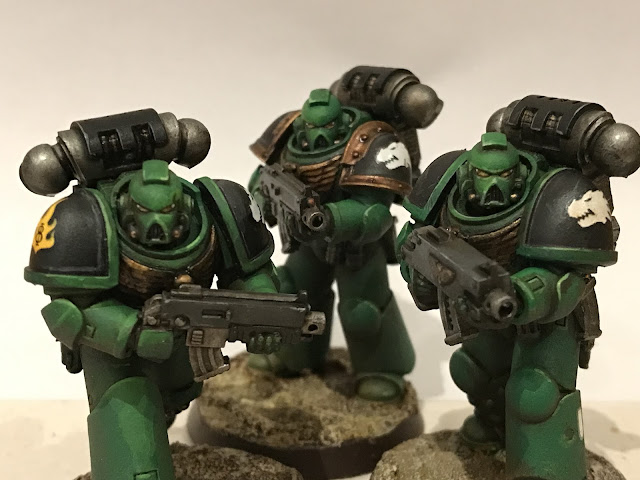
+ All the batch painting has built to a stage where the final details are relatively quick and enjoyable. I've opted for yellow eyes; taking my prompt from the Salamanders shown in Codex: Armageddon. They were painted by painting the lenses Scorched Brown, then blending in Yriel Yellow. +


+ Beyond this, the painting is really limited to developing the gold with a couple of layers of highlights followed by a brown wash; and highlighting the weapon casings, pouches etc. with a mix of black, white and a touch of dark brown. Finally, I used a dilute combinations of Moot Green and Warpstone Glow in various proportions to add some highlighting to the green armour, particular around the head. +


+ They've come together rather nicely, I think – I'm very pleased with the results, and think they fit well with my conversion (at the back). +

+++


Wednesday, February 8

+ inload: Adeptus Titanicus Eldar summary – and lore +

 + 'Alaitoc is Ready' +


+ Eldar Titan summary for playtesting +

+ The past few inloads have focussed on the rules for fielding Eldar Titans (thus far, just the Phantom) in the modern version of Adeptus Titanicus. If you're interested, here are noosphericinload links for the following:
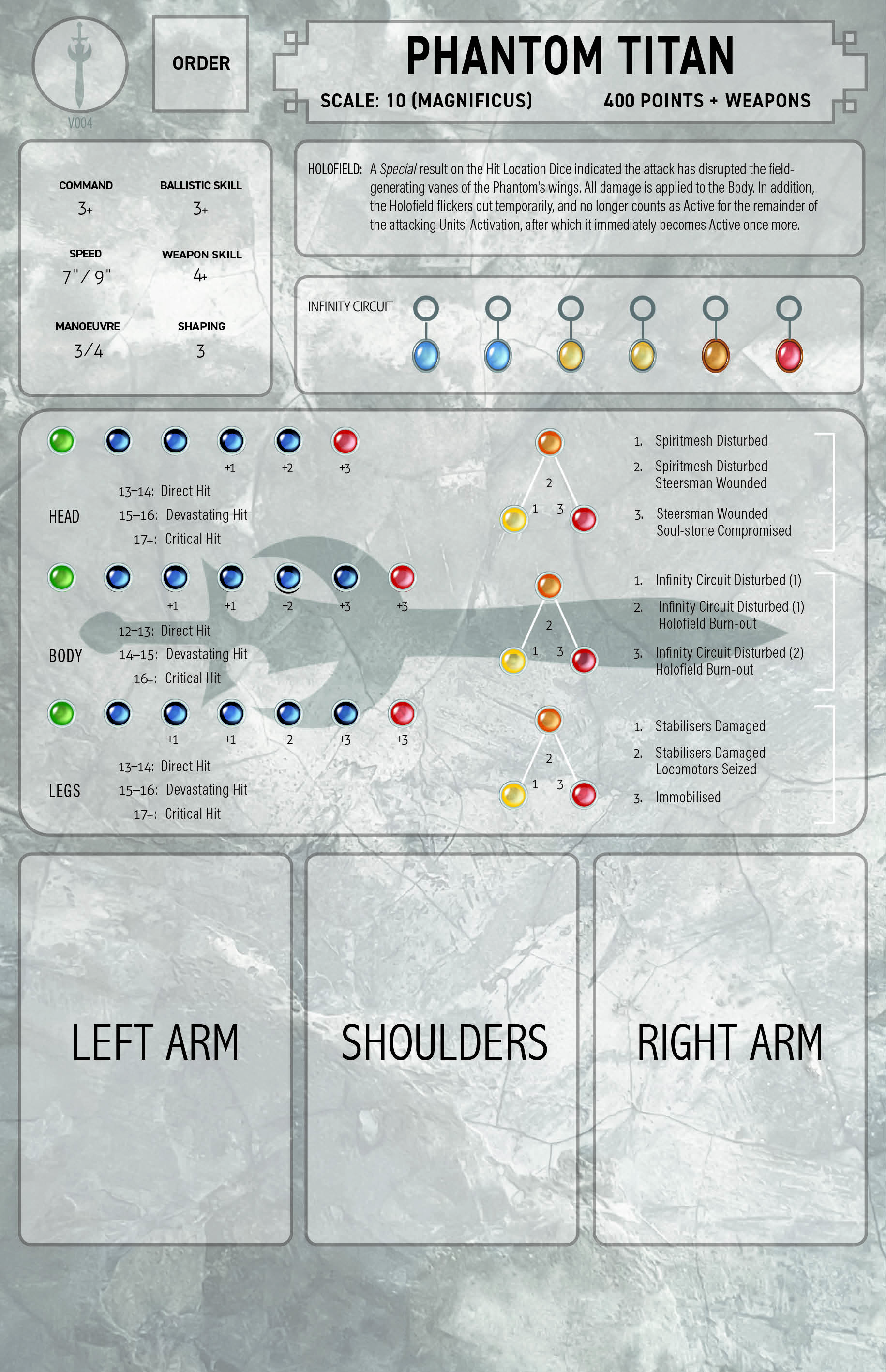
+ These have had minor tweaks since the articles above, so here's a summary, including an updated Terminal and set of Weapons Cards, plus the bare-bones rules you need to try them out. I'd love to hear your experiences with them. +


+ Full size versions of the fan-made files are available for free download from the +Death of a Rubricist+ Facebook group. +

+++

    + Playtesting Eldar Titans +

    + In addition to these, you'll need the following get-you-by playtesting rules. These are additional clarifications on how the game runs, and how certain weapons interact with or effect Holofields. These are additional clarifications on how the game runs, and how certain weapons interact with or effect Holofields. +
      • List building – Replace all references to 'Maniple' for 'Conclave'. Eldar do not yet have Strategems. For the moment I suggest you playtest without them for either side.
      • Game prep – Replace all references to 'Princeps Senioris' with 'High Steersman [name TBC]'. Determine Missions, Deployment and Battle Field Control as normal. Deploy as normal.
      • Strategy Phase – Treat all references to 'Princeps wounded' as 'Infinity Circuit Disturbed'; treat all references to 'MIU Feedback' as 'Spiritweave Disturbed'.
      • Movement Phase – Treat all references to 'Reactor' as 'Infinity Circuit'
      • Damage Control Phase – apply the following adjustments:
        • 1. Activate Unit.
        • 2. If Infinity Circuit Level is orange roll D6; if red, roll D10 on Wraithtension Table.
        • 3. Repair Roll with number of dice equal to 'Shaping' 
        • 4. Distribute results as follows: 
          • X+ Repair weapon (see weapon card) 
          • 4+ Reduce reactor level by 1 
          • 6 Repair 1 critical damage 
          • 6 Repair Holofield Burnout  [Holofield Burnout: Holofields are inactive]
      • Combat Phase 
        • To Hit Modifiers – treat references to 'Steersman Wounded' as 'Moderati Wounded'.
        • Ignore all reference to Void Shields.
        • Note that weapons on the 'Shoulders' location are not affected by 'Carapace' restrictions with regard to targetting enemy Units within Scale.
      • End Phase – Treat all references to 'Infinity Circuit Disturbed' as 'Reactor Leak'.
      • Orders tables changes
        • Emergency Repairs: Treat all references to 'Servitor Clades' as 'Shaping'
        • Shutdown: Replace text with 'Holofields are no longer Active, can only be activated in Damage Control Phase, make normal repair rolls, reduce Infinity Circuit stress level by 2.

      Calling on the Infinity Circuit

      • 1. Roll Reactor Dice 
      • 2. Advance Infinity Circuit level by number of Reactor Symbols 
      • 3. If result is Awakened Machine Spirit perform an immediate Command Check
      • 4. If Command check is failed, roll D6 on Wraithtension Table 

      Wraithtension table – D10 Effect 

      • 1–2 suffer S9 hit to body, bypass Holofield.
      • 3–5 Holofield Burnout; if Holofield already burned out, resolve as result 6-8.
      • 6–8 Suffer D3 S9 hits to body, bypass Holofield.
      • 9–10 Titan is destroyed; all Titans within 15" (except Corrupted Titans) lose all orders. Titan then falls in a random direction.

      Holofields

      Instead of the energy-absorbing warp-based void fields of the Imperium, or the brute power fields of the Orks, Eldar Titans rely on misdirection, deception and sensor-baffling for defence. 
       
      The wing-like harmonic vanes that form a distinctive crest on the backs of Eldar Titans weave a web of photonic projections about the War Engine. The projections create a field of visual distortion, baffling perception across all electromagnetic spectra, and thus making it more difficult for attackers to target the Titan.
       
      While holofields operate dynamically, their effectiveness is enhanced by movement. The faster the Titan moves, the more effective the defence.

      • A Unit attacking a Target equipped with Holofields suffers a -2 modifier to the To Hit roll, which is cumulative with other modifiers. 
        • This is reduced to a -1 modifier if the Target is on First Fire orders or Shutdown orders, or if the Target is Immobilised.
        • If the Target has Full Stride or Charge orders, successful to Hit rolls of 6 must also be re-rolled.
      • A Unit attacking a Target Unit equipped with Active Holofields may not declare a Targeted Attack.
      • Weapons with the Blast trait that Hit a Target Unit with Holofields scatter D6in before the attack is resolved (use the small arrow on the Hit symbol to determine direction), unless the To Hit result is a 6. If the attack misses, it scatters D10 as normal.
      • Weapons with the Beam trait must make a check against BS with no modifiers when attacking a Target with Active Holofields. If the result is a miss, the Beam continues its path; resolve the attack against subsequent models as though the intervening model was not there.

      Holofields and weapon traits clarifications

      • Holofield Burnout indicates the holofields are not Active. The holofields become Active only when repaired.
      • Attacks with the BypassMelee, Psi trait(s) are affected by Holofields as described above. Note that this means Melee attacks cannot make Targeted attacks until the Holofields are not Active.
      • Units equipped with Holofields are affected by Concussive weapons as normal if hit.
      • Attacks with the Firestorm trait are resolved as normal against Units with Holofields.
      • Attacks with the Shieldbane or Voidbreaker trait(s) have no additional effect against a Unit with Holofields.
      +++

      + Eldar Titan Clans and Craftworlds +

      + But enough of rules – what about the lore? I've been unpicking and following the few extant threads from GW about Eldar Titans, and it's actually pretty cohesive. +

      + Eldar Titan crew +

      + Eldar Titans all contain a spirit stone. The pilots, called Steersmen, are granted a small portion of the spirit stone, which they wear as a bandana on their head. The stone bonds physically with the Steersman, and is used to form a bond with the Titan. It cannot be removed until death, after which the Steersman's personal spirit stone (worn on the breast, and often shaped to reflect the Clan's symbol) is interred within the Titan, forming part of the War Engine's Infinity Circuit. The forerunner is then being able to lend their wisdom and advice to the living Steersman/men that follow.  +

      + The Titan's Infinity Circuit is thus a microcosm of the larger circuits used by the Craftworld at large. It's unclear whether the Titan Clan's Infinity circuits interact with each other, or with the Craftworlds' broader circuit, or remains isolated. Perhaps it varies from Clan to Clan. +

      + Small Titans, such as Revenants, will have one living Steersman, while larger Titans such as Phantoms vary between those with a single crewman to those with three or four. Almost all Steersmen are close blood relatives, and families often serve together in Conclaves – groups of Titans – within the larger Clan. Twins and triplets, being vanishingly rare occurrences in Eldar society, are particularly well-suited to piloting Titans, owing to their shared heritage. +

      + In battle, the steersmen use their Soul-stone fragments to form a linked mind with the Titan and each other, allowing them all to move with a singular purpose, and with the heightened focus and clarity of thought of the most single-minded Exarchs. +

      +++

      + The Titan Clans, Craftworlds and the Eldar Path + 

      + Eldar Titan Clans (at least the few we know of) form part of the Craftworlds, but live apart in separate enclaves, as they're a bit unusual. Other Eldar find them a bit disturbing owing to the way they finish each others' sentences and generally act in concert – a result of the shared mindstate they have in battle. The relationship of a Clan to a Craftworld can perhaps be viewed a little like that of the Adeptus Mechanicus to the broader Imperium – mutually reliant and supportive, but with a clear distinction. +

      + In this, I think of the Eldar of the Clans are a little like Eldar Rangers, in that they distance themselves from the other members of the Craftworld (though in the case of the Titan clans culturally, rather than physically as they Rangers do). Aspect Warrior Exarchs are probably treated with a more extreme version of this, with other Craftworlders paying them wary respect, but mostly avoiding them. +

      + The Eldar of the Titan Clans aren't lost on the Path as Exarchs are, and it's unclear whether becoming a steersman is a Path in itself, or restricted in some way. Again, I think this is rich soil for writing the lore of one's own Craftworld or Clan. Perhaps some more militaristic Craftworlds, like Biel-Tan, have a lot of back-and-forth of individuals between the Clan and the broader Craftworlds, with their Steersmen benefitting from experience gained while walking other Paths of the Warrior. Others, like Saim-Hann for example, with its culturally atavistic approach, might have quite closed-off and culturally isolated Clans, with virtually no interchange between the Clan and the other inhabitants. +

      +++

      + What are the Clans like? +

      + Craftworlds appear to be able to support multiple Clans. The following Clans are attested in Codex Titanicus as examples. Some of the lore is interesting to read in light of modern Eldar background – little seems to have changed, but where it is different, it's quite marked!

      Protectors of the Fallen (Fir Dinillainn)

      Since Imperial records began, the Eldar Phantoms of the Saim-Hann Craft World have been known as the Fir Dinillainn – the Protectors of the Fallen. Yet on their own time scale, this name is but a recent acquisition, earned by an act of outstanding courage and selfless sacrifice to another clan many thousands of years ago. Lord Amthillian, leader at the time, sacrificed a third of his force to protect the dying warriors of the Fir Linithion clan – his companion in the field – so that their spirit-stones could be retrieved. By that single act of self-sacrifice, the Fir Lirillyon – the Knights of Purpose – were renamed the Fir Dinillainn.

      Since that day the Phantoms of the Saim-Hann Craft World have astonished even Imperial forces with their selfless heroism.

      + A nice, dare I say 'generic', first Titan Clan to read about? The events described – or self-sacrifice to protect spirit-stones – are iconic of the Eldar in general, and could be applied to pretty much any Eldar force. +

      Watchers over Ancient Wrongs (Fir Farillecassion)

      It is widely-rumoured among the few Eldar unaware of the truth that the true location of the Black Library – said to hold the Eldar codices that concern themselves with the worship of Chaos and tell of the Eldar's downfall – must be the Biel-Tann [sic.] craftworld. Although this is certainly untrue, the Phantoms of Biel-Tann do display an unparalleled hatred of Chaos. The driving force behind this hatred is a fervent wish that no other race should suffer the terrible downfall that befell the Eldar.

      Inquisitor Trant tells of his journey to Truan IX to destroy a Khornate coven. However, Trant arrived too late – upon reaching the surface he found that virtually the entire populace had been wiped out. In the rubble of the western continent's capital city he found a half-burnt banner bearing the symbols of the Fir Farillecassion – the Phantoms of Biel-Tann. They had arrived before him.

      + Besides the change in spelling, it's interesting to see that Biel Tan, far from being the xenophobes of modern 40k, were crusading in order to save other races at this point. +

      Eagles Born of Fire (Fir Iolarion)

      The Fir Iolarion – Eagles Born of Fire – were almost completely destroyed four centuries ago when they lost control of the warp gates aboard their craft world, Lugannath, allowing the Daemons of the warp to enter and attack them. For many years the clan drifted helplessly in space while they laboured to make the necessary repairs: stranded, and with their numbers severely depleted by the creatures in their midst, they were reduced to being one of the weakest Eldar clans.

      Over time, however, thanks only to their own unrelenting and steadfast efforts, they have not only regained the power they once had, but have exceeded it tenfold. Their almost total obliteration is now regarded by their leaders as a baptism of fire.

      + ...and the last Clan comes from Lugannath, one of the few Craftworlds that had any lore at all in this period, and then disappeared for a few editions. Their Titan Clan sheds little light on the broader Craftworld. +

      + What can we take from this, and why's it relevant? Well, first off, I think it's fair to say that while there's not a clean slate to work from, equally there are some nice starting points. +

      + At this point in time, the Eldar colour schemes hadn't yet been 'locked-in' so firmly, and so I think you could happily defend Titans painted in unique clan colours, those of its parent Craftworld, or perhaps a combination of the two. +
      +++

      + ... and speaking of painting +

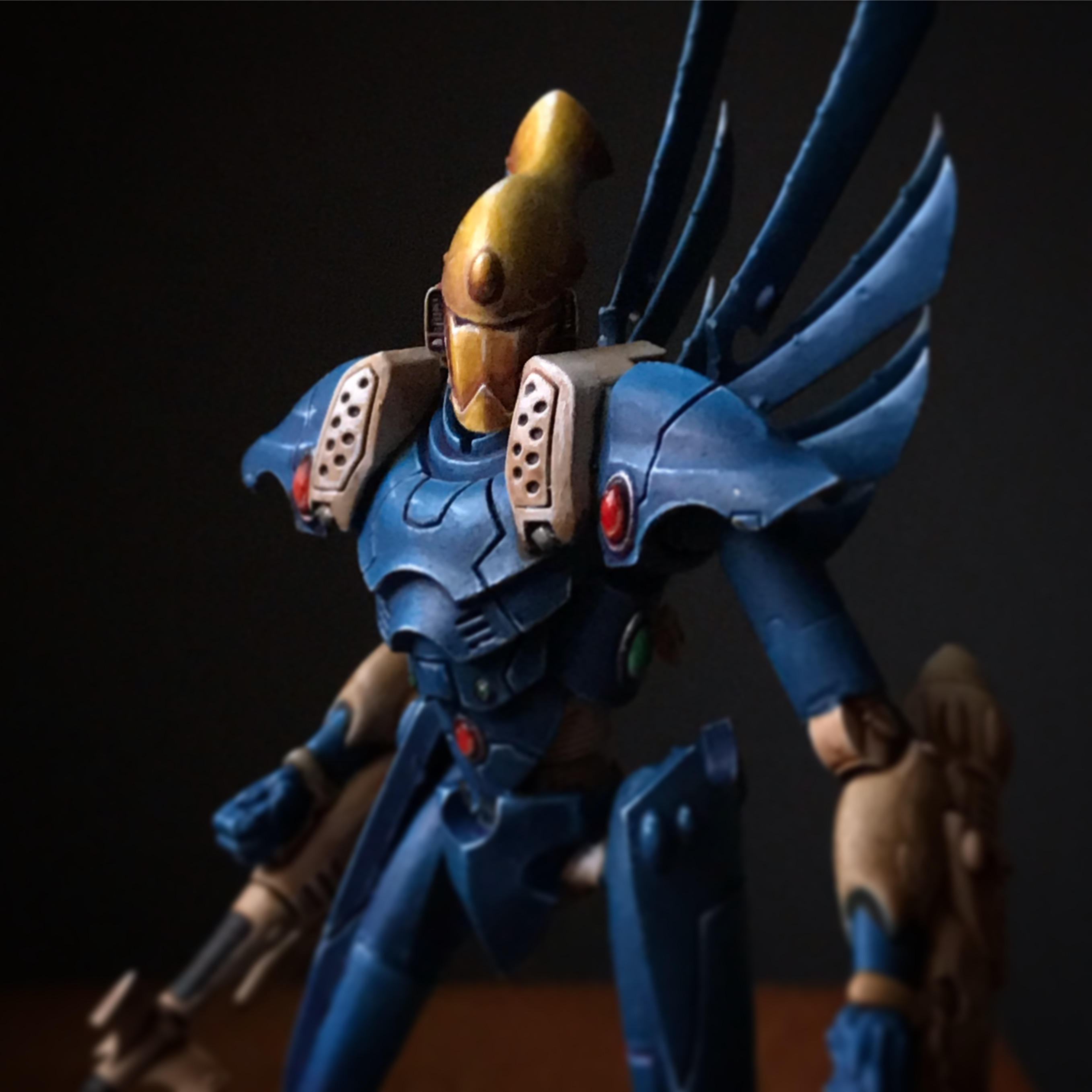
      + I hope you're not too bored with this Phantom, but I'm delighted with how he's coming out. The model is now ready for the table, with the final details still to be decided upon. +


      + This front view shows that the body itself is all complete: the additions now will be some details – though I'm slightly nervous about [+SCRAPSHUNTERRORABORT+]ing the existing work up! These will include:
      • Clan logo
      • Personal details
      • Banner.
      + The old lore had the Titan's banner hanging from the weapon, which is an option, but I'm leaning towards it going between the legs, which has a big ol' area of negative space crying out for some interest. It'll also help draw the eye, balancing the figure a bit. +

      + Secondly, because the weapons are magnetised, they move – and hanging a banner from one seems a problem waiting to happen. +


      + Both weapons need further attention, but the Wraith Glaive in particular needs its blade painted. I'm umming and ahhing about whether to try a colourful blade (a device I personally dislike for Imperial weapons, but seem fitting for the Eldar), perhaps in pink or green; a pale ghostly hue; or metallics – perhaps with a hint of colour near the hilt to suggest a glow. +


      + The D-bombard likewise needs polishing off, though it's not clear from this over-exposed image! It's nice to have some sunlight back in the mornings, but today was not great for picking up detail. +


      + And to prove the back detail exists, here's a rear shot. +


      + To close, here's a scale shot, showing the Phantom next to its Imperial counterpart... and what's that odd glyph behind? Could it be that work is restarting on the Gargants, too? +

      +++

      Thursday, January 12

      + inload: The Nature of the Warp +

      + Gaze into the warp + 

      Since the dawn of time, every man and woman has heard a deep, unnameable and urgent yearning. It is those who first heeded the urge that were driven to band together, to grow, to build, to resist the vicissitudes of an uncaring cosmos – and to fight. The urge spurs us to excess, to conflict; fills us with an addiction to knowledge and the will to resist subsumption or dominance by other wills.  
      The urge has a metaphysical root – and a physical dimension, a location deep in the heart of the galaxy, a region where the material universe and the true reality intermingle. More than our adopted homes, more than the Cradle-world; it is this region, this Eye of Terror, that is humanity’s natural domain.
      Here, time and space become one with metaphor and thought. Here, a man’s worth become written into physicality; as his very mind and soul become woven with his corporeal flesh. It is here that humanity will achieve its Apotheosis.
      + Apostle Uralak Hein +

      The warp

      The warp is an alternate dimension that co­exists with the material universe. Some know it as the Sea of Souls, and these perhaps understand it best of all, for every creature in the material universe also has an existence in the warp: a spirit-self or soul. The emotions and thoughts of the creature stir the stuff of the immaterium just as its physical self affects the material world around its body.

      Such ripples as mortals make are tiny; but across populations and aeons, great waves and currents build up, shifting and rewriting the unreal landscape of the warp. Wars, conflict and intrigue – and the emotional highs and lows they effect – cause the warp to churn and curdle, throwing up deadly storms of energy that wax and wane in power.

      All such storms represents an aspect of emotion, such as desire, anger, ambition, or hope; and the more powerful the emotion, the more urgently the energy is drawn into confluence with similar energies. Most such storms dissipate, dissolving back into the indifferent and limitless substance of metaphor and dreams that is the stuff of the warp. Others, however, grow to become self-sustaining, attracting more and more analogous energies to themselves, and thus building into colossal tempests.

      These confluences of energy can attain a form of self-consciousness; alien to our understanding, but nevertheless present. These inhabitants of the warp are daemons, voracious beings who would consume the material universe to feed their hunger. Such is the paradoxical nature of the warp that such independent daemons are simultaneously created and destroyed in an endless cycle, while remaining ever-present and immortal.

      Independent daemons

      Daemons are simultaneously formless and recognisable. Should a choir of psykers have the strength of will to gaze into the warp without going mad, each member would see a daemon differently; uniquely. Some might see shifting bands of colour, or a great lightning-wracked clouds of emotion. Others might see a shapes similar to his or her own species, albeit with spindle limbs, wings or great claws, as the daemon’s whim – and intrinsic nature – shape it.

      Such independent daemons can engage in metaphysical battle with their kin; the victor absorbing the loser just as a weather system engulfs another, or as a predator swallows its prey. Such death is meaningless, for daemons are immortal; and – being composed of emotional energy – they simply live on in another form, as part of a yet more powerful daemon.

      Such minor powers can grow to great influence as emotions in the material world rise. Wars and famines and plagues feed the daemons – and, as the war is won, or disaster relieved – the warp grows calmer once again; and the daemon’s influence is reduced. Some even dissipate into nothingness, swallowed back into the sea of souls itself.

      Daemons thus crave the power that the actions of mortal souls gives them. Just as the material world affects the warp, so the actions of daemons can have a mirror in the real world; stirring vague thoughts of injustice into a sudden urge to murder, or inspiring a politician to take a grave risk in search of a great reward. Attracted to passions like those that make them up, daemons can be drawn into the real world through the expenditure of such emotion – usually focussed through ritualised actions. Here, they exchange their energy for physicality, burning swiftly through their reserves. A daemon that materialises must feed – in the only way it knows how: by inspiring the heightened emotions that make it up.

      To daemons, the material universe is a dry, suffocating place lacking in the life-giving psychic energy of the warp. Daemons seldom enter the material world save at one of the handful or places in the galaxy where reality is fractured and the warp vomits psychic power into the void. The biggest of these places is the Eye of Terror, a region of the galaxy where entire worlds are overrun with daemons capering in the energy flow.

      Psykers and possession

      All mortals stirs currents and waves in the energies of the warp. A few, known as psykers, can – intentionally or not – draw energy from the warp and into the material universe. With experience they can give form and purpose to the raw power of the warp, reading minds, sending mental images or messages, locating people or objects, or perhaps seeing into the future or the past – as time is as meaningless as any other dimension in the warp.

      Even the strongest psyker is at risk from the daemonic entities in the warp. Just as a psyker can draw energy from the warp into the material universe, so his actions will inevitably draw daemons, too. Sometimes the power of Chaos corrupts the psyker gradually, tainting his mind with alien ideas and motivations. Sometimes a daemon is strong enough to overwhelm the mortal’s soul entirely, displacing it from the physical shell and launching itself screaming with triumph into the material universe. Such events are known as possession; the soul of the previous occupant either devoured, dispersed across the warp or horrifyingly entrapped as an impotent spectator in whatever atrocities the daemon wreaks.

      +++

      The Great Powers

      Beyond independent daemons are the Powers, the very greatest warp-tempests of all; primal and eternal aspects of the immaterium. Khorne, the Blood God, draws those whose lives have been drenched in slaughter and who thrive in battle. Nurgle is the god of physical corruption and disease and gathers all those who died in its grip. Tzeentch is the Lord of Change, the great conspirator, who constantly feeds the ambition and intrigues of mortals  before he consumes them in the greatest betrayal of all. Slaanesh the Lord of Pleasure, the purveyor of secret excess and secret vices, collects those whose deepest desires remain unquenched.

      Each of the great powers can be pictured as fell and terrible deities, monstrous personalities akin to the gods of myth. Constantly at war with each other, they stride over landscapes of dream and metaphor, directing their armies of subservient daemons to harry and raid and claim new lands from the contested regions between their dominions and those of their rivals. Equally, they can be envisioned as immense and timeless tempests; mindlessly buffeting one another, continually swallowing up and regurgitating smaller storms whipped up in the narrow regions between their realms. Neither interpretation is true, for in the maddening nature of the warp, ambiguity is all. Khorne is at once a cyclopean dog-faced giant, enthroned on an ever-growing throne of skulls; an abstract and recondite clash of swords on bone; and a cyclopean and unknowable storm of spirit.

      The Realms of the Powers

      At the heart of their realms, each Great Power holds their court and exercises their absolute, unbridled power over their innumerable subjects as the whim takes them. Here they are truly godlike, the nature of the place and their will as one. The Great Powers are simultaneously the monarchs of a region of the warp, and their dominions themselves. At the centre of the realm of Tzeentch, for example, is no mere personality (though indeed at the heart of the Infinite Maze stands the Tower of the Great Sorcerer) for Tzeentch is also the very crystal-laced ground and numinous aether that makes up his kingdom.

      Within the spaceless infinite extension of the warp, like attracts like. Thus, with the death of its physical body, the soul of a mortal creature is cast adrift in the limitless sea of energy. Eventually the souls of all but the strongest are drawn to the most powerful influence – and into the realms of the Chaos gods themselves, there to feed their lusts.

      Between the Powers

      Further out from, and between, the cores of the four Great Gods of Chaos – if such a concept can be grasped for an inherently dimensionless space – the Power’s direct influence wanes, and eventually breaks down into the broader, infinite sea of chaos; just as a raging stormfront fades imperceptibly into the ocean. Here, beyond the reaches of the broad collections of strong emotions that make up the Great Powers, there is the potential for smaller squalls and minor powers to exist – composed of subtler, more complex, or less universal emanations of spirit-stuff. Here dwelt, and in some sense, still dwell, the Gods of the Eldar.

      Between the storms of pleasure and rage, for example, lies the potential of Khaine – a dead god currently swallowed up by the swollen strength of Slaanesh and Khorne, whose waxing influences have subsumed all between them into a fatally tempestuous region of countervailing anger and fervour. Within the border country of fertility and hope, meanwhile, lies the dormancy of Isha; a powerful tempest long-swallowed up by a burgeoning and cancerous growth of Nurgle’s realm.

      +++

      Legionaries and the Warp

      Renegade Space Marine Legionaries often lead brutal, fearless – and emotionally stunted – lives, in which decisions are instant. Stripped of the full spectrum of human emotion, an Astartes’ metahuman mind draws what remains into hyper-focus, simultaneously offering some measure of protection against some forms of daemonic temptation, and opening them more fully to others.

      Imperial Space Marines follow a strict regimen of ordered prayer, devotion and duty. This is a spiritual shield against the darkness, for without such obsession, their minds could wander in dark places.

      The Legions of the Eye, meanwhile, have cast aside such restrictions and duties in favour of pursuing their own ambitions. Far from a danger to be flatly rejected or avoided, most see the Warp as a source of power. The focussed, single-minded and disciplined nature of the Legionary, together with their raw physical prowess, makes them inherently attractive to the powers of the warp. Where the Astartes go, war, desire, unrest and despair follow, as surely as night follows day.

      So it is that the Great Powers have become patrons to the Legions – not in any understandable sense, for how would mortals, however powerful, treat with forces of nature? – but through the living message of each Legion’s mysterious, warp-touched Primarch. These extraordinary beings, who straddled the material and spiritual realms, all crossed over into the warp itself, ascending to become a serried pantheon of Daemon Primarchs.

      Such symbols have power in the Eye of Terror, and whether their sons accepted the pacts or not, the Primarch’s Legions intrinsically came to belong to the Gods of Chaos. Some, like the Emperor’s Children, were claimed whole-heartedly by a particular patron, and enthusiastically accepted the role; others, like the Word Bearers, came to honour and serve the Gods as a pantheon. Even those who resisted – in part or in full – like the World Eaters, found their very resistance itself a form of twisted devotion.

      The Sons of Horus, in their hubris, attempted to claim all the gods, seeking to play one off against another – but in so doing, they winnowed away the favour and attention of all...

      +++

      Tuesday, November 29

      + inload: Lamb's World camouflage tutorial test +

      + Mustering the Guard +


      Dearest beluft Sîa,

      It hath bene many a moonth synse last I wrot. And forre it I am sorrowed. Ther hath bene scant chans. Butte now Worron hath lendedde me hys pensil and I have savedd some offe my rashion pacc cardbord onne wych to write. And so here is my letter. Wrytting is not come natural to me as you knowwe well, beluft. But I was torn and wont to you to write.
      […]

      The vittels are scant, but good. We drinc well, and so far we haff not found the [REDACTED] we arre tolt we are to fyte.

      And soe we slepe in the baracs (a sort of grete living hutte like ourres but to hous not a famillie but three-scorre menne) and feast in the messehall. Ydris is the cooc and, when stocc is ryte, he coocs dyshes of Lammb’s World. Of home.

      Over the droppe scones the others oft fyt forre a sore remyinder of home they arre; but to me they are ascces in my mouth, for they remind me only offe you, beluft. And howwe apart we arre. Throne willingge, home to you schalle I come in somme days.
      […]’

      +++


      + The Bolter and Chainsword forum is running a 'Muster the Guard' hobby challenge [+noosphericexloadlink embedded+], which invites you to paint any Imperial Guard models to help celebrate the release of the new Codex. It seemed the perfect excuse to deploy some Guardsmen from sentry duty in the Cupboard of Opportunity, so above you can see a twenty-five (twenty-six, if you include the dog) strong platoon of Lamb's World Guardsmen, who've been malingering in the barracks for too long. +

      + One of the very first inloads on this blog, back in (coo) 2013, was a camouflage tutorial for the Lamb's World desert camouflage. You can find it here: [+noosphericinloadlink embedded+]. +

      + One of my older models – the result of following the tutorial. +


      + Coming back to a paint scheme some years later inevitably raises the question of whether to try to match the original, do a sort of 'redux' version that benefits from developments in the materials, techniques and – of course – one's own experience, or to throw everything out and start from first principles. I usually err on the side of the latter, but here I was interested to see whether the blog could live up to its original vision. 

      Death of a Rubricist started out as a place for me to record my paint recipes, techniques and ideas for when I wanted to scribble something down.  Useful when trying to work out what paint I'd used on a particular army, for example. It's grown a bit in scope since, but using 2013 me's advice would be fun, I thought. +

      + My plan, therefore, was to try to follow the tutorial. Of course, some things in life are inevitable: the sun rises, the world turns, and GW updates their paint range. As a result, a lot of the paints are no longer extant. I'm planning to work through a squad this week, so I'll see what tweaks I need to make. +

      +++

      + Seeing how it works +

      + The numbering below relates to that in the original tutorial; I've simply appended my additional comments here.

      _I–IV
      + The models were built, primed with Halfords Grey and undercoated with Humbrol Desert Yellow 93, both of which I'm pleased to see are still around.


      _V–VI
      The first stage of the fatigues used to use Scorched Brown and Gryphonne Sepia, both of which have been replaced. In place of Scorched Brown, I'd suggest you use Rhinox Hide or Mournfang Brown, though the principles apply to any dark tone. I used the former here. 

      Gryphonne Sepia has been replaced with Seraphim Sepia. I was initially sceptical of this wash, but after a few years I've either succumbed to Stockholm syndrome or Seraphim Sepia has proven a worthy successor, so it works just as well here.


      + More to come over the next few days, I hope. Once I've worked through, should I update the old tutorial or write a new article out? +

      +++


      +++

      Monday, December 6

      + inload: Iron Warriors trio +

      + inload: Scions of the 242nd +


      'Footsore no more.' Ostrod murmured, half to himself. It was a peculiar half-honour. He wouldn't be making landfall with the rest of the 242nd Grand Company. Instead, he was being made a Palatarch of his own Chain. Sergeant, he thought for a moment, before considering that there was no reason – none at all – to use the old Terran term now.

      + Ostrod +

      Promotion and transfer. He, along with two others, were on a shuttle to liaise with a new Grand Company. The other two sat opposite him in the mostly-empty bay. Masked behind his helm, he sat rigid as his eyes scanned them.

      One was unfamiliar. Ubricz he knew in passing. In their plate, he could be the twin of Ostrod. Identical armour; only details differentiated them. Ubricz had a rigid approach to armouring; as coldly efficient and unsentimental as the Iron Circle that he so admired. Besides the temporary transfer marking that had been stamped above each of the new officers' primary hearts, Ubricz's armour was unmarked by any personal honorifics or personalisation. Ostrod felt a peculiar sense of shame at the spiked pauldron and pseudleather apron he bore; the skull-shaped finials at the end of each strap seemed somehow opulent; needlessly boastful.

      Ubricz sat as rigidly as his observer, hands resting on his knees. Besides the occasional rocking of the shuttle, he might easily have been an empty suit of armour.

      Admirable, for an Iron Warrior.

      + Ubricz +
       
      Spitefully, Ostrod looked for faults. It came easily to him. He noted the non-standard backpack – doubtless some recent replacement. Even Ubricz, it seemed, was not infallible. 

      Frustratingly, that seemed to be it. Even the combat blade at his belt was perfectly placed for cross-draw. 

      Dismayed, he looked for criticisms in Ubricz's armament. Newly-issued bolt pistol – that matched his own – and a chainaxe. Peculiar. An unusual, though not frowned-upon, choice. The axe swapped speed and finesse for power and reach. Ostrod smiled thinly. 

      Variance. Weakness.

      Satisfied, in some strange, unplaceable way, Ostrod turned his attention to the third warrior. Ident-runes flagged him as 'Ixod Konstantz'. The Space Marine bristled and turned to Ostrod with a clanking of heavy plate and grind of pistons. Ostrod barely stopped himself – shamefully – from flinching. Active reports. Konstantz had clearly tweaked his armour to alert him when being scanned.

      + Konstantz +

      Ostrod looked away, feigning disdain, and the other Legionary turned back to the combat-ready slump he had been in before. He had, in any case, seen all he needed. Konstantz's armour was older than Ubricz's, or his own. Mark III plate, battered and war-worn. Ostrod wondered if it was a 'pure' set, issued as Mark III; or a mongrel suit, adapted and refined from a suit of Crusade armour like that worn by the other two on the shuttle.

      There was something of the fanatic in Konstantz, Ostrod considered. Bristling, reactive, angry. He even wore trophies: an old ork tooth – judging from the discoloration, from some ancient battle – and a human skull. Ostrod couldn't help turning back for a second.

      No, not a human skull.

      That had belonged to an Astartes.

      +++

      + Commission complete +

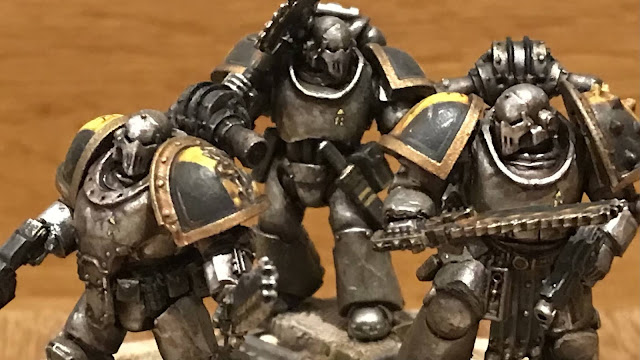
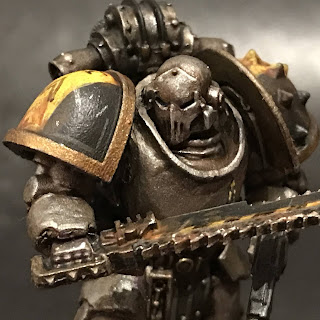
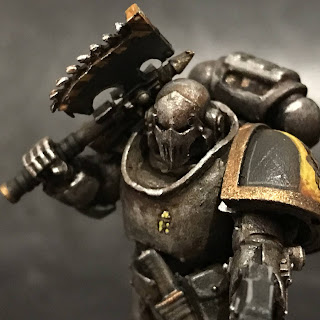
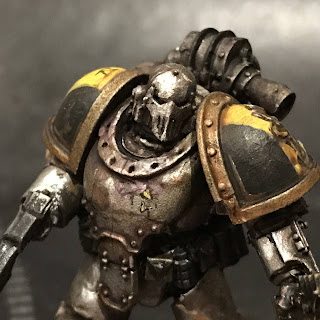
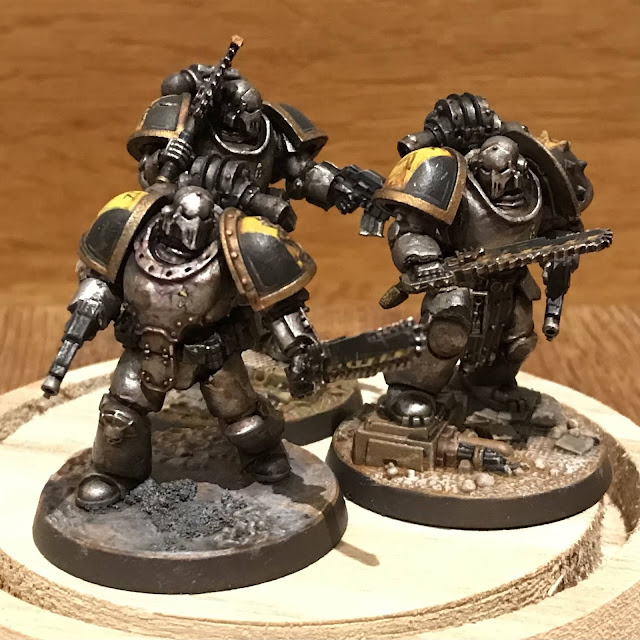
      + After a wait for the final bits, these three vicious warriors are all finished and ready for deployment by their new commander. I thought I'd get a few shots of the finished models, and post up a couple of thoughts and notes. +

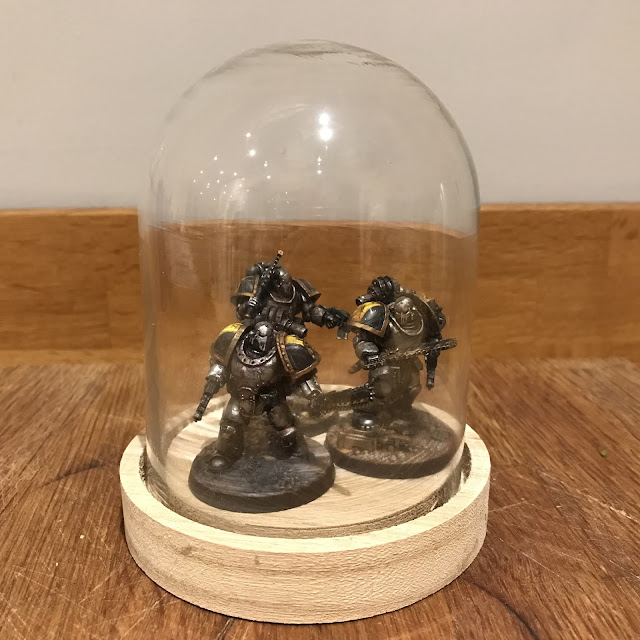
      + Everything looks swish in a bell jar! Trazyn the Infinite would be proud +

      + This was a really enjoyable project – small, self-contained, and a welcome return to a favourite army of mine. I always judge the success of a commission by whether I want to keep it afterwards. I'm pleased (if slightly regretful!) to say that these three pass the test. +


      + Part of the reason that I keep coming back to Space Marines – despite thinking of myself as a Guard player at heart – is that they have such a broad and deep background. Each Legion, Chapter or Warband seems to riff on the basic concept of 'Space Marine' slightly differently, so there's a joy both of familiarity with the shapes and building blocks, and of opportunity in going slightly further or in a different direction with each model. +


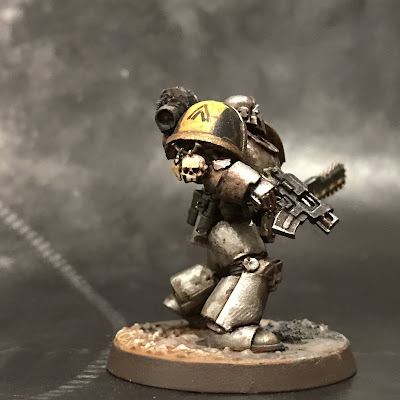
      + One of the things that I wanted to do here was make use of bits that had appeared since I last worked on my Officio Monstrosa project – in the example above, a Space Marine Heroes series 2 Terminator. These figures are push fit and include integrated bases, which I think is one of the best things GW does in helping to create evocative poses. There are obvious drawbacks (for multiples, matching existing basing schemes), but where they work, there's no substitute for how integrated bases help with the posing of figures. +


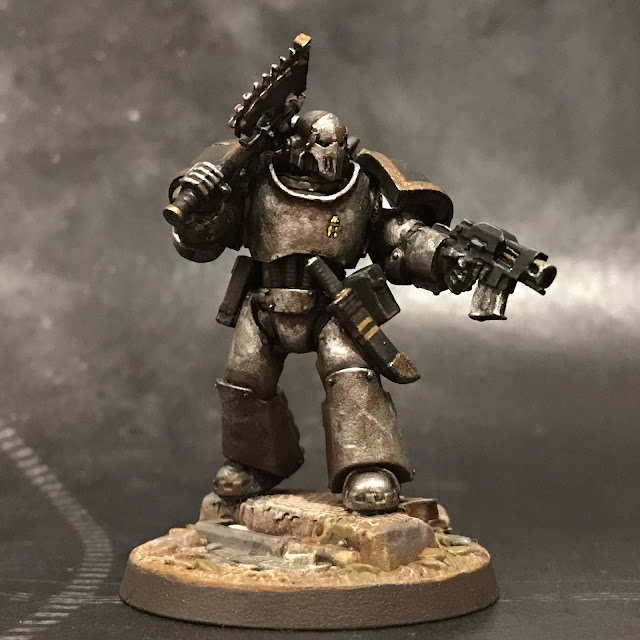
      + A disdainful upright posture for this marine. I wanted to convey a confident, dutiful impression for this marine, so kept him largely clean. The resting chainaxe implies he's not at all on edge about executing his duty – the angle of his pistol suggesting finishing someone off, rather than honourable combat.+ 


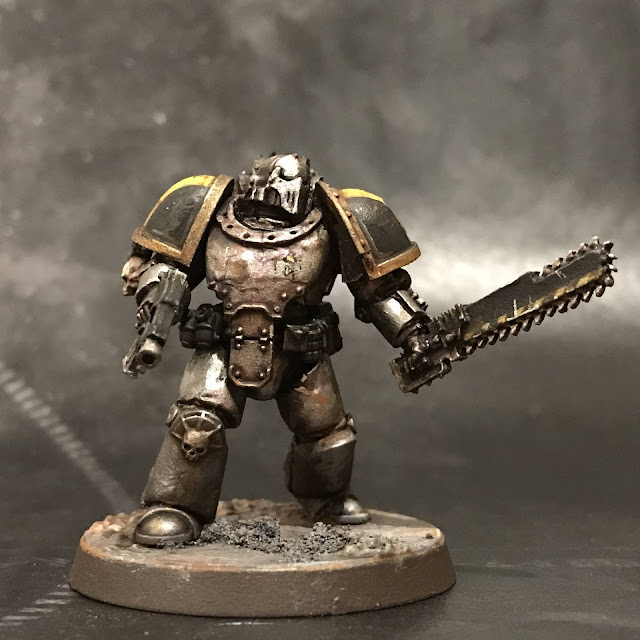
      + As a rule, Iron Warriors are bitter and resentful types, restrained and efficient, and I wanted to get that across. As we know, 40k doesn't have any goodies – and it's sometimes good to reinforce that with a slightly swaggering, bullying posture for villains like the Fourth Legion. You don't have to be screaming to be evil. +


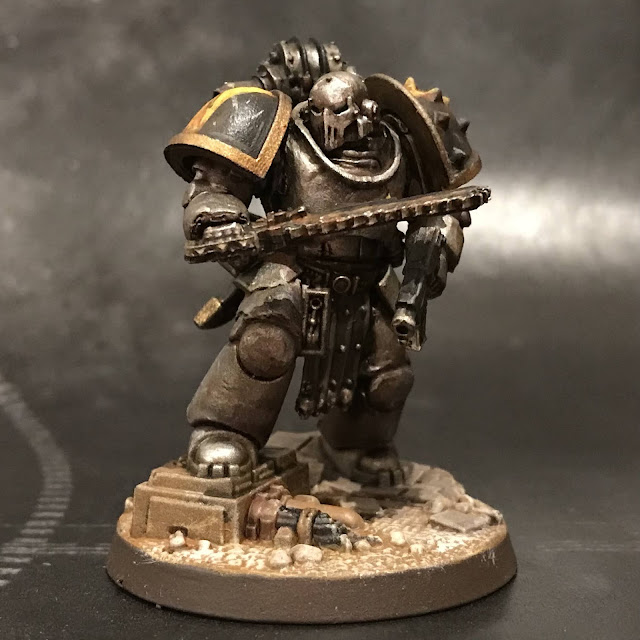
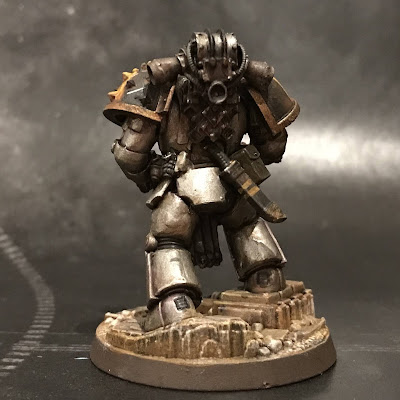
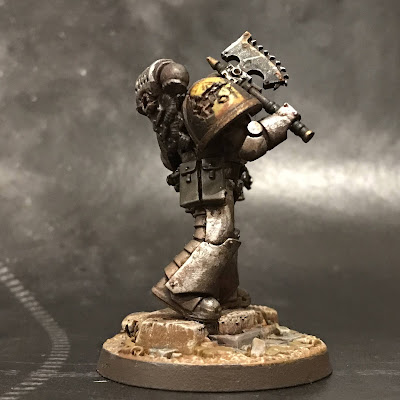
      + A plainer, battered and more traditional look for this last Iron Warrior, up-armoured in (appropriately enough) a battered Mark III Armourum Ferrum breastplate. With most Space Marines colour schemes, I think it's easy to fall into a trap of doing too much of their accent colours – Ultramarines with more gold decoration than blue, for example – and this is particularly the case with black or metal schemes, where any addition will draw the eye. The hazard striping so common to the Iron Warriors scheme has been restricted to the chainsword, where it adds Iron Warriors flavour without being too eye-catching. The combination of yellow and black is retained in a simpler, cleaner form on the pauldrones. +


      + Modern-looking Tactical markings and trophy-hunting makes for a stark juxtaposition. You can suggest a lot about an army with little details like this. +
      +++


      + To finish, here's a little group shot. Onwards to victory! Iron Within! Iron Without! +