Showing posts with label background. Show all posts

Wednesday, May 6

+ inload: Creating a Reaver Titan +

+ Origines Dubiae – the Scythian +

+ Work in progress +

Scry-chronicle pre-mission datasquirt: {authval: Sensorius-principal Ossteon}

Validity: {principal >14% accur.}

'And it came to be told that Titans would march, and the storm would follow with them.'

Mission parameters:_________________________


+ Scythian +

Recently we looked at the crewing of Titans [+noosphericinloadlink embedded+], with particular reference to the Reaver. That inload covered a lot of the theoretical side of things, so today we'll start looking at one specific Titan, and how we can use the ideas to create some personalities for gaming and narrative.

I hope that the inload covers off how I approach things, and encourage you to have a go yourself. It's great fun!

+ A motley crew... +

+ Where to start? +

There's no need for a crew if we don't have a Titan, so let's work out the Legio and individual Titan. I've been mulling over what Legio to work this deep dive around, and have settled on the Stormlords – Legio Tempestus – for the following reasons:
  • Legio Tempestus has a rather peculiar and winding background, with three homeworlds, and good options for the Titan to be Loyalist, Traitor, Blackshield – which also means that it's as general and open an opportunity as I can get for a 'catch-all' generic Reaver Titan crew.
  • A 'canon' Legio with an established history both in-universe and the real world gives me the best chance of finding background dots to join.
    • As a good example of that, 'Legio Tempestor' [sic.] turned up to help defend Armageddon during the Third War, according to Codex: Armageddon, so there's a great example of those lovely little notes that prompt a story.
  • It'll make for a great excuse to get some paint on some AT-scale Titans and create an opposing force for my Legio Metalica (another Legio that has flexibility in loyalty – or at least plausible deniability...)

+ Naming the Titan +

I exloaded on naming Titans back in the dim and distant past, and you can read it here: [+noosphericinloadlink embedded+]. Taking that sage advice to heart, I looked at existing names for the Stormlords. Odrysian appears in the Traitor Legios book:


... and Tempestus appear in lots of other books and rulebooks, notably Abnett's seminal Titanicus and McNeill's Mechanicum. A sample of Tempestus Reavers includes:
  • Arcadia Fortis
  • Hand of Dominance
  • Metallus Cebrenia
  • Raxvalian
  • Jogozh
  • Cerulean Stride
A nice varied bunch, and a good example of not hewing too closely to your theme: a mix of names can give a richer feel to the Legio culture. Here, I played around with some High Gothic names, and mused on using plant names – binomial nomenclature's a great place to find inspiration for cod-Latin. Urtica Dioica, for example is stinging nettle, and strikes me as a great name for a Titan.

In the end, I thought a single-word name would suit – easy to remember and it fits in with the Titanicus rulebook and Horus Heresy black books naming (e.g. Odrysian, Raxvalian). I opted for Scythian, which is general enough to work for loyalist or traitors, and also quicker to say when gaming than a longer double-barreled name!

Like T. S. Eliot's cats, Reavers deserve more than one name, so there'll also be a High Gothic name in addition to its Low Gothic cognomen, but that'll be decided upon in the closing stages of the project, as I'd like to muse on that a bit more.

Next inload we'll start looking at the crew of the Scythian – and how their personalities, and Scythian's own, affect one another.

+++

Monday, March 30

+ inload: Personalising your Titans – crew and structure +

+ Crewing a Titan +

+ A Titan is crewed by its Princeps and Moderati – but who else is involved; and what do they actually do? Today's inload investigates what's actually going on inside a Reaver Titan, and how you can use the info to help create fun narratives for your games or force background. +

+++

Scry-chronicle pre-mission datasquirt: {authval: Sensorius-principal Ossteon}

Validity: {principal >14% accur.}

+ Thought for the day: Knowledge is power, guard it well. +

Mission parameters:_________________________

+++


+ Nuts and bolts of Titan crew +

Prior to the 2018 release of Adeptus Titanicus (AT18), the background about Titan crews was fairly thin. Jervis Johnson's original 1987 release (AT87) had this to say:


The core concepts of Princeps as the commander and Moderati as support have held true ever since, even if the atmosphere as a whole has become more bound up in mysticism, doctrine and so forth.

The new rulebook expands considerably on this, with these rather lovely blueprint-style plates that inject some nice pseudo-realism into the game.


These are riddled with fun stats like the Titan's resting height (25.21m for the Mk XXIII Koron-Valerius configuration Mars-pattern Reaver Battle Titan) as well as naval-style berthing gauge, and more sci-fi stuff like reactor output and anima integrity; all intended to give us a sense of the universe as well as a bit of concrete info.

I'm pleased that the stats are tied to this very specific type of Titan, so there's still wiggle room for making your own stuff – to justify, for example, why your Forge World's particular pattern of Titan is slightly taller or shorter.

For the sake of the inload, the bit we're interested in is the Conventus complement or crew. For this Reaver, we're told it's as follows:

  • Crew: 4–8
  • Clade: 9–17

While an update to the original background, it's nice to see that the old material is still valid – the Specialist Games studio (and GW in general) is pretty good at sensitively updating material like this to expand upon, rather than overwrite, older background.

As we'll see, there's lots of info to get our teeth into, but there's also a lot of freedom in interpretation, so however you like your Titans – as walking battleships with a central voice of command, or as enormous robo-jockey battlesuits – there's a way to bring your vision to the table.

+++

+ Crew of the Reaver +

Delving deeper into the image, it reveals where this crew are placed in the Titan, and gives us their names.

  • Armoured Head – Princeps and two to five Moderati; presumably the variance depends on the pattern and specific Titan.
  • Limb weapon mounting point(s) – Weapons moderati
  • Plasma Reactor – Tech-priest
The Clade is also explained by the Plasma Reactor – these are the sort-of human Servitors that enact the crew's will. 6–14 are noted as being housed in the Plasma Reactor, and this is the evidence for suggesting that the Tech-priest is formalised as part of the crew, rather than the 

Incapable of independent thought, servitors simply follow the orders of the crew, and presumably help to ensure general systems like the shield projectors or stabilisers are operating smoothly, so the Tech-priest and Moderati can concentrate on the important stuff which requires independent thought.


The numbers in the image above need a little detective work to make sense. With a Clade of 9–17, but only 6–14 in the plasma reactor with the Tech-priest, we're short by three. With three primary weapons – one on each arm, and a third on the carapace – I think it makes most sense for the missing servitors to be assigned to primary weapons, and stowed in either alongside the Moderatus in individual gunnery command chambers, or (depending on the specific type of Reaver) perhaps in the weapons or mounted within the walls. I imagine some Forgeworlds are more or less concerned with the servitors' dignity!

An alternative – and remember, this is all informed guesswork – is that the missing three servitors could be accounted for as gunners for the automated defence weapons, be patrolling the deck as combat servitors, or pretty much any other task you'd like them for in your Titan.

+++

+ What do the crew do? +

The names of the crew are a mix of High Gothic cod-Latin and naval/military terms, which means that we can make some educated guesses as to their roles and duties.
  • Princeps
    • Perhaps the easiest to define, and certainly the most explored in the background, is the Princeps. This crew member takes the role of the ship's captain, and is also the one who has the most direct and deep connection to the Titan; feeling its body as his or her own.
  • Primus
    • This rank is in Betrayer, the Primus is seemingly reponsible for actioning the Princeps' orders; covering movement and aiming and firing the weapons.
  • Steersman
    • From implication, the Steersman is in charge of directing the Titan's movements; maintaining a course and speed.
  • Navigator
    • ... and the flip side of the Steersman taking you somewhere is the Navigator showing the Princeps where they need to go. In the context of 40k, Navigators are usually a special abhuman, but here I think it's most likely a more mundane map-reader and person in charge of analysis.
  • Sensorious
    • We can interpret this as someone in charge of the Titan's sensor array – something akin to a real-world officer in a naval operations room, in charge of identifying threats and hazards through 'spoor', the 40k equivalent of radar, sonar etc. 
    • Pleasingly, the sensorium is also a biological concept; it's the part of the brain that receives and interprets experiences – which is very on-brand for a 40k Titan.
  • Oratorius
    • With heavy Classical/religious trappings drawn from orare ('to pray'), the Oratorius can be interpreted as being in charge of that very 40k-coded mix of militarism and mysticism; so having some role to do with channeling and placating the Machine Spirit of the Titan and guarding the spirits of the crew. 
    • Alternatively, we can draw the origin of the rank from Oratorio, which is a musical term, suggesting this Moderatus orchestrates everything; making sure all the crew and systems are working together.
  • Weapons Moderati
    • Fairly clear here, I think. A Weapons Moderatus is in charge of a particular primary weapon.
  • Tech-priest
    • The other easy one – or at least a more well-documented 40k role – the Tech-priest in a Titan is in charge of the Servitor clade, monitoring and overseeing the plasma reactor, and directs repairs. He's the chief engineer, but with a heavy coat of religious paint.
In some background it's suggested that the Princeps controls everything that the Titan needs to do actively – movement, weapons and so forth. This relegates the rest of the crew to support roles. In other bits of background, we have the Princeps operating more as a directing force; so they order the Moderati to fire the weapons or increase the Titan's speed, for example – but it's the Moderati themselves that action things.

If you prefer the former, this makes having a crew on the smaller end much more sensible: one Princeps supported to two Moderati. If you prefer the latter, it makes more sense to have specialist Moderati directly involved in aiming and firing the guns, or moving the Titan's legs. And of course, you can happily blur the roles a bit: the Princeps deciding all the Titan's movement, for example, but the Moderati actually enacting things.

By terminology (and the appearance of the 'Secundus' rank in Betrayer), we can take the Primus to be the second-in-command – a 'Number 1' that's a senior Moderatus. We're told that Moderati are effectively Princeps in training, some (but not all) of whom will one day ascend to command a Titan of their own. You can decide how formal you want your Legio to be; and having titles like Primus are one way of showing it.

As a third option, it's notable that the 'gunnery command chamber' listed is singular, so all the weapons Moderati and our missing servitors could be grouped together rather than in individual little 'bubbles' for each main gun. But that begs a questions – where is this gunnery command chamber, and what form does it take?

+++

+ Where do the crew go? +

Besides the background in the book, we've also got the models to help guide us. The Forge World Reaver Titan is the Mars-Pattern, and that has the Princeps and two Moderati in the head...

+ Pict-capture from Games Workshop – used without permission +


...while under the carapace you'll find a Tech-priest and three servitors embedded in the walls and ceiling. Bafflingly, GW have precisely zero pictures of the Reaver interior on their website, but you can can see some great shots of the interior built and painted by Goddenzilla at their blog Kaiju Country [+noosphericexloadlink embedded+].

What can we take from this? At face value, that the Mars-pattern Reaver sits toward the lower end of the crew complement outlined in the rulebook background. Given that the Clade is represented by just three visible servitors, however, rather than the minimum of six, we should probably assume that the model doesn't quite reflect the in-universe reality – so it's entirely possible that there are more Servitors and possibly Moderati in other parts of the Titan that simply aren't shown/modelled.

+++

+ Rivet-counting +

For explorations of the 'fuzzy edges' of 40k like this, I've always leaned towards the 'yes, and' principle. By that I mean that while there's often an answer within the 'official' background, there's lots of room for interpretation and variety. 'Yes, Mark II power armour has a fixed helm – and there are some variants that have a mobile helm'. It allows people to point to particular details and stick closely to 'the canon lore', but also allows for updates, retcons and good old fashioned exploring and creativity.
Do Reaver Titans have the Princeps and two Moderati in the head? 
Yes, and some also have more Moderati elsewhere as well/this Legio has all the crew in the gunnery deck/this pattern only has the Steersman there/this particular Titan crams seven crew into the head.
You have a lot of freedom. While Titans can be identified as different types, they are ritualised and individual creations – so their creation has as much in common with a church or temple as with, say, a tank or car.

Churches of a particular era can be identified by being built in a cross shape, and will have an atrium, an apse, an altar etc. – these are the things that make them a church building rather than, say, a town hall – but there will also be a lot of variety in the specifics. The point is that they're individual buildings, and not mass-manufactured.

Likewise a Reaver can be identified by certain elements: being broadly human-shaped, having mounting points for three primary weapons, broad scale (covered by the in-universe term Immensus), and having a machine spirit that can be interacted with by the Princeps. The finer details – berthing gauge, resting height, reactor output etc. – will vary depending upon the particular Forgeworld, time and circumstances of its creation. This extends to the crew compartment, and thus the crew.

On top of that, besides the design of the individual Titan, the Forge World's, Legio's and crew's cultural and societal idiosyncracies, beliefs and ranking systems will also differ, which means that there's absolutely no reason why different Titans of the same type might not have different crews for various reasons. 

+++

Back to the crew. What does this variety mean for our hypothetical Reaver crew? Well, all Reavers must have a Princeps, and must have a Tech-priest, and must have at least two Moderati. Beyond that, you've got a lot of flex.

Even within a Titan Legion, different Titan patterns and variants exist. Mars- and Lucius-pattern Titans might serve together as the result of ten thousand years of war, alliance and trade, and there are presumably lots more patterns of Titan, some of which might cram all the crew into the head; others of which split them between the head and a gunnery deck; and still others might have the crew elsewhere. 

AT87 made this explicit, with the 'Deathstrike head' variant. This replaced the head entirely with a giant gun (Jes Goodwin clearly channeling his inner Mekaniak with this design!), and moved the crew to a fire control platform or tower:

Incidentally, it's my guess that this concept of a giant centreline gun with a viewing platform served as part of the inspiration for the new Warbringer-Nemesis Titan.


The variety of heads Jes designed suggests that the GW design team left lots of design space open on what exactly was going on in a Titan's head. The Command and Custodian Heads (top left of the picture) suggest a mobile command and control centre, perhaps with more space for Moderati – these would be a great head to use as inspiration if you want lots of Moderati there. I can picture a two-tiered bridge-style interior, with the Sensorius, Oratorius and Princeps on one level, and a Steersman and two weapon Moderati on the next level down.


The weapons heads – particularly the close combat and Corvus assault head – would suggest that the Princeps and Moderati were tucked away elsewhere in the Titan, on a separate command and control deck, so this concept might be your choice if you prefer a naval-style 'ops room' to the more common pilot-style approach.

(The design, of course, suggests that – but doesn't insist upon it. You're quite welcome to have your Princeps and Moderati perched above a chainblade if you wish! That mix of reverence and danger is very fitting for the insanity of the 41st millennium).


+++

+ Conclusion +

Much of this is my speculation, and its purpose is to spark some ideas for you to help design and explore the crew of your Titan.

The point that I'm dancing around is that you can have a very rigid and structured system for your Reaver (and other Titans), or a very freeform one. Like much of 40k, you've got the whole gamut of sleek Star Trek-style sci-fi right down to techno-barbarian thugs following through with blood ritual, taking in hooded monks guiding their titan through organ-style keyboards, amputees in fluid-filled tanks, fighter-pilot style charmers and much, much more.

Keep your inload-port cycled open, as I'm planning to use the info and ideas above as a way to explore a Reaver crew of my own devising – to show how this all works in practise, and how we can apply it to  making fun models with a bit of story behind them.

+ Cue 80s montage music +

+++

Friday, April 11

+ inload: 8th Squad, 2nd Company +

+ Squad Greon; 8th of the 2nd Company +


+ Another inload that's been lurking ready to polish off. I can't quite believe that, apparently, I finished these in 2023(!). I guess in between other projects and painting their Epic-scale counterparts, it has been a while. +

+ This inload has remained embargoed in this noospheric node because it was orginally intended as a series – but rather than sit on it forever, I thought you might like to have a grand sweep! +

+ Below, then, is the extent of my finished Salamanders – though there are more on the way. After all, what reinvigorates interest in a project more than taking a look back over the finished ones? +

+++


Unlike the others, his measure of patience had run dry some time ago. Another breakdown. Another pause. Volkaeus Orurr breathed out testily.

Looking for a distraction, he reached for the rail and clambered up to the Rhino's roof one-handed, his boltgun in the other. Magnificence was not the fastest transport in terms of raw speed, but unlike the convoy vehicles, he mused darkly, it could keep going. 

The transporters were not vehicles intended for service in hostile environments like the Dune Seas. With a regularity that struck Orurr as perversely ill-fitting to their mechanical reliability, every few hundred klicks one or another of the tankers or luggers would slew to a halt as filters clogged, tyres slumped, or the over-stimmed and under-rested hiveborn crew passed out in the unaccustomed heat. The convoy would pause, on edge and nervy, as the errant vehicle was coaxed back into life, winched back onto the track, or otherwise repaired. 

The worst were the failures that billowed thick, oily smoke – as potent a signal as any the orks might hope for. Easy pickings here, the coiling smoke suggested.

Not for the first time, the Salamander cursed the name of Herman von Strab. According to Captain Mir'san, it was largely owing to the Imperial Commander's arrogance and mismanagement that these intra-hive transports were all that was available for the backline armies. Hurriedly fitted with bulky external breathers and heat shielding before being filled with vital water, fuel and materiel, the vehicles were slow and unreliable – and thus the convoys were perfect targets for the roving greenskins.

The cream of Armageddon's armies had been lost in the early conflict, and the replacements far from confident. Upon his arrival, Chapter Master Tu'Shan had been appraised of the situation by Captain Galenus of the Ultramarines' 4th, and had immediately taken it upon the Salamanders' broad shoulders to ensure the world could fight; that its vital roads and arteries would be protected from roving marauders. Clapping his cousin on the shoulder in gratitude, Calgar had made his gratitude clear that the Ultramarines would be freed to prosecute the offensive. 

+++


The ever-present chemical tang was acerbic; but the height afforded by the Rhino gave him a moment's relief. The vehicle crews needed rebreathers in the hot, dry air, but the Space Marine's genewrought might made the air merely unpleasant. He wrinkled his nose in distaste and looked about him.

Armageddon's sun was low in the sky, red and ominous. Dark spots across it marked orbital defences – or more likely the wreckage of the same. The ground was seemingly an endless sea of yellow-grey dunes; the road all but hidden. Orurr's belted helm knocked against his leg as he straightened up. 

Nothing for five hundred miles in any direction. No landmarks save the distant hive – and that had long been swallowed by the dust. Not even Astartes' vision could penetrate that.

+++
+ V'reth Tardisdemi +

Previously known as Man'Ekes Kenndh, he adopted the name V'reth Tarsidemi following his tempering. Noted as 'Melancholy of aspect and pensive by nature', Tarsidemi appeared to regard his promotion to the Battle Companies as part of a great cycle; an inevitable result of his forebear's consumption in the pyres of warfare, rather than as a result of any exceptionalism on his part.

Regarded as over-analytical and tiresome by his previous squadmates in the 6th Company, he was an uneasy fit amongst the Flamehammers. He found a more fitting place within the Defenders of Nocturne, where both his asceticism and his appreciation for aesthetics came to be regarded as strengths.

+++

+ Cassax Fo'ken +

Bastards. That was what they always were. Fo'ken had fought seven different species of Xeno bastard, and been involved in wars on seventeen different campaigns involving human bastards. Oh, they varied – different weapons or tactics or heights, novel spines or scales or ululations – but all that mattered, to Cassax Fo'ken, was that they were bastards that he had to kill.

The orks were no different. Not for him the Salamanders' ritual term – the gurm kenndh, or 'Old Enemy'. No, to him, the greenskins were simply bastards. Small bastards, big bastards, bastards with big guns... It mattered little to him.

In truth, he was an outlier. The first to be assigned to Greon's squad, Fo'ken was as dependable as any of his brethren – though few sought him out for comradeship.


+ Typhak Numatone +

Unequivocal and single-minded from an early age – 'from the cradle,' joked his parents – the boy who was to become Brother Typhak Numatone had the given name of Br'Tra, which meant 'supremacy' in his city's tongue. Whether through destiny, a sense of filial duty, or simple nominative determinism, Br'Tra doggedly purused Ascension, believing it to be the only way to do honour to his family. Such ambition is not infrequent on Nocturne, but Numatone was able to moderate raw drive to avoid pride and become a considered – if impulse-driven – addition to the 2nd Company.
 
The reinforcing studs on his left greave are an example of the customisation that Salamanders are wont to practise on their armour. Famously, every Salamander creates his own armour – and while this is broadly true in terms, it remains the purview (and responsibility) of those inducted into the Cult Mechanicus to truly render it into Power Armour. 
 
+++

+ On Armour +

During their time in the Seventh company, each Scout will work under the auspices of a Techmarine to forge the external plates of what will become their suit of armour. Not all will prove of battlefield quality, and Scouts are encouraged to retain the items they have forged – thus a talented individual will be proudly 'bare-celled'.
 
The pattern of armour a Scout will undertake to create will be suggested after consultation with the Techmarine, Officers of the Seventh, and (usually) a representative of the Promethean Cult. Thus a Scout may begin to manufacture a suit of any STC-approved mark – and in exceptional cicrumstances, even beyond these. By far the most common in the centuries approaching the Badab and Armageddon campaigns was Mark VII plate, vulgarly known as 'Aquila Armour' on account of its prominent eagle-headed breastplate.
 

When the time comes for a Scout to advance to a Reserve Company, they will present their plate to one of the three Masters of the Forge for inspection and sanctification. The Forgelords will assign an underling – usually a Techmarine, but occasionally an adept and sanctioned Battle Brother who has chosen to sponsor the Scout – to convert the suit of inert plate into functioning Power Armour.
 
The newly-ascended Reservist will then use the armour going forward. Most Salamanders will continue to refine their craft, expanding their skills in the forge by creating additional plates or even full suits. Some focus on aesthetic changes such as lizard-scale trimming or patterning visible only to those with Firesight. Others favour practical augmentation of their existing suit, adding sub-surface reinforcement or back-ups to keep their armour functioning under stress. 
 
A few petition the Techmarines to allow them to attempt other patterns of armour, seeking the challenge of inviting the notoriously fickle 'ruh' (machine spirit) of ancient patterns into their creations – this accounts for the relatively high number of seemingly ancient armour patterns in a Chapter that practices ritual destruction of grave goods. Of course, since a warrior will wear only one suit of armour, other surviving suits may remain as relics – and as with other Chapters, it is relatively common for such relic suits to be used for honorifics, either in whole or in part.

+++


+ Yaptan Greon +

+ Adrak Ush'en +

He had filtered out the rattling creak of the tracks, the ever-present squeaks and groans of Magnificence, and Sepor's private murmured mantra. It was harder to ignore the bucking as Magnificence's suspension made heavy work of this rutted, ill-maintained section of road. The Marine opposite, Numek, hammered a gauntlet on the internal door after a particularly rough jolt.

"Zer Nazan, Ka – much more of your driving and we won't need the gurm to kill us."

The driver yelled back an expletive.
 
Ushen grinned. He could have connected his autosenses to the Rhino's slaved pictcapters, but – jolts and knocks notwithstanding – preferred using his own eyes to peer through the vision slits. 

The war was visible. Immanent. Explosions within the smoke lit the low, disturbed clouds. The horizon seemed to smoulder. Ushen's eyes –as yet still dark by nature – glittered as though kindled. 

Even at this distance, the greasy shimmer of the hives' void shields were visible. They illuminated the dust storms around them, each hive a dim and eerie beacon to the invading gurm kenndh. He wondered, idly, if the convoy drivers could see them.

Ushen was under no illusions that the distance from the primary hives protected him or the others from attack – but he was equanimous about this. The Promethean Cult had long since taught him to anneal resignation or fatigue into stoicism and self-reliance. His faith was firm, deep-set; and built on the sturdy framework of childhood tales that had proven very real. The mythic cycles of the stormlizards; the galactic presence of the dusk wraiths; and – of course – the intrinsic evil of the gurm kenndh: humanity's old enemy.

It was as elemental as the dust or the ground. If he were to meet his end here, it would make no odds to his faith.

+++

+ Illor Hak'phast +

+ Mulbaku Numek +

+ On Geneseed+

Those invested with the geneseed of Vulkan demonstrate measurable physiological superiority to transhuman norms in relation to cellular repair. While making them no more resistant to direct damage than any other Space Marine, they have a baseline advantage in overall resilience – in short, making them fractionally harder to put down and swifter to return to battle than other Astartes.

For the Salamanders long history, this has repeatedly proven a critical boon. Most recently, during the mournful Badab War, the veterans of the Second Company were treacherously attacked during a parley. It was partially owing to their unexpected resilience that they were able to survive the attack.

On Armgeddon, their extreme temperature tolerance and radiological resistance – again markedly superior to those of other Astartes – made them well-suited to the hostile chem-and atomic-spoiled environments in which they found themselves embroiled. They are remembered in song on Armageddon for being those Space Marine most closely associated with the populace. While the noble Blood Angels and courageous Ultramarines took the war to Ghazghkull and his horde, spearheading numberless assaults and thwarting key ork advances, the Salamanders under Tu'Shan and his Captains instead turned to the numberless petty battles that raged across the continent.

Fragmented and frequently isolated, the geneseed gifts of their Primarch sire – along with mental resilience cultivated by their peculiar practises – allowed them to operate at peak efficiency. That they are so fondly remembered by the people of Armageddon is particularly notable when one considers the other aspect of Vulkan's gift: their inhuman appearance. 

The Primarch Vulkan is usually pictured as a coal-skinned giant with glowing red eyes. Whatever the truth of the matter – and ten thousand years separates the modern Imperium from the days of gods and monsters – the bulk of his descendants certainly demonstrate similar physical differences. These emerge gradually, and with varying speed. 

+ Nomix Nor'jargan +

+ Dakad Ka +


+++


Apropos of nothing, it's been quite fun sorting out the markings and thinking about the not-quite-Codex organisation of the Salamanders. I keep having to remind myself that the squad system doesn't work like the Ultramarines. Minor stuff, but it's in such details that we can find diversion and enjoyment.


Tuesday, August 15

+ inload: Three finished Salamanders Space Marines +

+ Brothers in arms +

+++

+ Brother Tarsidemi +

V'reth Tarsidemi

+ Previously known as Man'Ekes Kenndh, he adopted the name V'reth Tarsidemi following his tempering. Noted as 'Melancholy of aspect and pensive by nature', Tarsidemi appeared to regard his promotion to the Battle Companies as part of a great cycle; an inevitable result of his forebear's consumption in the pyres of warfare, rather than as a result of any exceptionalism on his part. +

+ Regarded as over-analytical and tiresome by his previous squadmates in the 6th Company, he was an uneasy fit amongst the Flamehammers. He found a more fitting place within the Defenders of Nocturne, where his stoic aestheticism came to be regarded as a strength. +

+++

+ Brother Numatone +


+ Unequivocal and single-minded from an early age – 'from the cradle,' joked his parents – the boy who was to become Brother Typhak Numatone had the given name of Br'Tra, which meant 'supremacy' in his city's tongue. Whether through destiny, a sense of filial duty, or simple nominative determinism, Br'Tra doggedly purused Ascension, believing it to be the only way to do honour to his family. Such ambition is not infrequent on Nocturne, but Numatone was able to moderate raw drive to avoid pride and become a considered – if impulse-driven –addition to the 2nd Company. + 

+++

+ Brother Nomix Nor'jargan +


+ Promotion from the 5th Reserve Company proved bittersweet to Nomix Nor'jargan, for he had thrived under the Drake Hunters' light-handed command and dispersed nature. Unusually for the Reservists, he was present during the Badab War; one of the few who had been allocated to support the 2nd in combating the Secessionists.  +

+ A void-warfare specialist employed in the Salamanders' fleet, his promotion was advocated by Pellas Mir'san personally. Having lost a great number of valued veterans in the bitter campaign, the Captain of the 2nd wanted staunch, proven warriors – a description that matched the dutiful Nomic Nor'jargan to a tee. +


+ Warriors three of the 8th Squad +

+++

+ Three complete, more to come +


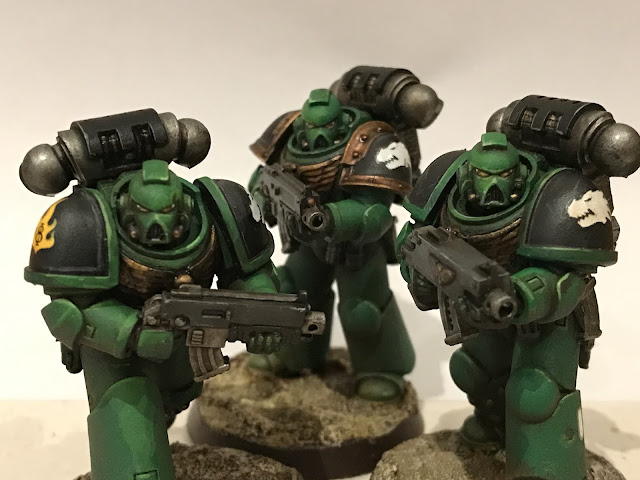
+ All the batch painting has built to a stage where the final details are relatively quick and enjoyable. I've opted for yellow eyes; taking my prompt from the Salamanders shown in Codex: Armageddon. They were painted by painting the lenses Scorched Brown, then blending in Yriel Yellow. +


+ Beyond this, the painting is really limited to developing the gold with a couple of layers of highlights followed by a brown wash; and highlighting the weapon casings, pouches etc. with a mix of black, white and a touch of dark brown. Finally, I used a dilute combinations of Moot Green and Warpstone Glow in various proportions to add some highlighting to the green armour, particular around the head. +


+ They've come together rather nicely, I think – I'm very pleased with the results, and think they fit well with my conversion (at the back). +

+++


Monday, August 14

+ inload: Dust of Armageddon markings +

+ Salamanders 2nd Company markings +


+ Work in progress – it seems a long time since I've been putting paint onto models, but it was a welcome return. +

+++

+ 8th Squad, 2nd Company +


+ As you can (hopefully!) see, the models are getting close to being finished. It's been a very different set of techniques to my usual process. Not sure I'd do everything this way, but it's nice to expand my repertoire. +

+ Although it's been a long time since I started them, the actual painting process has taken very little time indeed – though as always, the devil's in the details, so I won't make any promises on when the final touches will be in. +

+++

+ Combat squad 1 +


+++

+ Combat squad 2 +


+++

+ 4th Squad, 2nd Company; and Lieutenant +


+++

+ Markings +

+ The Salamanders' lore is not always entirely clear. Always a bit more nebulous than other First Founding Chapters, what little there was has been partially overwritten by info from Nick Kyme's Black Library books, which itself has only been partly incorporated into the GW books. This is nothing new – nor is it a problem. While there's some security to be drawn from following a clear set of rules in terms of markings, such rules are always subject to the vagaries of time and chance – what was de facto correct in previous editions can easily be swept away. For that reason, I prefer to regard GW's info on markings as 'correct for a point in time', rather than immutable law. That allows you to nod to existing rules (great if your group lean more towards canonicity and pseudohistorial gaming) while also giving you a bit of freedom of expression. +

+ Ultimately, the lore can change, and your models will likely outlast it! FOr that reason, if nothing else, never compromise on making and painting your models to suit your taste first and foremost. +

+++

+ The vagaries of the Salamanders' background does extend to its markings, but as of the 8th edition Codex supplement, there is at least a big block of info, though a deep dive reveals a few awkward gaps. Despite having quite an unusual structure (seven companies of 120 or so marines each) and a number of practices that are decidedly non-Codex, it's sometimes referred to as a Codex Chapter – although perhaps this is an out-of-universe misunderstanding of the Codex Astartes. +

+ The Codex Astartes is essentially a 40k version of The Art of War – not the rigid list of strictures and dictates in which it's portrayed in memes, but rather an expansive and open treatise that has multiple interpretations. In this way, then, the markings we see below can be seen either as very idiosyncratic to the Chapter – and perhaps providing inspiration to their (thin on the ground) successors; or can be seen as a very clear example of Codex-approved markings. The iconography of the Salamanders, therefore, is very much an example of how you wish to interpret it – and this is what I mean by correct for a point in time. There are a couple of slightly contradictory statements in GW publications about the Salamanders' organisation, but we can square that circle by picking one and saying that this is the one that's true during the  Second Battle for Armageddon. +

+ Basics +


+ In terms of the nuts and bolts of the markings, the squad markings are shown above. These show the eternal flame and the squad number or sigil enclosed in the flame. From left to right above is a marine of the 4th Squad, Second Company; a Lieutenant of the Second Company; and a marine of the 8th Squad, Second Company. +

+ Here we see the deviation from the Ultramarines' Codex structure, as the 8th squad in a Battle Company would usually be a designated Assault Squad. For the Salamanders, it's another Tactical Squad. +


+ The left pauldron bears the Salamanders' Chapter sigil: a head of their namesake. 
The white icon on a black field is what denotes them as being Second Company – the black field marks them as being part of a Battle company, and the white specifically refers to the Second. +

+ Variation +

+ When working on an army, you'll often find some models that – for one reason or another – just don't work with the decisions you've made. Happily, 40k background often owes as much to mediaeval pageantry as modern military strictures, so you can happily play it by ear. Try to ignore the nagging voice that says 'this marking should be in this place' and picture yourself being attacked by the model – does what you see announce your attacker as belonging to a particular group? If so, job done. +

+ You can be as consistent or varied as you like. Personally I like consistency in a Chapters like Ultramarines, but for the Salamanders, who have a proud tradition of making their own personal wargear and armour, there's a good argument for variation for variations sake. +

+ Here, this sergeant has a studded left pauldron, leaving no space for the Chapter icon. As a result, it's been moved to the right pauldron, booting the eternal flame symbol to the lower right greave – my thinking being that this allows friendly forces to still identify who the marine is. +

+ Since the squad number would often be unclear, I kept it on the pauldron – you can just see a small white numeral at the front of the pauldron. This is a good example of making a virtue of seemingly contradictory information, for this approach is that presented in the Badab War Imperial Armour books. +

+ This in turn offers a nice narrative twist – we might say that this marine is a veteran of the Badab War campaign, recently promoted to lead his own squad; and granted leave to retain a previous campaign's iconography as a mark of respect to fallen brethren. The Codex, after all, suggests changing markings between conflicts to confuse the enemy... and so it all ties off nicely. +

+++