Showing posts with label Titans. Show all posts

Monday, March 30

+ inload: Personalising your Titans – crew and structure +

+ Crewing a Titan +

+ A Titan is crewed by its Princeps and Moderati – but who else is involved; and what do they actually do? Today's inload investigates what's actually going on inside a Reaver Titan, and how you can use the info to help create fun narratives for your games or force background. +

+++

Scry-chronicle pre-mission datasquirt: {authval: Sensorius-principal Ossteon}

Validity: {principal >14% accur.}

+ Thought for the day: Knowledge is power, guard it well. +

Mission parameters:_________________________

+++


+ Nuts and bolts of Titan crew +

Prior to the 2018 release of Adeptus Titanicus (AT18), the background about Titan crews was fairly thin. Jervis Johnson's original 1987 release (AT87) had this to say:


The core concepts of Princeps as the commander and Moderati as support have held true ever since, even if the atmosphere as a whole has become more bound up in mysticism, doctrine and so forth.

The new rulebook expands considerably on this, with these rather lovely blueprint-style plates that inject some nice pseudo-realism into the game.


These are riddled with fun stats like the Titan's resting height (25.21m for the Mk XXIII Koron-Valerius configuration Mars-pattern Reaver Battle Titan) as well as naval-style berthing gauge, and more sci-fi stuff like reactor output and anima integrity; all intended to give us a sense of the universe as well as a bit of concrete info.

I'm pleased that the stats are tied to this very specific type of Titan, so there's still wiggle room for making your own stuff – to justify, for example, why your Forge World's particular pattern of Titan is slightly taller or shorter.

For the sake of the inload, the bit we're interested in is the Conventus complement or crew. For this Reaver, we're told it's as follows:

  • Crew: 4–8
  • Clade: 9–17

While an update to the original background, it's nice to see that the old material is still valid – the Specialist Games studio (and GW in general) is pretty good at sensitively updating material like this to expand upon, rather than overwrite, older background.

As we'll see, there's lots of info to get our teeth into, but there's also a lot of freedom in interpretation, so however you like your Titans – as walking battleships with a central voice of command, or as enormous robo-jockey battlesuits – there's a way to bring your vision to the table.

+++

+ Crew of the Reaver +

Delving deeper into the image, it reveals where this crew are placed in the Titan, and gives us their names.

  • Armoured Head – Princeps and two to five Moderati; presumably the variance depends on the pattern and specific Titan.
  • Limb weapon mounting point(s) – Weapons moderati
  • Plasma Reactor – Tech-priest
The Clade is also explained by the Plasma Reactor – these are the sort-of human Servitors that enact the crew's will. 6–14 are noted as being housed in the Plasma Reactor, and this is the evidence for suggesting that the Tech-priest is formalised as part of the crew, rather than the 

Incapable of independent thought, servitors simply follow the orders of the crew, and presumably help to ensure general systems like the shield projectors or stabilisers are operating smoothly, so the Tech-priest and Moderati can concentrate on the important stuff which requires independent thought.


The numbers in the image above need a little detective work to make sense. With a Clade of 9–17, but only 6–14 in the plasma reactor with the Tech-priest, we're short by three. With three primary weapons – one on each arm, and a third on the carapace – I think it makes most sense for the missing servitors to be assigned to primary weapons, and stowed in either alongside the Moderatus in individual gunnery command chambers, or (depending on the specific type of Reaver) perhaps in the weapons or mounted within the walls. I imagine some Forgeworlds are more or less concerned with the servitors' dignity!

An alternative – and remember, this is all informed guesswork – is that the missing three servitors could be accounted for as gunners for the automated defence weapons, be patrolling the deck as combat servitors, or pretty much any other task you'd like them for in your Titan.

+++

+ What do the crew do? +

The names of the crew are a mix of High Gothic cod-Latin and naval/military terms, which means that we can make some educated guesses as to their roles and duties.
  • Princeps
    • Perhaps the easiest to define, and certainly the most explored in the background, is the Princeps. This crew member takes the role of the ship's captain, and is also the one who has the most direct and deep connection to the Titan; feeling its body as his or her own.
  • Primus
    • This rank is in Betrayer, the Primus is seemingly reponsible for actioning the Princeps' orders; covering movement and aiming and firing the weapons.
  • Steersman
    • From implication, the Steersman is in charge of directing the Titan's movements; maintaining a course and speed.
  • Navigator
    • ... and the flip side of the Steersman taking you somewhere is the Navigator showing the Princeps where they need to go. In the context of 40k, Navigators are usually a special abhuman, but here I think it's most likely a more mundane map-reader and person in charge of analysis.
  • Sensorious
    • We can interpret this as someone in charge of the Titan's sensor array – something akin to a real-world officer in a naval operations room, in charge of identifying threats and hazards through 'spoor', the 40k equivalent of radar, sonar etc. 
    • Pleasingly, the sensorium is also a biological concept; it's the part of the brain that receives and interprets experiences – which is very on-brand for a 40k Titan.
  • Oratorius
    • With heavy Classical/religious trappings drawn from orare ('to pray'), the Oratorius can be interpreted as being in charge of that very 40k-coded mix of militarism and mysticism; so having some role to do with channeling and placating the Machine Spirit of the Titan and guarding the spirits of the crew. 
    • Alternatively, we can draw the origin of the rank from Oratorio, which is a musical term, suggesting this Moderatus orchestrates everything; making sure all the crew and systems are working together.
  • Weapons Moderati
    • Fairly clear here, I think. A Weapons Moderatus is in charge of a particular primary weapon.
  • Tech-priest
    • The other easy one – or at least a more well-documented 40k role – the Tech-priest in a Titan is in charge of the Servitor clade, monitoring and overseeing the plasma reactor, and directs repairs. He's the chief engineer, but with a heavy coat of religious paint.
In some background it's suggested that the Princeps controls everything that the Titan needs to do actively – movement, weapons and so forth. This relegates the rest of the crew to support roles. In other bits of background, we have the Princeps operating more as a directing force; so they order the Moderati to fire the weapons or increase the Titan's speed, for example – but it's the Moderati themselves that action things.

If you prefer the former, this makes having a crew on the smaller end much more sensible: one Princeps supported to two Moderati. If you prefer the latter, it makes more sense to have specialist Moderati directly involved in aiming and firing the guns, or moving the Titan's legs. And of course, you can happily blur the roles a bit: the Princeps deciding all the Titan's movement, for example, but the Moderati actually enacting things.

By terminology (and the appearance of the 'Secundus' rank in Betrayer), we can take the Primus to be the second-in-command – a 'Number 1' that's a senior Moderatus. We're told that Moderati are effectively Princeps in training, some (but not all) of whom will one day ascend to command a Titan of their own. You can decide how formal you want your Legio to be; and having titles like Primus are one way of showing it.

As a third option, it's notable that the 'gunnery command chamber' listed is singular, so all the weapons Moderati and our missing servitors could be grouped together rather than in individual little 'bubbles' for each main gun. But that begs a questions – where is this gunnery command chamber, and what form does it take?

+++

+ Where do the crew go? +

Besides the background in the book, we've also got the models to help guide us. The Forge World Reaver Titan is the Mars-Pattern, and that has the Princeps and two Moderati in the head...

+ Pict-capture from Games Workshop – used without permission +


...while under the carapace you'll find a Tech-priest and three servitors embedded in the walls and ceiling. Bafflingly, GW have precisely zero pictures of the Reaver interior on their website, but you can can see some great shots of the interior built and painted by Goddenzilla at their blog Kaiju Country [+noosphericexloadlink embedded+].

What can we take from this? At face value, that the Mars-pattern Reaver sits toward the lower end of the crew complement outlined in the rulebook background. Given that the Clade is represented by just three visible servitors, however, rather than the minimum of six, we should probably assume that the model doesn't quite reflect the in-universe reality – so it's entirely possible that there are more Servitors and possibly Moderati in other parts of the Titan that simply aren't shown/modelled.

+++

+ Rivet-counting +

For explorations of the 'fuzzy edges' of 40k like this, I've always leaned towards the 'yes, and' principle. By that I mean that while there's often an answer within the 'official' background, there's lots of room for interpretation and variety. 'Yes, Mark II power armour has a fixed helm – and there are some variants that have a mobile helm'. It allows people to point to particular details and stick closely to 'the canon lore', but also allows for updates, retcons and good old fashioned exploring and creativity.
Do Reaver Titans have the Princeps and two Moderati in the head? 
Yes, and some also have more Moderati elsewhere as well/this Legio has all the crew in the gunnery deck/this pattern only has the Steersman there/this particular Titan crams seven crew into the head.
You have a lot of freedom. While Titans can be identified as different types, they are ritualised and individual creations – so their creation has as much in common with a church or temple as with, say, a tank or car.

Churches of a particular era can be identified by being built in a cross shape, and will have an atrium, an apse, an altar etc. – these are the things that make them a church building rather than, say, a town hall – but there will also be a lot of variety in the specifics. The point is that they're individual buildings, and not mass-manufactured.

Likewise a Reaver can be identified by certain elements: being broadly human-shaped, having mounting points for three primary weapons, broad scale (covered by the in-universe term Immensus), and having a machine spirit that can be interacted with by the Princeps. The finer details – berthing gauge, resting height, reactor output etc. – will vary depending upon the particular Forgeworld, time and circumstances of its creation. This extends to the crew compartment, and thus the crew.

On top of that, besides the design of the individual Titan, the Forge World's, Legio's and crew's cultural and societal idiosyncracies, beliefs and ranking systems will also differ, which means that there's absolutely no reason why different Titans of the same type might not have different crews for various reasons. 

+++

Back to the crew. What does this variety mean for our hypothetical Reaver crew? Well, all Reavers must have a Princeps, and must have a Tech-priest, and must have at least two Moderati. Beyond that, you've got a lot of flex.

Even within a Titan Legion, different Titan patterns and variants exist. Mars- and Lucius-pattern Titans might serve together as the result of ten thousand years of war, alliance and trade, and there are presumably lots more patterns of Titan, some of which might cram all the crew into the head; others of which split them between the head and a gunnery deck; and still others might have the crew elsewhere. 

AT87 made this explicit, with the 'Deathstrike head' variant. This replaced the head entirely with a giant gun (Jes Goodwin clearly channeling his inner Mekaniak with this design!), and moved the crew to a fire control platform or tower:

Incidentally, it's my guess that this concept of a giant centreline gun with a viewing platform served as part of the inspiration for the new Warbringer-Nemesis Titan.


The variety of heads Jes designed suggests that the GW design team left lots of design space open on what exactly was going on in a Titan's head. The Command and Custodian Heads (top left of the picture) suggest a mobile command and control centre, perhaps with more space for Moderati – these would be a great head to use as inspiration if you want lots of Moderati there. I can picture a two-tiered bridge-style interior, with the Sensorius, Oratorius and Princeps on one level, and a Steersman and two weapon Moderati on the next level down.


The weapons heads – particularly the close combat and Corvus assault head – would suggest that the Princeps and Moderati were tucked away elsewhere in the Titan, on a separate command and control deck, so this concept might be your choice if you prefer a naval-style 'ops room' to the more common pilot-style approach.

(The design, of course, suggests that – but doesn't insist upon it. You're quite welcome to have your Princeps and Moderati perched above a chainblade if you wish! That mix of reverence and danger is very fitting for the insanity of the 41st millennium).


+++

+ Conclusion +

Much of this is my speculation, and its purpose is to spark some ideas for you to help design and explore the crew of your Titan.

The point that I'm dancing around is that you can have a very rigid and structured system for your Reaver (and other Titans), or a very freeform one. Like much of 40k, you've got the whole gamut of sleek Star Trek-style sci-fi right down to techno-barbarian thugs following through with blood ritual, taking in hooded monks guiding their titan through organ-style keyboards, amputees in fluid-filled tanks, fighter-pilot style charmers and much, much more.

Keep your inload-port cycled open, as I'm planning to use the info and ideas above as a way to explore a Reaver crew of my own devising – to show how this all works in practise, and how we can apply it to  making fun models with a bit of story behind them.

+ Cue 80s montage music +

+++

Monday, March 2

+ inload: Adding character to your models through customisation +

+ Raising a God-Engine +

+ Evoking character through customisation +


+ A hobby-horse inload today, on why making your models your own matters – and some ideas for where to start. +

+ While the principles can be applied to any model, I focus here on a Titan for three reasons. Firstly, they're lovely big centrepiece models. Secondly, they can be intimidating to adapt; and thirdly, because I haven't done any Adeptus Titanicus stuff for a while, and it's nice to show off work you're proud of! +

+++ 

+ Theoretical: Why modify the basic kit? +

Model kits are designed to be built a certain way, and anything you do to make your version stand out can help to add interest and impact to the model. Since both tabletop wargaming and painting for display imply some form of social interaction or having an audience, modifying and customising your kits is a great way to make your stuff stand out. Vive la difference!

You might do this purely for functional reasons – the tournament you're attending requires you to build and paint models rather than use paper stand-ins, perhaps; you might do it for your own pleasure or as a challenge; or you want to demonstrate your skills and imagination to other people – or just yourself.

In all likelihood, the impetus to modify your kits is driven by some combination of the three. And in turn, how much time and effort you want to put into converting and customising is down to your taste. Here I'll outline a few starting points.

+++

+ Practical: Where do I start? +
First things first, if you paint your model after assembling it, you're already modifying the kit. There's nothing inherently scary or intimidating in personalising your work, so we can get over at least that hurdle immediately.

+ Posing +

There are lots of simple ways to make your models your own. Perhaps the simplest is reposing it. For some kits – like this Warlord – reposing is easy, as all the parts are separate. This is both a blessing and a curse for personalisation: it makes things easy, but as variation in pose is baked-in, it's that much harder to make a pose stand out – after all, every version of this Warlord kit will be slightly different, even if you opt for the 'factory standard' pose.

I've exloaded before about reposing Titans (go check out this article about reposing Reavers' legs, hosted on Maximal Fire [+noosphericexloadlink embedded+], for example) so suffice to say here that (with fully-posable models) taking your time to consider the pose you want and executing it carefully will go a long way, while physically modifying the kit can further emphasise your customisation. 

+ Re-posing +

The feet on this Warlord are single-piece, and so the relatively simple job of trimming off and refitting the toes at angles here adds to the sense of weight and ponderous movement.


Changes like this – that require physically modifying the base kit – are what's normally considered conversion, and it's one step on from posing.

The big hurdle for trying this is psychological. Trimming or cutting into a piece to modify it from how it was designed is stepping into terra incognita – but fundamentally it's the same skillset as trimming something off the sprue and assembling it as intended. If you can do the latter, you can do the former. 

Again, having a strong idea of the pose and effect you want before you begin is important. A strong plan will help you – but don't let planning paralyse you. Trust your skills and give re-posing a go.

For kits that have a single set pose – tanks; the more modern 'multi-part but fixed pose' infantry from GW; old-school one-piece metal figures etc. – your effort is more immediately obvious, and you need do less to make your model stand out.

+++

+ Kitbashing +

Posing and simple conversion work will add a little character and personality to your model, and that's just while sticking to what's in the kit. Once you go beyond that, you can bring in extra parts from elsewhere.

Using parts from one kit to alter another is called 'kitbashing' – and it's distinct from conversion in that the parts are usually broadly compatible, and require little or no modification to do. Things like swapping heads from one kit to another are classic kitbashing, but it also applies to bringing in third-party bits, like the gun – or indeed head and armour plates here, all from Battle Bling [+noosphericexloadlink embedded+].


+ Conversion +

Throwing money at the problem isn't necessary – and while it's lovely if you can find a third-party element that you really love, functionally such changes are replicable. If you're looking for a genuinely unique custom job, then you can combine the skills from kitbashing and re-posing to make your own parts from others – or from scratch.

This graviton cannon combines a modified Taro Modelmakers [+noosphericexloadlink embedded+] part from another scale (a 40k Knight) with some spares from the leftover Warlord armour plates – keep useful looking bits in your bits box!

+ Basing +

A good base is a key part of creating a sense of belonging to a particular setting or place, and will help to (literally) ground your model. A few scattered additional bits and pieces here (from Varus Miniatures  [+noosphericexloadlink embedded+] and Battle Bling again) create scale and enhance the character of the piece. Wordlessly, the fact the figures are facing in the same direction as the Titan suggests they're allies – it really can be as simple as that.

It's also a great example of narrative and story. Anything that you can do to grab the viewer's attention is worthwhile – but holding onto that attention relies on you respecting the audience and giving them something involving. Include some details that reward lingering on your model, that make the viewer ask what's going on – it's more rewarding for both your and the audience.


+++

+ How far? +

This, of course, is up to you. Changing your model to better reflect the character you've come up with can involve complex or complete resculpting – either traditionally or with CAD and 3D printing – but it can be as simple as making a minor tweak. 

Neither approach is 'right', but I tend to find the more effort I put into a piece, the more I feel connected with it, and that is always a win. After all, you spend a lot of time and energy on these models, and they'll last as long as you want them around.

Give yourself a break if the result isn't perfect first time – refinement will come with practise – and ultimately, you only need to please yourself.

With all that said, I think you'll find that developing the character of your model, planning out how you'll execute it, and giving it a go is very rewarding indeed. Good luck!


Wednesday, April 23

+ inload: Bloodsong goes public +

+ Bloodsong complete + 

+ Free Adeptus Titanicus expansion with rules for Eldar Titans and Ork Gargants +

+ No time to waste? Just need the Google Drive link? +
+ Manifold access, my Princeps: [+noosphericexloadlink embedded+] +

+ Command new forces; engage new enemies! +

+++

+ Changes and updates +

... and now that everyone who just wants the free Bloodsong expansion has blithely closed this noospheric node, those that remain suckling on the datafeed can enjoy the inner secrets of the project.

Way back in 2018, shortly after the release of the new Adeptus Titanicus, I (rather fatefully) wrote:

I'll preface this by saying that these rules are only intended to tide players over until we get some official rules.

Well, seven years have passed, and not so much as a squeak from Games Workshop on any official rules for Eldar and Orks, so since 2023 I've been tinkering away on creating a full print-ready expansion for the game so xenos enthusiasts and those looking for a new Open Play challenge can get involved. 

The result is Bloodsong, which has gone through nine 'alpha' iterations, being playtested and tweaked in a small pool in various back rooms and on the + Death of a Rubricist + Facebook group (thanks for all feedback thus far!). It's now complete to the point that it's ready for more broad distribution, with everything from custom Command Terminals and Weapon Cards to instructions for how to print the 50pp booklet to the right size. Perhaps most importantly, it explains how to use the supplement with the official rules to create all-Eldar or all-Ork forces.

For anyone who's already been using the supplement, this new public version includes the following improvements:

  • Practical additions: 8 Maniple equivalents – 4 each for Eldar and Orks.
  • Extensive improvement and refinement of the Ork section, polishing it to match the Eldar. Clarification of suggested base sizes and conversion ideas for Gargants.
  • Mega Gargant rules clarifications.
  • Useability improvements: a table of contents, 'How to use this book' and development notes throughout.
  • Single page formatting (view it on Acrobat in two-page view with cover page)
  • Terminology tweaks – the Wraithtension table had started to annoy me, so it's now the Wraith Matrix table, which feels a bit more 'Eldar' to me.
+++

+ Find new enemies and allies for your Imperial and Traitor Titans for Open Play Titanicus! +

+ What's next? +

Next, I hope, is for the supplement to get more feedback from other gaming groups, which will help to tweak and adjust the points values to make for more fun and exciting games, and highlight any glaring clangers I've made.

Besides the nuts and bolts of the mechanics, my next priority is improving the look of the layout by adding some artwork and more background material: example Titan/Gargant pictures for the maniple equivalents, nicely styled in-action battle pictures, and some design flourishes to make it as professional as possible – I've been aiming to make it as user-friendly, polished and attractive as I can.

If you can help – either by supplying pictures of your own models, or suggesting artists I can ask, please do let me know in the comments, either here on the blog, or on the Facebook group – or through the Google Drive link:

+++

+ Tell me more! +

Glutton for punishment, eh? Want to know more about the process and past development? By using the [+insphere contentsieve+] at the top right of the page, you can search for Titanicus and read through all the various changes and designer's notes – here's a good start, if you fancy looking at the philosophy and process behind the project [+noosphericinloadlink embedded+].

+++

Wednesday, March 12

+ inload: Cassus Belli, Imperator Titan +

+ Cassus Belli, Imperator Titan +

'How like a god he is, that ancient machine, primal of his kind, the Imperator! His mighty fists, massive like two towers of destruction, laden with the doom of mankind's bitter foes. He watches over us now as battle joins, and in his shadow we shall advance upon our enemies and defeat them.'
+++

I have very kind and generous friends, and Lucifer216 is the master of artifice that has granted the Legio Metalica this magnificent creation. Even bereft of his upper towers, he's the biggest model I've ever worked on. He was 3D printed and given to me assembled, as shown:


... which meant I had little to do in terms of construction beyond a little gap filling. For this I used greenstuff, using the blade end of a modelling tool to cut and place small strips, then the blunt end to smooth and shape it.


The cold, hard, unforgiving light of day shows both the results of my cack-handed efforts, and some of the minor print damage. The material is pretty sturdy, with some flex, but the detail on the digital sculpt is perhaps a bit fine to translate well – this is the reason the towers are missing too: Lucifer216 found that the filigree of the stained glass windows simply didn't print well.

He's suggested substituting the towers with the Civitas Imperialis spires [+noosphericexloadlink embedded+] from the Titanicus range, which I think's a great idea.


This rear shot shows the repairs made to the plasma reactor breach. Note I've left the gap in the doors; it just seemed fitting – a  good space for a techpriest, perhaps? [+noosphericexloadlink embedded+]

+++

+ Painting +

There's no avoiding that this is a huge model, so I thought the best bet was just to get stuck in – otherwise he's going to lurk intimidatingly forever!

He's received a black undercoat, followed by brown and red zenithal sprays.


A scale shot to show the size of the beast:


Thursday, January 30

+ inload: Varnish, transfers and acrylic paint +

+ Heraldry and battered metal boilerplates +


+ The casting of propitious runes and god-engineering stumbles onwards as the time creeps closer to the Beachhead deadline. Today's inload looks at transfers on Titans, including bimblings on varnish. +

+++

+ Titan Maniple +


They're getting there. Slowly but surely, every day brings completion that little bit closer. I just hope it's in time! One weekend and sixish evenings to go, and still plenty to do to get them as I want.

With that said, they're at least playable at this point, so let's push panic to one side and enjoy the last steps. This inload [+noosphericinloadlink embedded+] has struck-through text to indicate which steps I've completed since then, and as you'll see it's mainly the banners left to go – though those will be finishing touches done after the oils washes are in place.


+ Transfers in place on the shoulder, ready to be softened in and integrated. +

+++

+ Adding transfers: theoretical +

I've used transfers here and there on different models and units, but generally prefer to freehand markings, as I enjoy the focus it brings me. For this project, however, I wanted to shake things up and try something new – and combining transfers and oils is something that I've rarely if ever done.

Having decided I was going to do it, I then needed to choose whether to use the iconographic or hyper-realist designs from the Metalica transfer sheet. I was really torn on this. On the one hand, the simpler icons seem more akin to practical markings to be used on an engine of war... but the more complex, detailed versions are more akin to devotional artworks that might appear on religious icons.

Since a Titan blurs these roles, I decided that it made sense to use the simpler stuff for more practical purposes: squadron marking and faction equivalents, which would be consistently placed lower down the Titans, so allies can quickly assess things in the fog of war. More complex, realistic artwork would be reserved for higher up the Titan, where such finery primarily serves decorative and heraldic purposes rather than practical ideas.


+++

+ Adding transfers: practical +

The process of getting transfers on is fairly simple:

_i +Preparation+  Paint your model to a finish you're happy with (e.g. highlighted and shaded).

_ii +Protect+  Apply a varnish – I used Winsor & Newton Professional spray varnish (matt finish) [+noosphericexloadlink embedded+]. Gloss is probably better for this stage, as it creates a smooth, glassy finish that means the transfers lie as flat as possible. However, I didn't want to splash out for a second can of varnish, and I want a matt finish eventually.

_iii  +Wetting+  Cut out the transfer (including the backing) and dip into the water pot. Let it get soaked, then place it on your palette while it loosens itself from the backing.

_iv  +Solution+  Use a brush to paint Microscale's Microset solution [+noosphericexloadlink embedded+] over the area you want to apply the transfer.

_v +Placement+   Bring the transfer and backing up to the area, and use a clean damp brush to gently slide the transfer across into the correct position. Try to avoid any bubbles.

_vi +Patience+   Allow to dry thoroughly. The transfer will now be in position, but will look glossy and the edges will often be obvious.

+ Transfer in place after stage vi – note the reflection of the light, and the circular shape of the transparent backing. +

_vii +Repetition+   Apply a second coat of Microset, working outwards from the centre of the transfer, and leave to dry. The solution softens the transfer and helps it adhere to the surface.

_viii +Integration+   Once completely dry, use a clean brush to apply Microscale's Microsol solution [+noosphericexloadlink embedded+] over the transfer. This partially dissolves the transfer, helping it to settle onto the surface and look painted on.

_ix +Sealing+   Once that's completely dry, apply a second coat of W&N spray varnish, and allow to dry to finish.

+++

+ All over bar the shouting +

That brings us to this stage (well, step 8), and as you can see, the transfers now look more settled in. Of note here is the effect that varnish has on the metallics – the matt sheen kills the reflectivity of the metallics. The result's not unpleasant, but it's worth bearing in mind if you've spent ages working on the metals. For these, they've deliberately been left as basecoats so that I can develop them later on.


It's worth noting that transfers and freehand painting aren't mutually exclusive, and nor are you restricted to the designs on the sheet. The example above is a very simple example of this – before the transfer on the left knee (right of picture) was applied, I painted on a yellow circle that would fit within the cog shape. Since part of the transfer is clear, the yellow shows through and looks like an integral part of the design.


Key to my plan is that the designs evoked (or even matched) the original inspiration – another reason why I went for the simpler, more iconic designs from the sheet for these parts.


For the larger areas on the Warlords – the big shoulder plates – I've instead gone for the more detailed versions. Still in two minds about the decision, but he who hesitates is lost, and all that. Steel Hammer, above, has this large Legio symbol on his shoulder, and a similar variant on the other side.


Old Three Skulls, being rather larger that the original, has received some additional nods to his name – a trifecta of skulls on the shoulder in the same arrangement as on the original's weapon banner, and three smaller yellow skulls running along the cockpit.

+++

+ Painting nameplates +

But it's not all transfers. I've also been doing some building and painting. First off, I built Fors Clavigera an alternative missile launcher to better evoke the Barrage Missile Launcher of the original.

The old models used the same weapons for carapace and arms (rather than having specific mounts for each), so as you can see below it's quite ungainly. I wanted to ensure it evoked the idea of the original, while having a similar feel to the other modern weapons.


I built it with a bits box dive. At the base is a magnetised Apocalypse Missile Launcher connector, so I can still swap it out if necessary. The mounting is from Battle Bling, and the larger parts are from the new Imperial Guard big artillery piece – one of the super-lascannons. This was trimmed down and carved into a shape to evoke the original. 

The upper armour is from a Reaver Power Fist – I cut the central part away and married them together, while the part with a cable near the front is a Reaver close combat weapon upper arm. Finally, the missile piece itself is a Leagues of Votann (new squats) piece, given to me by TrojanNinja (thanks!).


I sprayed and basecoated it, then popped it in place to see how it looked. You decide – does it look about right?


Elsewhere in the maniple, Praeterita Carnivorus (Carnivore to his friends) has had the armour and lenses of the cockpit painted, ready for oils and trim:


You'll also note here that I opted to add a yellow transfer rather than paint his groin completely yellow (as in the original). Just like the alterations to the carapace stripes, I thought this was a better, less distracting compromise between the original and the retrohammer remake.


And I also spent an enjoyable few minutes painting the chequers on Old Three Skulls' Power Claw:


This involved little more than thinned Scorched Brown paint, a fine-pointed brush, and time. I'm still in two minds on whether to continue the chequers over the 'knuckles' or not. What do you think?

+++

+ Painting nameplates +

I also started putting the base paint down on the nameplates. These are from Obsidian Forge [+noosphericexloadlink embedded+], and will sit on the magnetised terminals that I made for the force, so it's easier for both me and the other players to track which Titan is which.

The first stages I've taken to paint them are:

_i  Apply a brown undercoat – this gives a nice warm undertone.
_ii  Stipple Balthazar gold over the whole surface. Make sure you get a nice thin coat over the whole surface, including in the recesses within the text.
_iii  Work Seraphim Sepia wash into the recesses, leaving large areas clear.

+ End of stage _III +

More to come soon!

Thursday, January 9

+ inload: Metalica plans and preparation +

 + Toll the great bell once! +

+ Painting progress +

+ Sound the chime to rouse the Machine Spirits to wakefulness! +

+ I'll need to come up with a suitable Maniple name... +

When I decided to paint a new Titan maniple for the Beachhead event, I was aware that it was a pretty big task, and so it's proving! So... much... trim. 

The good news is that I'm finally getting to the end of the base painting. This has involved lots of subassemblies, of which I'm thoroughly sick; and so it's been a welcome milestone to be able to glue the [+SCRAPSHUNTERRORABORT+] things together at last, resulting in what you see here.

+++

+ Painting plans +

+ Here's my plan for getting these over the line. [+APPENDEDIT: I'll  be striking through bits that have been done since this inload was initially posted, so you can see my progress. +

_1  The next stage for all of them will be adding the black stripes to the white plates, and add some highlights and initial shading to the base coating. This will include panel lining, where appropriate. I'll use a purply-brown for the red, and a blue-grey midtone for the white.

Trying to visualise the eventual colour balance is a bit tricky – I know the oil washes and varnish will mute the colours somewhat, but I'm still having to force myself not to grime things up at this point. For this reason, the highlights probably need to be a bit brighter and pinker than looks right – as the yellow-tinged glaze/filter will warm it back up and bring it back to a neutral red. That's the theory, at least.

_2  After that, I'll add the transfers. Once those are in place, I'll varnish to protect the transfers – I'm still undecided on whether to use brush-on varnish to topically protect the transfers, or an overall spray.

_3  After that, we're onto the oils. My plan is to use burnt umber and raw sienna to bring some warmth, richness and visual texture to the large flat plates, and help the transfers sit in.

_4  I'll then switch over to the additional bits and bobs, so the oils have plenty of time (ideally a week or so) to dry/oxidise. These additional bits are:
  • Titan banners (between the legs)
  • Weapon banners
  • Terminal name plates – courtesy of Obsidian Forge [+noosphericexloadlink embedded+]
  • Three objective markers for primary missions: Secure and Hold and Salt the Earth
  • Three objective markers for primary missions: Asset Protection and Defend and Extract
  • Titan Honour Banner for primary mission: Honour thy Forebears
  • Two markers for secondary mission: Deny Them
  • Three markers (one Primary, two Secondary) for secondary mission: Glory and Honour
  • Six markers (one Shield, one Spear, two Alpha and two Beta) for secondary missions: Priority Assignment and A Matter of Honour.
_5 Polishing up the detail. This is basically everything else – but given a lot of the weathering, detailing and so forth will have been done previously, this should (touch wood) mainly involve polishing up the bases.

Quite a lot to do... Pass the brown paper bag for hyperventilation practice! I'll have to have a think about how I'll do the various markers.

+++

+ Specifics +

+ For quick reference and as an aide memoire, here are my notes for what specific details each Titan needs. +

This retrohammer project is an affectionate update, rather than a direct translation. As noted in earlier inloads, some of the weapon loadouts are now illegal or non-existent, so I'm having to make some concessions to modernity. The same will apply to the details of the painting. I want things to be recognisable, but also to take advantage of the larger, more detailed models. To that end, I'll be adapting bits here and there – these notes should flag the sort of decisions I'm making.


First up is Steel Hammer, Titan of Princeps Prime [sic.] Kurtiz Mannheim, who carked it during the Second War for Armageddon (whisper it low, but these are 40k-era Titans sneaking into a Heresy event).  As the only Titan without a studio equivalent, I've got a lot of freedom here. 
  • Black chevrons on shin, stripes on shoulders and above head.
  • Update left arm weapon – and redraft list! Shave points to bring in plasma?


Carnivore has had a name tweak to Praeterita Carnivorus. Evocative of the old name, but with a bit more over-the-top pomp and grandiosity of the modern game, it translates roughly to 'Past Carnivore', or 'Carnivore of things past' – a pun I couldn't quite resist. It's also a reference to the Victorian-era polymath John Ruskin, for reasons I'll expand on below. Praeterita was a sort-of biography; an elegy of a lost past – which seemed a fittingly pompous adjunct to this backward-looking project.

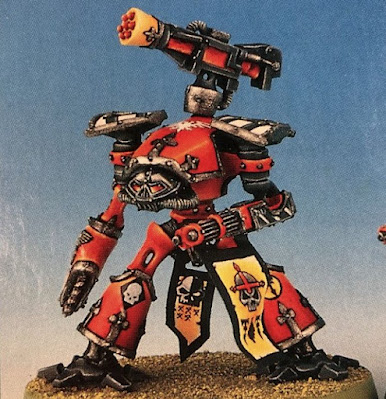
Here's the inspiration:

  • Paint left pauldron red.
  • Black chevrons on right pauldron.
  • Update right arm to laser blaster.
  • Black diamond and skull on right knee.
  • Black Opus Titanica symbol in yellow circle on right knee.
  • Yellow striped carapace – though I'm tempted to make this a three-colour stripe (white, yellow, black) to put a bit of space between this and the modern Fire Wasps scheme.
  • Yellow groin – perhaps with black transfer to avoid drawing the eye too much.
  • Titan banner (between legs) – black skull and two small black kill markings.
  • Moderatus banner (left arm): Legio symbol in centre on red field, surrounded by small black icons, surmounted by Opus Machina; all bordered in white and black chevrons.
  • Nail icon to add somewhere, along with reference to Lycurgus and Fortune.


Ferratus Tertius is the furthest along of the group, and has served as a bit of a testbed for things. I'm pleased with how he's coming along, though I am erring towards swapping out the Gatling blaster for something a bit more visually similar to the vulcan megabolter, like Battle Bling's cyclone mega-bolter [+noosphericexloadlink embedded+]. You'll note that I've painted the head white, rather than silver, for increased contrast. Heraldically, I reassure myself, it still reads as 'Iron Skull'.

Ferratus Tertius
  • Black diamond and skull on right knee.
  • Black Opus Titanica symbol in yellow circle on right knee.
  • Titan banner (between legs) – black skull and three small black kill markings.
  • Moderatus banner (right arm): Legio symbol in centre on red field, surrounded by small black icons, surmounted by Opus Machina; all bordered in white and black chevrons.
  • Repaint shoulder armour red.
  • Key icon, and reference to Odysseus to be added.


Fors Clavigera is my modern take on Clavigera/Ferratus Primus, and the reason for the John Ruskin nod. Fors Clavigera is a series of essays he published, which outlined his social economics and proto-environmentalism. 

The reference is the three 'Fors' by which the working man could influence things: force, fortune and fortitude – which are symbolised by Hercules' club; a nail (of Lycurgus – of Sparta fame); and a key (of Odysseus/Ulysses) respectively. 

The names of all three of these items are derived from 'Clava' – and so this is a good example of how you can dive into a cool but throwaway name and invest it with a bit more gravitas (or disappear entirely up your own rear end!). Incidentally, it also means that Clavigera is feminine, making this a God-Engine following the old naval tradition of referring to ships as 'she'.

Of all these titans, Clavigera is the one that I think least resembles the inspiration, and so I'm going to try my hand at converting a barrage missile (as seen below), and possibly replace the gatling blaster with an alternative.

  • Swap upper carapace for red; include white Aquilla.
  • Chainfist to be painted red.
  • Black stripes on shoulders.
  • Black diamond and skull on right knee.
  • Black Opus Titanica symbol in yellow circle on right knee.
  • Titan banner (between legs) – Opus Machina and five small black kill markings.
  • Moderatus banner (right arm): Legio symbol top centre on yellow field, surmounting black diamond flanked by Opus Titanicus symbols; all bordered in black.
  • Club icon, and reference to Hercules to be added.


At the other end of the column is Trismegistus the Great, affectionately known as 'Old Three Skulls', who is simply plodding along.


  • Powerfist to be painted with yellow and black chequers.
  • Black stripes on left shin (after strengthening white field and red trim).
  • Legio symbol skull on right knee.
  • Yellow Opus Titanica on left knee.
  • Titan banner (between legs) – to add?
  • Moderatus banner (right arm): Three black skulls on yellow field with red border.
+++