Showing posts with label Imperial Guard. Show all posts

Friday, January 9

+ inload: Imperial Guard Rough Riders +

+ Steel Legion Rough Rider Brigades +

+ Horses, as is commonly known, are best of all the animals, and fittingly it's coming up to the Year of the Horse. So I thought I'd kick off the New Year with some thoughts on Imperial Guard Rough Riders. Tenuous link? Perhaps, but buckle in for another year of meanderings and modelling. +

+++

+ Rough Riders +

Like psykers, Ministorum priests, whiteshields, and beastmen, Rough Riders are one of those edge units that GW have brought in and dropped out of the Imperial Guard line-up over the various editions of the game – presumably when the designers are particularly enthused about the concept, or a general mandate comes from management. Who knows? 

Likewise these units tend to have enthusiasts, but are less generally popular than things like tanks. The key thing for me is that they lend a slightly archaic, gothic sci-fi feel to the Guard, which can otherwise feel a bit like a real-world army. Nothing wrong with that, of course – that's one of the key appeals to the faction – but I also like the feeling that these weirder elements are in the background.

I've had Rough Riders in various forms in most of my Guard armies, and they were something that I was keen to include in my Steel Legion force, as they appear in the Battle for Armageddon boardgame. However, there have never been Steel Legion cavalry models, and so some conversion/kitbashing would be necessary.

Happily, after a long drought, Rough Riders seem to be back in favour at GW, and there is not one but two plastic kits for horsey soldiers.


+ Theoretical +

I've written about Steel Legion Rough Rider brigades for The Ashes of Armageddon, in this noospheric node [+noosphericexloadlink embedded+] about the 4th Rough Rider Brigade, 'The Forgotten Fourth'. There I've tried to elide the older background with the more modern interpretation of the Steel Legion and Armageddon. The result is that the 'Rough Rider Brigades' included horse-riding cavalry, but were effectively an honorific name, and that the Steel Legion's Rough Rider Brigades were recon forces; the bulk of which were made up of things like Sentinels, 40k-jeeps and mounted infantry.

Part of that was forced by the models I was able to get from contributors – at the time I wasn't able to find any Rough Riders specifically converted to be Steel Legion. Happily, since then some have popped up, perhaps most notably by the absurdly talented Bjarni í Dali (@bjarnidali on Instagram [+noosphericexloadlink embedded+]) – go check 'em out. 

For my take, I was torn between the two current Rough Rider units available: the Death Korps or Attilan. Each had its own advantages. The Death Korps Death Riders (of Death) might seem the more obvious choice: their steeds are clearly adapted to dangerous environments, with rebreathers and goggles, and the riders are in long coats.

However, after a bit more consideration, I decided that the Attilans were a better fit. Armageddon, while unpleasant in the extreme, isn't quite as bad a rad-blasted wasteland as Kreig. The Attilan kit is less distinctive  (and popular) than the Death Riders, it'd be less obvious where the base kit came from. 'Normal' horses also fit my image of slightly retro Steel Legion Rough Rider better.

+++

+ Practical +

Some not-so-subtle hint-dropping later, and I was the happy recipient of some Christmas goodies. After unpacking the Attilans, I was pleased to see that they'd require even less conversion work than I'd anticipated. The boots and long coats fit very nicely with the Steel Legio aesthetic, so I felt all they really needed was a head swap, change of details and some resculpting on the arms.

The Attilan arms come with fur-lined glove/gauntlets and heavy shoulder pads. These could easily be left in place (deserts can be cold, too!), but I decided they'd be relatively easy work to refashion. To do so, I used clippers to cut away the bulk of the shoulder pad (happily, on the side facing the body, you can see the outline of the pad, which makes this easier), then trimmed them to shape with a craft knife.


For the gloves, the Attilan originals are slightly pointed; longer at the bottom at the top. I drew a mark with a blade to give me a line to square them off, then carefully trimmed them back, matching the width of the forearm. The results are the same length as the Steel Legion infantry gloves.


Of course, this leaves a question hanging – what about the heads? 

As the most obvious and distinctive part of the kitbash, I was delighted to find a third party company, Tiny Legend [+noosphericexloadlink+] that makes some great proxies. They have recently started their 'Blitz Legion' line. I'm planning a proper review of their stuff in a future inload, so suffice to say here that I can thoroughly recommend them. Absolutely brilliant sculpts, lovely prints in an excellent resin, and very clever use of a different, slightly flexible resin to allow the chest-mounted rebreathers to marry up with the heads in different poses.


I've finished building a unit of five Rough Riders using bits and pieces, mainly from Tiny Legends' Blitz Legion Sergeant Retinue, which comes with lots of options for arms, heads and hands.


So, nice and quick and simple! I've based and primed these, and hope to be splashing some paint on them soon.


Thursday, September 18

+ inload: September update +

+ A whole new boardgame +


+ Slow progress on painting and modelling, but I've been teaming up with Sinan to put together an event! +

+++

+ Third War in 3rd +

Themed around the Third War for Armageddon, sixteen (or eighteen) players will be be playing two linked games. I won't share too many details here just yet, but I've excited to see so much enthusiasm for what we assumed would be a pretty niche event.

The #3rdwarin3rd tag on Instagram is up for people to share their pics.


The event happily coincides with my main 40k-era enthusiasm at the mo, which is Armageddon. Regular inloaders will remember the work I've been doing on the Armageddon Prime [+noosphericinloadlink embedded+] expansion for the old Battle for Armageddon board-wargame.

I've not been idle there, as you can see below, as I've been working on creating my own set of counters:


The plan is to get these printed up on covered greyboard and match the originals as closely as I can. How does this relate to the event? Well, the plan we're currently working on is to have a 'campaign map' to provide some immersion – players will get to see how their forces are doing on a strategic scale between the games, and they'll be able to take away some custom counters of their own forces as a keepsake.

Tickets, alas, are already sold out, but if it's a success I think we're both keen to try to run another.


+++

Painting – between summer holidays, heat, work and general malaise – has been a bit spotty and intermittent. We therefore have more Steel Legion specialists nearly polished up for the 707th:


... and closer to events, my Squat killteam progresses for the PCRC campaign in just eight short weeks. I'm really enjoying these. Tempted to get some BattleBuilder nameplates for the gang – you can use my referral code and 'MournStarfall' to get 10% off, if you'd like to fancy up your forces too [+noosphericexloadlink embedded+].


And last but not least in this much-delayed update, I've also picked up some more Epic stuff. I think Epic: Legions Imperialis is in a much better place at the moment, so if you've been tempted to give it a go, I'd recommend it. More in a dedicated inload.


+++


 1,500pts Steel Legion 707th

HQ – 445pts

  • Command HQ – 178pts
    • Colonel (70)
      • Carapace armour (5)
      • Refractor field (15)
      • Power weapon (10)
      • Bolt pistol (3)
      • Bionics (5)
    • Standard Bearer (10)
      • Regimental standard (20)
    • Medic (10)
    • Comm-link (15)
    • Grenade launcher (15)
  • Mortar squad – 95pts
  • Anti-tank squad (35) – 115pts
    • Missile launcher team (20)
    • Lascannon team (30)
    • Lascannon team (30)
  • Commissar (40) – 57pts
    • Carapace armour (5)
    • Bolter (2)
    • Power weapon (10)

Troops – 320pts

  • Command section – 81pts
    • Lieutenant (35)
      • Power weapon (10)
      • Bolt pistol (3)
      • Carapace armour (5)
    • Plasma gun (8)
    • Missile launcher  (15)
    • Comm-link (5)
  • Infantry Squad (60) – 78pts
    • Flamer (3)
    • Missile launcher (15)
  • Infantry Squad (60) – 78pts 
    • Plasma gun (8)
    • Heavy bolter (10) 
  • Infantry Squad (60) – 83pts
    • Melta gun (8)
    • Missile launcher (15)
Heavy support – 
  • Leman Russ Vanquisher (175) – 190pts
    • Hull-mounted lascannon (15)
  • Leman Russ battle tank (140) – 145pts
    • Hull-mounted heavy bolter (5)

Thursday, July 10

+ inload: Basing musings and heavy weapons +

+ Imperial Guard heavy weapons +

+ Lasguns can achieve a lot, but every Guardsman appreciates a big gun at their back. +
'Imperial Guard heavy weapons are crewed by a team of two men. Generally speaking, one crewman carries and fires the weapon whilst the other carries and loads ammunition. [...] This arrangement is unique to the Imperial Guard.'

+ Codex Imperial Guard +

So says the venerable first ever Codex the Imperial Guard got – unwittingly making basing and rebasing a source of low-level psychic angst for Guard players the subsequent decades.

These new weapon teams stood aside from the older Imperial Army models, where individual soldiers had their own (generally shoulder-mounted) gun. The new models were more akin to the field artillery  pieces from Rogue Trader, like ork Hop-Splat guns and Squat Mole Mortars, with separate models for the gun and the crew. At the time of release, this was a fun way to let you play with the cool 'gun team' models the GW were releasing for the metal Regiments then being rolled out.

The lascannon and mortar were unbased models, with the crew on separate 25mm bases; while the autocannon and heavy bolters had seats for the gunners and the loaders separate. The Catachan and Cadian missile launcher gunners were on cavalry bases of all things, while the other Regiments had both team members on 25mm. Quite a mix, and typical of the 'model first' approach of the period. Lots of players opted to put the guns on bases of various sizes, or otherwise adapt to what looked best to them. The Codex went on to give a few suggestions of how this all worked in practice, and we all happily bumped along.

Spool on a few more years, and new heavy teams were released in plastic. Whatever the weapon, all the teams were now consolidated/abstracted into a single 60mm base (flat rather than raised and bevelled, for some reason) containing the gun and two crew members. As tournament-style competitive gaming became more important, this was codified, so lots of players moved their old weapon teams onto 60mm bases for a few more editions 'til now, when the current 40k rules call for 50mm bases... I've got a certain recalcitrance to rebase purely to suit a new edition. Part of that's laziness, part of it's a sense that I don't want to mess around with models I'm happy with, and part of it's that I tend to edition hop, so it's all a bit academic: I'd be robbing Peter to pay Paul.

In all truth I've never been particularly fussed about sticking to the letter of the rules on basing anyway – the look of the models has usually driven any decisions I make on things like this. My Lamb's World Guard heavy weapons, for example, have been on 50mm bases for years because they're particularly delicate models and so looked lost on bigger bases. Likewise when I originally built these Steel Legion for the Aldebaran 18th [+noosphericinloadlink embedded+], I only had one heavy bolter, which I wanted to include in an infantry squad and so popped them team on an oval to fit with the squad better.

That's not a standard issue base!

However, blast markers, movement, range... all these things can (in theory) be affected by the shape and size of the base, so at gaming events where I've been playing pick-up games against new people, I've always made clear what's 'correct' and what's a change for the sake of visuals. Happily, in twenty-odd years of such gaming, I've never met anyone who's voiced any complaints, but there's part of me that does feel a little conflicted when models aren't on 'current, official' bases – I know I'd feel like a plum complaining about something so minor, so perhaps everyone's been keeping quiet out of politeness!

+++

+ Basing the Steel Legion +

All of which is really a long preamble into the topic of today's inload, in which I agonise about which bases to use for my heavy weapons teams.

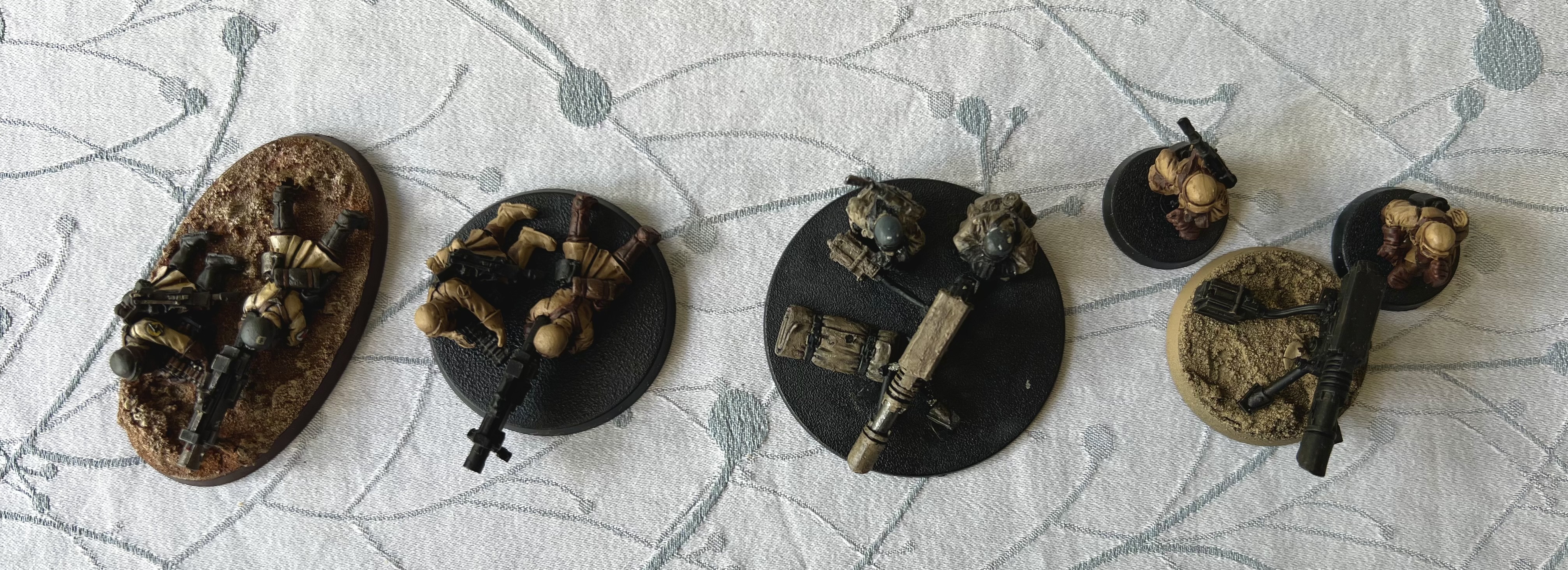
Pictured here are some Steel Legion heavy weapon teams; some old, some new, and hopefully you can sympathise with my dilemma. From left to right we have a heavy bolter team on a 120 x 92mm oval; a heavy bolter team (just about balancing!) on a 50mm base; a lascannon team on a 60mm base and a lascannon mounted on a 40mm base together with two crew members.


Steel Legion missile launchers are much smaller models and so, unlike the other weapon teams, were provided with 25mm bases:


+ Consistency versus pragmatism +

To me, the oval works best for the heavy bolter: the 50mm is too small to support the gun and gunner together, while they'd be lost on a 60mm base. Conversely, the lascannon fits quite nicely on a 60mm base; and is substantial enough to sit on its own 40mm base, with the crew separate. That's much more convenient for storage and transport, but leaves the heavy bolter crew as the only ones on a combined base.

So let's try some other options for the lascannons. Here's one on a similar oval to the heavy bolter (though set at a different angle). Cool, but only possible because I've converted the crew...


Here's an example of the same team moved to a 50mm base, and here I think this works quite well. The team doesn't look so lost as the set on the 60mm base, and I suspect this'll be more practical for both storage and gaming.

However, it'd definitely agitate the brain worms to have one team on an oval and one on a 60mm round... argh!


After consulting my (very patient and indulgent) friends in the PCRC, I think I've decided on keeping the missiles on individual 25mm bases; the heavy bolters on ovals; and have lascannons on 50mm bases. But what are your thoughts – and how do you base your heavy weapon teams?

+++

Things like this are silly considerations in the grand scheme of things, but nothing halts work and kills enthusiasm for me like analysis paralysis. Having a plan in mind is useful – but for those instances where I just can't make up my mind, I sometimes find it helpful to press ahead with stuff I am sure about – in this instance, how I'm painting the coats on the infantry.


One big batch later – as noted in this inload [+noosphericinloadlink embedded+], I'm aiming for a balance between effect and speed rather than a highly-polished display result – I've got the coats of all of the original figures in the army completed, so the next stage will be revisiting the guns and greys.
After that, I'll turn my attention to the goggles, faces and leathers; leaving just the Army Group symbol (white lightning bolt on green field) to finish.

... but to finish today's inload, here's the hero of the hour, our currently nameless Primaris Psyker, who's taken on quite a character and become a favourite after the few 2nd edition games we've had.

Wednesday, June 25

+ inload: Armageddon Steel Legion release history +

 + Resupply: Seventh Army Group +

+ A patrol from the 7th Army Group take on a mob of Goffs. +

+ Known by those fighting it simply as 'The War', what would later be titled in Imperial histories as the Second War for Armageddon involved millions of Imperial Guardsmen and a colossal amount of kit. Some was imported from off-world, but for the most part, Armageddon's production capabilities were equal to the task. +

+ Today's inload looks at some extra equipment I've mananged to lay my hands on for my Steel Legion force. +

+++

+ History of the Steel Legion +

The Steel Legion release was a bit of a peculiarity, as was much to do with the Codex Armageddon supplement to 3rd edition 40k. The Codex was an interesting experiment from GW: rather than being focussed on a single army, it included extra units and rules allowing you to create Salamanders or Black Templars Space Marines forces; a Speed Freek specific list for the orks; and the mounted Steel Legion Regiment for Imperial Guard. In addition, it had lots of maps and background and ideas for fighting in the battlefields of this specific warzone. In many ways, it was the precursor to today's 'War Zone' campaign books.

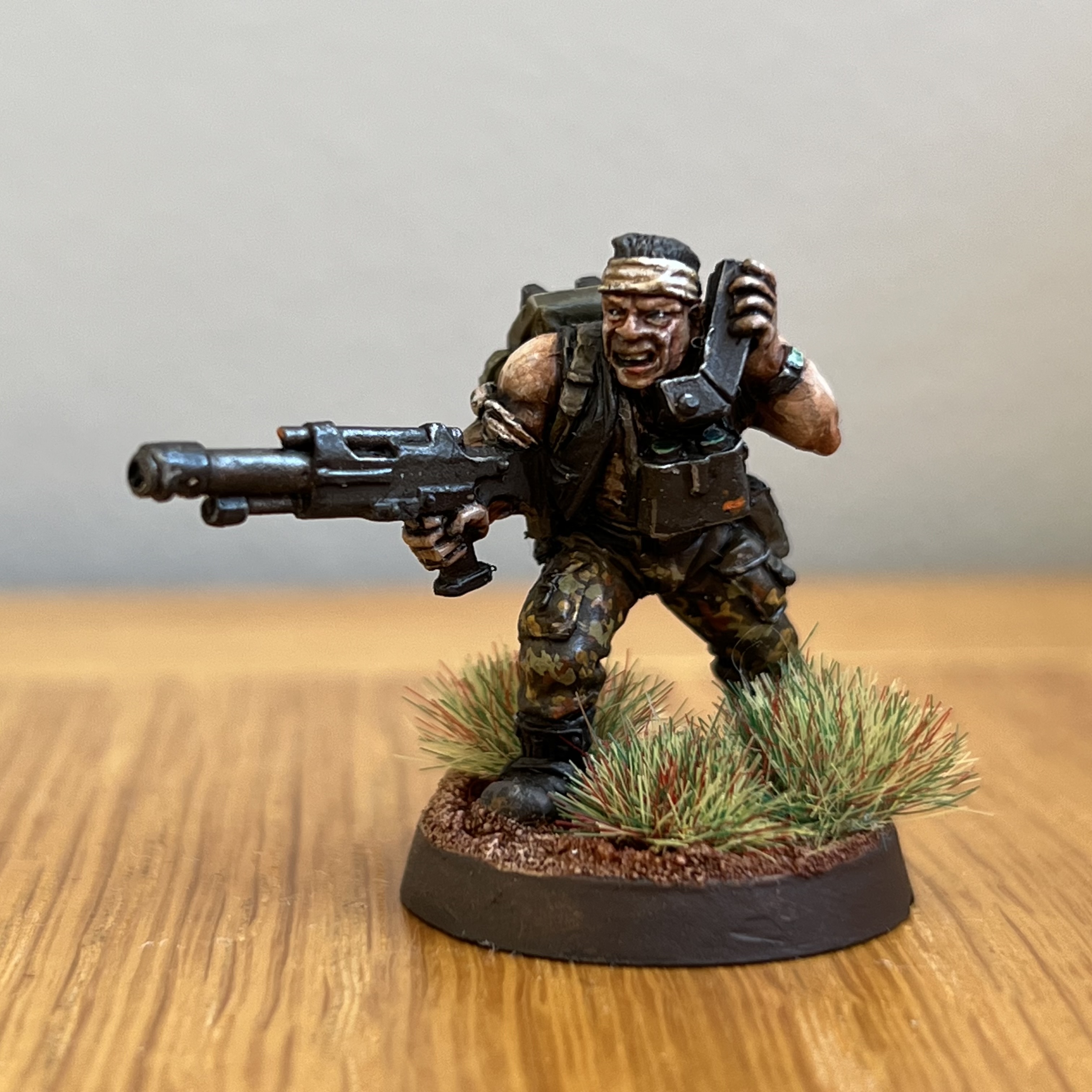
The models were also a bit unusual, as they marked a transition between the metals of 2nd edition 40k and the plastics of 3rd edition. The full range – such as it is – can be seen here, on the Collecting Citadel Miniatures wiki [+noosphericexloadlink embedded+]. When compared with the earlier metal ranges for the Guard (Valhallans, Catachans etc.), you'll spot the available Steel Legion are a bit thin on the ground. Sculpted by the Perry Twins, the models we did get are wonderfully characterful, as this typical lasgun sculpt shows. 


In many ways the Steel Legion release was a bit of a last gasp of the metals. Unlike the previous Regiments, which were the de facto official kit for Imperial Guard, the Steel Legion were released after the plastic Catachan sprue and just a couple of years before the plastic Cadian sprue, and the way the wind was blowing, I think most contemporary gamers were beginning to see plastics as the future; so the Steel Legion always had a whiff of a stop-gap special release; a fun addition to the upcoming Cadians who would become 'the basic Guard'.

This feeling is emphasised by the small range. The earlier Regiments were (generally speaking) each released in two loose waves – an initial infantry box and officer followed up a couple of months later by a few alternative lasgun, special and heavy weapon sculpts, plus another sergeant and officer sculpt. The Steel Legion never received reinforcements of this kind, instead having a slightly larger single wave that included a couple of variant officers, a single extra special weapon and two heavy weapon teams.

In the weapons and equipment we can see this transition more clearly. The preceding metals all shared some universal equipment. The lasguns, water bottles, grenades and special/heavy weapons were shared universally across all the various ranges, from Mordian to Tallarn, as the examples of Catachan and Cadian lasguns below illustrates:

Catachan comm-link
 

The lasgun here was universal for Guard across the range.
A shot of various bits from the Cadian range – note the identical lasguns on the left; and examples of the universal  plasma, flamer, melta gun and bolt pistol models, too.

The Steel Legion (and much later, Vostroyans), differed here. They had a new unique pattern of lasrifle, which was clearly based on the then-current plastic Catachan lasgun. It had the same casing and slimmer, less cartoony barrel; but with less of the barrel exposed, and with a folding stock instead of a solid one:


The water bottle and other equipment had much the same signature as the older Perry sculpts, but were unique to the range. Little details like this make them stand out from the older Regiments, and presage what would come – though they remain a niche range. With just six lasgun sculpts, repetition is quick across an army.


More obviously, the Steel Legion got entirely new heavy and special weapons, which – to my eyes at least – were light years ahead of the clunkier old ones, and gave the Regiment a slightly more 'modern warfare' feel than the older equivalents.

The plastic Cadian range came out just three years later in 2003, and while the metals remained on sale, the Cadians quickly came to dominate. The Steel Legion therefore became a bit of a footnote in collecting history, but – as I hope you'll agree – the models are still lovely.

+++

+ What's new? +

Finding second-hand Steel Legion is now a challenge. Not only were they around for less time than the older metal Regiments, but their slim range of just two special weapons (grenade launcher and plasma gun) and three heavy weapons (missile launcher, lascannon and heavy bolter) was not evenly distributed – missile launchers and grenade launchers are very common, as they were packaged with the infantry squad; but the others are much rarer – and hence unfortunately tend to be prohibitively expensive.

You can still pick up some bargains, if you don't mind a bit of conversion work. The lascannon below was missing its crew, but a separate lucky find gave me one of them, and I converted a spare missile launcher gunner to act as a second member of the crew (at the back here) – a simple matter of cutting at the shoulder and wrist to have him holding a remote trigger while scanning the horizon.

The autosavant is trying to reconcile the non-standard crew – the body language says it all!


Alongside these I managed to pick up a couple of plasma gunners and a spare heavy bolter gunner. He received the leftover missile launcher arm from the conversion above – a neat way to kill two birds with one stone, creating some visual variety in the limited poses available and also making use of spare parts.

You'll spot a second standard heavy bolter team and some plasma gunners, too; alongside some 40k weirdos (old Inquisition models) that I thought fitted the vibe of the force.


The PCRC are planning an old-fashioned event, where I'm hoping to get to field some or all of my Steel Legion, so I'll get to painting. If time, budget and skill allows, I'd like to have a go at creating some Steel Legion Rough Riders to go with the army, as a nod to those from the Battle For Armageddon boardgame.

... and apropos of nothing other than I liked them, I indulged in some Steel Legion-themed dice to go with the army, and some 'sustained fire' dice for our continuing 2nd edition games.


+++

Friday, June 14

+ inload: The history of the Leman Russ battle tank – 1991–2024 +

+ Rivet-counter Friday: The Leman Russ Battle Tank +

+ Games Workshop updates models every so often, and while they sometimes make a song and a dance about it, at other times it happens without much fanfare. The Imperial Guard (or Astra Militarum, if you're feeling SEO-fancy) are close to my heart, and their Leman Russ Battle Tank is one old warhorse that – perhaps fittingly – hasn't had much fuss made about its various incarnations. +

+ In looking at it, I was surprised to find out quite how many versions of the basic Leman Russ that there have been – and that's without going down the rabbithole of Forge World variants. Given its ubiquity in-universe, it struck me that it'd be fun to have a look at them, so let's pull on our best enginseer's robes, get down to the garage-barrackshrine, and have a proper viddy at this timeless classic. + 

Notice: This inload is an unapologetic deep-dive for rivet-counters and model tank obsessives, so be prepared for quite a lot of unnecessary detail and detective work about a fictional tank! My aim for this inload is to scribble down some notes I've found while working on in-universe article for The Ashes of Armageddon project [+noosphericinloadlink embedded+], and so I hope it's interesting or helpful, whether you're trying to work out the provenance of your second-hand tank, or trying to add some coherency to your army background lore.

Secondly, I have scoured the noosphere for pictures, so do check out the links to the people who have unknowingly supplied some of the pics – my thanks to them, and if any owner would like me to take their picture down, please just let me know.

+++

+ What is the Leman Russ? +

+ Leman Russ of the 2nd Tank Division, Armageddon Steel Legion +

The Leman Russ is the primary battle tank of the Imperial Guard, forming the spearhead of countless armoured columns. Those enemies that do not fall to the bombardment of their cannons and numerous hull-mounted guns are crushed mercilessly beneath their heavy treads. These reliable and formidable tanks can be found in nearly every Astra Militarum regiment in the galaxy, and have become synonymous with the Imperium's fury.

With the exception of the specifically labelled Mark II and (curiously) Mark VII, all the mark designations in the article are my own; just to make discussion and comparison a bit easier. In the background there are at least 33 marks of Mars-pattern Leman Russes alone; and another 9 or so just from Ryza. The lesson to take is that there are clearly a lot of subtle differences in-universe!

+++

+ Leman Russ Mark I +

The first iteration of the Leman Russ arrived in Epic scale alongside Armies of the Imperium (1991), an expansion for the second edition of Epic: Space Marine (SM2). The tank thus rumbles into the books as a Rogue Trader-era vehicle.

+Pict-capture from Stuff of Legends+

A two-part model designed by The Citadel Design Team (and I suspect either Colin Dixon or Mark Copplestone – if you can confirm, please let me know in the comments), the underlying silhouette is in place already. Taking clear inspiration from World War II-era tanks, it sports a tiny little turret, front-facing hull-mounted weapon and sponsons.


I'm not convinced that the sponsons were heavy bolters at this stage. I have a vague recollection that they were simply bolters – but happy to be corrected on this. Likewise, I think the hull weapon was a heavy bolter.


Whatever the armament, it's clearly recognisable, even if the details and proportions would go on to fluctuate to the present day.


This version was used in the Armies of the Imperium rulebook (and reprinted in a White Dwarf of the period) as the vehicle on which 'Codex colours' were demonstrated – these were accompanied by a new range of paints.

+++

+ Leman Russ Mark II +

The first version was not around for long, and the Mark II – specifically so-named, as you can see from this excerpt from the 1993 catalogue – came to replace it. This version of the Leman Russ was designed by Norman Swales.

Quite why it was updated is unclear to me. The original had been around for less than two years when it was replaced – but perhaps it was as simple as Swales updating it to fit stylistically alongside his other tanks, such as the new Hellhound flamethrower tank and Deathstrike Missile Launcher released at this point.

The same catalogue page has not one, but two replacement Space Marine Predators (the Mark II and Mark III), so it's not like the Leman Russ was as special case. I confess to missing it entirely being advertised in White Dwarf, so if it received any coverage within, it's certainly slipped my mem-coils.


Whatever the reason, the new Leman Russ was much simplified. The bubble-shaped sponsons were replaced with drum-like ones, and the hull-mounted weapon became nearly as prominent as the turret cannon.  The tiny turret of the original becomes still more noticeable as the battle cannon calibre is further exaggerated

Perhaps most notably, the track units now look much more similar to the current version, with a longer flat top bit (probably not the technical term).

Looking at the timelines, I'm led to understand that lead times for GW these days are that the studio are five years or so ahead of plastic releases (i.e. they start work five years before a plastic kit hits the shelves); while metals could be turned around in months or even weeks. I don't know if that was the case back in the nineties, but if it was, it perhaps hints that the extremely simplified Mark II was a prototype/tester for the plastic. The underlying shapes of the turret of the Mark II and Mark IV are very similar, once you strip away the ammo box at the back of the 40k-scale one.

Whatever the case, this was destined to be another short-lived version...

+++

+ Mark III +

... Because Swales quickly went on to produce this version, which came out as one of the supporting releases for Epic: Titan Legions in 1994.


This is the first hint at the number of variants we would see in later years, with a special command turret and entire recovery version being created alongside the refreshed version.

In retrospect, perhaps the Mark II was simply a prototype that was cast up and released. That would explain the bare-bones styling – for the revised version is considerably more detailed and characterful – and also explain why the 92/93-era vehicles got short shrift in terms of coverage in White Dwarf.


Change for this version are notable. From subtle details like the appearance of exhaust pipes, and ammo box at the back of the turret (itself no longer the tiny one of the Marks I and II) to more obvious changes, like the now-familiar box sponsons and distinctive lascannon in the hull, this is a tank now clearly recognisable as the Leman Russ familiar to 40k-scale gamers.

This is no coincidence, because it's almost certain that this was produced at the same time as the entry below was being developed.

+++

+ Into 40k: the Mark IV; the first plastic Leman Russ +

Catapulted into 28mm scale, the Mark IV Leman Russ was the first big plastic vehicle kit for the Imperial Guard.


Released in 1995, the 40k-scale Leman Russ got a lot of coverage in White Dwarf. Given the relative lead times in producing the white metal Epic Mark III and big plastic 40k Mark IV, I wouldn't like to bet which was first. I would suspect, however, that the Mark IV was designed first, and the Mark III scaled down from that.

This chassis would serve for a long time, and changes from here on in got progressively more subtle.

+ The five-sprue original. Note the holes in the track side panels – these would later be lost (see Mark VIII below). Pict-capture from Dakka Dakka forum +

The Mark IV initially had fixed armament, with no options for the guns beyond a heavy flamer on an accessory sprue. The tracks were more complex than later releases, with separate wheels and track links. This last fact is the clearest way to distinguish them from later models, but for obvious reasons it's also quite hard to tell once it's assembled.

More subtle giveaways are that you've got a Mark IV:
  • The hatches on the side of the tracks. On this version, they are separate pieces, and stand proud of the side of the tank. In later versions, they'll become integrated.
  • There were two options for the turret hatch; one rounded, with has an armoured back, the second flat and split. The turret itself is connected to the hull by a large ring with two little clips (see 'variants', below, for a pic).
+ Hatch option 1 +

+ Hatch option 2 +
  • When looking at the front of the tank, there's a recess on the left for a light fitting.
+pictcapture from TrollTrader; used without permission+

  • Rear of the tank: offset storage bin on the right, two tubular exhausts on the left of the ammo box.
+pictcapture from TrollTrader; used without permission+

+++

+ Back into Epic scale: the Mark V +

Two years later, the Leman Russ was once more updated for Epic scale, this time for the ill-fated Epic: 40,000 (E:40k).


And what a shame that E:40k fell stillborn from the presses, as the models were – in my opinion at least – clearly the best iteration yet. Even as the rules were becoming completely abstracted, the inimitable Tim Adcock was producing the most distinctive, varied  and characterful tank models. Completely interchangeable (and compatible with the Demolisher variant), the Mark V  range could be assembled in literally hundreds of combinations, allowing you to have an entire armoured regiment with no duplication.

I absolute adore this range, and these are without a doubt my favourite iteration of this great tank.


+++

+ Mark VI +

2003 saw the release of Epic: Armageddon, and another Epic-scale Leman Russ. Now it was officially titled the Mars pattern Leman Russ – by this point GW seems to have leaned into the idea that the real world variants related to the in-universe naming a bit.


Available as a tank company box, this variant is surprisingly rare – likely because this edition of the game had little support, and saw Epic unsupported in the wilderness for the next 20 years.

It's a nice two-part sculpt (turret and hull), and as such more akin to the simpler Mark III than the Mark V. All the variation of the Mark V was gone, and the appearance of the tank much more uniform.

Of course, given the relative price of Epic: Armageddon against earlier editions, it was very common for gamers to use their old models, which is part of why it remains less recognisable then some of the earlier versions.

You'll spot the Vanquisher command tank – picked out as a 'Stygies pattern' – in its first mainstream GW release, too. The variant had appeared as a Forgeworld turret in both 40k and Epic scale, and had appeared in rules as early as 3rd edition 40k, popping up in the first Codex: Imperial Guard released.


+++

+ Variants +

Time, space (and frankly, inclination) mean that I won't go into detail about the dozens of variants created by Forge World (FW), but I will point out that FW largely exists because of Tony Cottrell's treadhead dream of super-detailing the Mark IV Leman Russ. The first releases for the subsidiary were super-detailing parts for the Leman Russ like searchlights and alternative turrets, and by 2006 there were loads of them in both 40k and Epic scale.


+ Epic-scale Leman Russ variants +

As far I'm aware, there wasn't a 'normal' Epic-scale Leman Russ mark from Forgeworld, but you can see that there are lots of turret variants on a common chassis – so it's arguable that this is a Mark in and of itself. Rivet-countery though this post is, I don't really have a dog in the race, so I mention it more for interest.

+ 40k-scale Leman Russ FW variants and upgrades +

FW came close to a complete variant in a couple of places. The Ryza pattern (top row, second from left), for example, had a resin body and turret, but still required the track sections from the plastic kit.

+ Forgeworld Mars Pattern hull upgrade and Stygies-pattern Vanquisher turret +

Even these variants had variants, as the resin parts were adapted to the changes in the plastic 40k-scale tank...

+++

+ Mark VII – the Mark IVa in disguise +

Joyfully nerdery – besides the Mark I original, this is the only tank that has had an 'official' designation on the box/blister from GW; and happily it seems to tally up with the list above.


2005 saw 5th edition 40k arrive [+scrapshunterrorabort+ this info was incorrect; thanks Nuke2099], and the Leman Russ was repackaged. The underlying kit was the same, but the old upgrade sprue was completely rehashed, and as a result the tank looks quite different.

Most notable are the track guards and new turret hatch, which change the silhouette quite substantially. The inimitable Dave Taylor's Genswick force features a squadron of these beauties:

+ Genswick 5th Armoured squadron from Dave Taylor Miniatures +

The earlier Mark IV hatch is visible above on the left and right tanks, and the new one in the centre. Since you got the entire old kit with the 2005 'Mark IVa', you often saw people take advantage of the variety on the sprues, so if you really want to find out whether yours is a Mark IV or Mark VII, it's surprisingly difficult to tell.

+ Mark VII turret hatch – note also the big box on the side of the turret. This would disappear in the Mark VIII. +


Unless there's a part from the old or new upgrade sprue on the tank (and even that's not foolproof), the only way I can think of to work out the vehicle's vintage is to gently scratch the paint off a section of the tracks – if the underlying plastic is black, it's likely part of the older Mark IV release (you can see the black track sprue in this image on Dakka Dakka). If it's grey, it's a later Mark VII.

+ Leftovers of the later grey sprue. This is a grey-plastic cast of the same sprue pictured above, rivet-counters – the runners are the giveaway; as the later Leman Russ kit had the tracks integrated into fewer, bigger sprues. +


Cosmetic differences aside, the 2005 Mark VII tank was still the same kit as the Mark IV. You can see the recess on the left at the front and the large ring for the turret to fit in in the WIP pic below, from the Scattered Dice Gaming blog.

[+pictcapture from Scattered Dice Gaming+]

+++

+ Mark VIII +

In 2009, a completely retooled Leman Russ tank would start rolling off the presses. This is the current 40k-era kit sold by GW.


The new kit sacrifices some of the flexibility of the old kit for variety and options. Most notably, the tracks no longer have their own sprue, and the wheel sprue is gone too. In their place is this:
+ Note the hatch for the front hull weapon is also integrated, rather than separate parts. +


This is much, much easier to build, with the tracks numbered and slotting into place more cleanly. The flip side of that is that it's now much harder to convert, as there's nothing within the hatch body. 

The Mark VIII kit also included lots of weapon options, so what GW tooketh away with one hand, they gaveth back with the other. Leman Russ variants, previous metal upgrades provided in a blister in the tank box, are presented in plastic for the first time. The kit includes options for the Battle Cannon, the Vanquisher (cleverly tooled as an extension to share parts with the Battle Cannnon), twin autocannons for the Exterminator variant, and the Eradictor, (which I love for the cool muzzle break, even if it's always been a bit crap in-game).

+ Eradicator on the left, based on a Mark IV with a FW Mars-Alpha conversion kit and turret (converted to hold the micro-nuke cannon); then an unconverted Mark VIII in the centre; and a Mark VII with Mars-Alpha conversion kit and turret. Phew!+

In fact, while the silhouette is similar, everything is different. Key changes include:
  • Smaller turret connection – this would require FW to retool their upgrade kits, and you can thus date those by the change too. The first ones had a simple big 'plug' of resin that fitted into the big gap. Later ones had a small plug to fit into the hole shown directly above – but in a nice touch FW also supplied a sort of converter: a large plug with a recess for the small plug, so whether you had a Mark IV/VII or VIII, the turret upgrade would fit. Nice touch!
  • The sponsons are also interchangeable now – even allowing you to friction fit them and change them on the fly. 
  • The hatches are now integrated parts of the tank. This is obvious in the side hatches, which are no longer separate parts – this flush side is a good diagnostic, as it also helps to date FW variants and conversions, like my Lamb's World tank below.

    + The flush side hatches indicate the tracks (and thus the Mars-Alpha conversion kit) are the later versions, modified to fit the Mark VIII. +

  • The turret has a lower profile and a shape closer to that of the Mark III than any of the following Leman Russ models – and as part of that, the box on the side (for a targeter? Ammo?) is also gone.
  • The recess at the front has gone; the entire front is now a single slab. 
  • At the back, the engine hatch is now (as elsewhere) integrated into the hull – and centred, with the stowage box option now gone. The exhaust pipes are now much more detailed, and are intended to sit either side of the (stowage?) box. 
+ Detail of the Mark VIII back +

Although I'm sad that the increase in options and ease of building has come at the expense of the hatches, which were always really tempting for conversions, in reality I think I built precisely one Leman Russ that had an open side or back hatch, and so it's not a terrible disaster.
There's always going to be an element of nostalgia for the kit you had as a nipper, but the new kit has benefitted from years of technical improvement and digitisation. The latter is not always a good thing for character, but I think a sense of organic sculpture is more important for individual figures than tanks and war machines. On balance, I think the Mark VIII is an improvement over the Mark IV/VII.
+++

+ Mark VIIIa+

Not a mark in itself, really, but today the kit includes a third sprue. This was originally sold separately, but GW have bundled it in as part of a price rise. Designed for the slightly more heavily-armoured Demolisher variant, it also includes parts for the Executioner (the plasma variant) and Punisher (the big BRRRRRT rotary cannon), along with some quite subtle differences to the hull, like reinforcement around the engine block and cover, and options for the ammo box at the back of the turret.
As it's completely compatible with the sprue above, you'll probably find that this hull top and turret appear every so often – so if you're scratching your head at an unfamiliar detail of a Mark VIII, check out the Demolisher sprue, too.

+++

+ Mark IX +

Appearing in 2024, this is a 30k-era dual scale release – both for Age of Darkness and Epic: Legions Imperialis (LI). This was thus the first Epic scale Leman Russ in 21 years (unless you count FW, and even then well over fifteen years).


ChaosBunker has done a brilliant run-down of the larger version [+noosphericexloadlink embedded+], so go check it out if you'd like to see sprue breakdown etc. – and you'll find the designer's notes on WarCom here [+noosphericexloadlink embedded+], so you can hear it from the horse's mouth.

I've not seen the larger version in person, but it seems a worthy successor to those that went before. I like the square hatches, additional detail and so forth; and it seems somewhat fitting that a tank that emerged largely unheralded in SM2 as Epic moved into the 40k era, should come full circle and end up rolling out in 30k era with the new Epic.

+++

+ Conclusion +

I'll restrict myself to saying that the new Epic ones are lovely little kits, which fit what I wanted the Leman Russ to look like for a long time – I'm also delighted that it took a mere 34 years for Epic ones to emerge in plastic...

You can see from my Lamb's World tanks that while a fan of the Leman Russ in all its forms I've never been completely satisfied with the aesthetic, but the fact that it's so open to conversion, adaptation and customisation is what makes it such a reliable and versatile tank, both in-universe and out.

+ All hail the Leman Russ! +


If you enjoyed this inload, you might enjoy Ork Vehicles of Armageddon Secundus on The Ashes of Armageddon