Friday, March 9

+ inload: The Alien Wars setting +

+ Background to the Nova Terra Interregnum +

In retrospect, the broad history of the Nova Terra Interregnum is one of Imperial ambition, division and decline. The preceding centuries had seen the Ecclesiarchy enjoy a rise in influence, culminating in the recognition of the Emperor as a God; followed by the gradual reassertion of the Administratum. Such tension inevitably led to conflict. Few historians would have realised how massive the convulsions would be, or how radically they would redraw the Imperium's path.

The conflict between these two pillars of Imperial power was, of course, complex and multi-layered. Some histories paint the Nova Terra Interregnum as a conflict between the neo-rationalism of Nova Terra against an increasingly theocratic Imperium, while others identify the Ur-Council as the acceptably bureaucratic face of a fundamentally religious movement. The truth probably lies between these poles: the scale of events is simply too vast and complex to summarise neatly. 

While later records boldly state that an Imperial Segmentum – Pacificus, to the galactic West – broke off from the Imperium, this is only true in the broadest sense. The immutable borders of Pacificus, established during the Great Crusade itself, may obey human reason; but the galaxy is a messy place. Five thousand years of gradual astral movement have shifted the locations of stars and systems, and new worlds are being re-discovered and lost all the time. 

+ Nova Terra +

Certainly the world of Nova Terra became a beacon for visionaries, dissidents, malcontents and dreamers. It was a beautiful and highly influential planet; at the hub of a reliable web of warp-transport and well defended from attack. Nova Terra was well-placed to influence Imperial politics. Five thousand years of wise diplomacy, investment and demonstrations of loyalty ensured that it radiated a sense of Imperial power and certainty that had gradually been lost from Ancient Terra itself amidst fifty centuries of petty power struggles, megalomaniac government and panicky, reactionary rule.

The period immediately prior to the Interregnum saw the High Lords of Terra lost in petty internal squabbles that saw the Imperium as a whole stagnate. After a number of assassinations, counter-insurgencies and open warfare on Terra, the Adeptus Custodes declared that the High Lords would have to be represented in absentia in order to ensure the safety of the Emperor's person; and governance of the Imperium became even more bureaucratic, disjointed and delayed than usual.

In exasperation, many systems turned to Segmental government; regarding the High Lords as too distant. Nova Terra was an obvious choice of regional government. It was well-regarded and admired by both the Administratum and Ecclesiarchy, and enjoyed considerable support across the sector owing to it acting as a bastion for stability during the War of the False Primarch in M33.

Nova Terra declared its Ur-Council  as the highest point of authority in the Imperium at some point in M34 – supposedly reluctantly, though it had rapidly and unashamedly gathered support and declarations of loyalty since its formation some two centuries prior. 

The Ur-Council of Nova Terra 
The Ur-council was a group of the great and good (or at least powerful and ruthless) of the Segmentum, with many similarities to the High Lords. Present on the Ur-Council were seats for representatives for the Inquisition; Adeptus Ministorum; Administratum; Adeptus Mechanicus and Imperial Navy. Indeed, a number of the figures were ex-High Lords themselves, including the Master of Assassins – who had resigned his seat on Terra in disgust.

Events began to spiral quickly after conflicting order from Terra caused elements of Battlefleet Pacificus to variously deploy and disarm; an embarrassing state of affairs that saw a number of oppportunistic worlds rebel in the face of Imperial inaction and equivocation. Hydraphur, the seat of the Segmentum Navy, declared that henceforth it would only obey orders from Terra once they had been ratified by Nova Terra. 

Conflict with Terra was all but inevitable once the Imperial Commanders of Colcha and Guryan, famed seats of resistance and bywords for loyalty owing to their actions during the Plague of Unbelief, immediately followed suit, drafting a proposal that stated that – while Ancient Terra should be respected as the birthplace of humanity and seat of the God-Emperor – Nova Terra was the obvious choice for temporal power to be focussed; as the Ur-council could provide more stable and clear-sighted leadership than the corrupt and discredited High Lords.

+++

+ Shifting loyalties +

One after another, countless worlds and systems came to declare for Nova Terra. Within a century, fifteen thousand systems had openly rejected the High Lords' rules; and by the time the numbers reached one hundred thousand systems – roughly a third of the Segmentum, with the remainder remaining pointedly neutral, Nova Terra made an official edict that Segmentum Pacificus would dissolve its connection with the rest of the Imperium. This was, of course, couched in diplomatic language, but the intent was clear.

The High Lords' response was weak and vacillating; with the bickering chamber unable to come to a united response. A number of small fleets fought isolated actions, but the skirmishes were limited and lacked coherence – not to mention the forces' understandable reluctance to engage supposedly friendly Imperial forces. 
None of this is to suggest that Nova Terra's governance was in any way less labyrinthine or complex than Ancient Terra's. The edict had only come to fruition through blackmail, hidden influence and a number of assassinations. As the saying goes; power corrupts. Absolute power corrupts absolutely.

+++

Tuesday, March 6

+ inload: Alien Wars inspiration I +

+ Fancy writing for the Alien Wars? +

+ A little colour text today, to (hopefully) provide a little inspiration for your #alienwars projects. The Twin Imperium of five thousand years is a broad palette, and I'm looking forward to shining some light on it with you all. +

I'm enjoying exploring a few different alleyways of the big picture, and will be posting up more short pieces of colour text like this to fire your model-making neurons, but I'd love to share your ideas, too.

+ If you'd like to contribute and have your Alien Wars writing posted up here, let me know in the comments (or on the Facebook page [+noosphericinloadlink embedded+] +

+ [inload datastate request] +

+ Submissions should be no more than 1000 words, clearly themed around the Nova Terra Interregnum, and ideally in *.Docx format. Submissions accompanied by model pictures will be prioritised. +


+++


+ Studies at an Alien University +

Sedimented, ancient dust cascaded from the book as Herm turned the cover back, releasing the aroma of the Haahon along with the creaking and cracking of some form of leather. The scent was stale, of course, but not unpleasant. They hadn't died to protect this. The fleecy, phytotic aliens had fallen back in good order, their study-space packed with double-blind alleys. Even the Pragsimal Rifles – elite, urban-trained soldiers – had to take their time squirrelling out the Haahon from the airy, coral-coloured buildings; clearing room after room. The crackle of small arms fire still echoed through the xenos university; but distantly. Herm's armsmen stood watch; but not at full alert.

The word 'book' sold it short. It was most definitely a tome. Thick and solid, it had a pleasing heft to it. The cover, like the book – like the architecture of the study – was triangular. Screened by a dome of some glassy, semi-transparent substance, daylight fell through to the study generously, easing any sense of danger. Even with the broken panes above, the scattered rubble and the distant smoke visible across the bay, this was an oddly comforting place, thought the Inquisitrix. She shrugged, privately. Xeno-holds usually felt subtly wrong. Even amongst species similar in broad proportions to humanity, surfaces were often at unexpected heights; objects at strange eye-levels.

Not so here. The Haahon were peculiar in this way: they venerated humanity. Emulated it; despite their biology being so grossly different. Some brief contact during the Great Scouring – a mere smear of cultural crossover – seemed to have led the ancient Haahon into a cargo cult of sorts. The Inquisitrix pictured them. Strand-dwelling groups; lurking near mist-haunted sea-shores, quivering as the humans emerged from their glittering craft.

It had made an impression. Five thousand years later, the Haahon stood at the brink of interplanetary travel. They had built a paradise of airy coral-coloured buildings, and colonised their two moons. And all this, the Inquisitrix thought, inspired only by material lost or discarded during some long-forgotten Rogue Trader's brief landings.

She allowed herself a satisfied smirk, as she leafed through the pages of the tome. They were illegible to her; though Maron was capable of deciphering it. The thought banished her satisfaction. How much have we lost, she pondered, that we are forced to steal our knowledge back from children-species?

She drew a hand slowly over her bestubbled head, a habit she had when gathering her thoughts. She would kill a dozen – a hundred – such species to restake humanity's claim on the stars. Terra may have stagnated and turned inward, but the Ur-Council was ascendant. Nova Terra had ambition. They had ideas – and best of all, they had worlds pledged to their cause of rediscovery and rebirth. Twenty thousand worlds. Herm's eyes glittered. Twenty thousand worlds today; and more tomorrow. This is the future of the Imperium; united under the Emperor, with a clear view of the past and the future.

Herm's eyes hardened as she swept the book up and turned to leave. Her scribe, Maron, bowed; as did Vonreuter and Cleme, her Pragsimal armsmen.

'Back to the ship. We have what we came for.'

'Another piece of the puzzle, zir-mam?' queried Maron.

She nodded.

'Just so. We will piece our heritage back together; if it takes another five thousand years. We have let things slip. Too much has been lost already under the suzerainty of small-minded Terran scribes. The Ordos already see the way the wind is blowing,' she said, darkly.

+++


Monday, March 5

+ inload: Ork squad leader +

+ inload: 'An Ork Called Hruk' +


+ Ident@ pict-capture ref: Muphrid theatre – ork sub-commander and slaves +

+ Hruk is another personality from the Rogue Trader scenario Battle for the Farm. Hruk is introduced in the ork player's brief, which reads:
'You are Thrugg Bullneck, an Ork Commander of the Charadon invasion force. [...] During the initial fighting, you led your troops against a small farm where you slaughtered the human defenders before firing the buildings. During that fight, you and one of your squad leaders (an ork called Hruk) discovered a cache of jewels. Not wanting to alert the rest of your command about this highly desirable loot, you buried the jewels [...] You don't trust Hruk and, to be fair, he doesn't trust you. You have both spent the past week watching each other very closely indeed.'

+ Who's Who? +

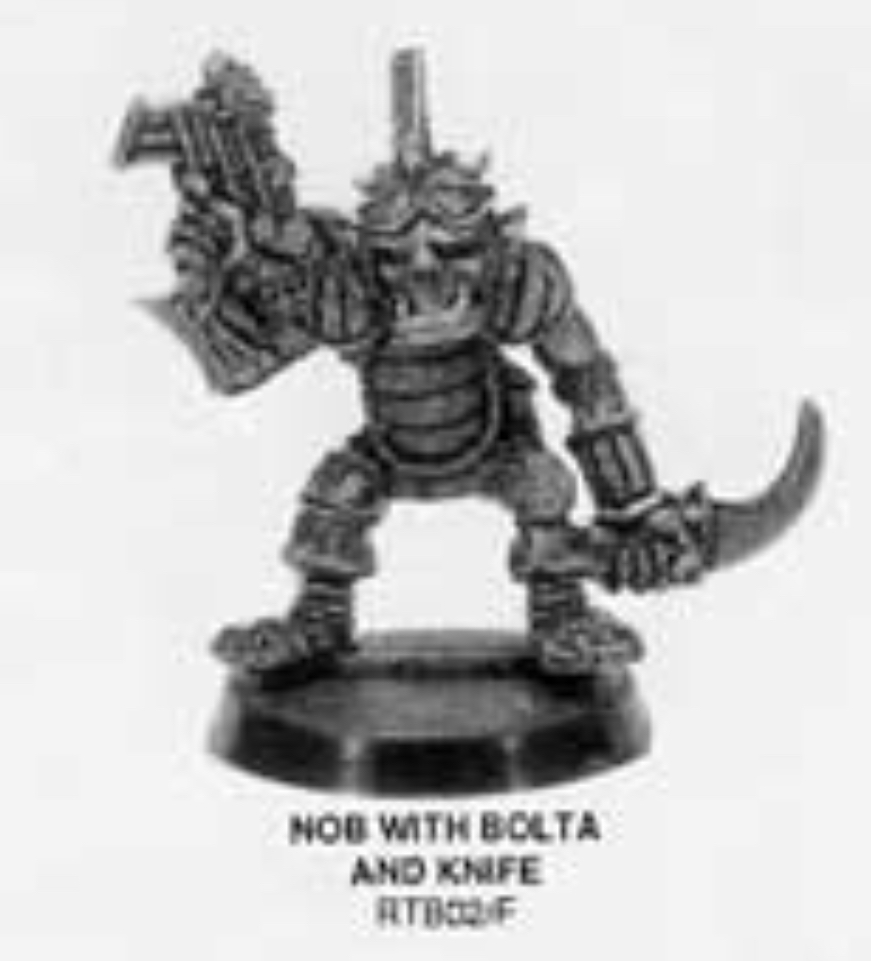
+ Identifying which of the original models is Thrugg and which is Hruk proved a bit tricky. The models are based on the RTB02 'Space Ork Raiders' box, which can be seen on the Stuff of Legends website here: [+noosphericexloadlink embedded+]. The artwork on the cover seems to show the ork I'd identified as Hruk in the dominant eye-catching position, while the one I thought was Thrugg is lower down and on the left. The advert also emphasises the 'Hruk' model, putting him front and centre of the personalities (though Thrugg is in the centre of the main shot). +

+ I thought I had solved this when I spotted that the paper counters at the back of Rogue Trader (intended to let you try out the game) showed Hruk wearing the distinctive helmet and armour of the model above. Unfortunately, having painted the model, I then ended up idly looking at the Collecting Citadel Miniatures wiki, and found that the models themselves solve this: the tabs listing 'Thrugg' and 'Squad leader' – as you can see on the wiki here [+noosphericexloadlink embedded+]... The only problem then is that the other ork personality is labelled 'Hruk' – d'oh!  I should probably have seen this coming, as the equipment lists in the scenario indicate that Hruk has a bolt pistol, something only present on the third personality. Obviously Thrugg is right to be suspicious, as Hruk is clearly dead sneaky! +

+ That minor [SCRAPSHUNTERRORABORT] aside, I'm pleased with the result. This chap will likely be renamed something else once I've got the 'real' Hruk built and painted, but in the meantime, here's a rundown on this squad leader. +


+ Painting: Theoretical +

+ What better colour to use for one of the Arch-Arsonist of Charadon's armies than Charadon Granite, one of my favourite colours? Sadly, my pots of that are quickly getting diminished. Figuring that orks are a good opportunity to play around with colours (slight variation and discolouration between models is a good thing for orks, after all) I took a punt at a replacement; IV-02 [+noosphericexloadlink embedded+], from a company called Instar. I'd not used this company before – I think they're a new start-up – and I'd like to do a more full review in future. Suffice to say that the colour match is excellent – you can see it here on the ork's armour plating/padding. +

Getting the pseudo WWII feel across was important, so I added a range of muted browns to the palette, brightening and warming things up with a splash of accent orange, Solar Macharius Orange. A muted palette like this can stand a couple of accents, so I also used a mid blue for the goggles. I like my orks to look a bit grubby, and these colours can all be mixed together in various proportions to produce a great range of subtle hues. +


Image from Rogue Trader

+ I definitely wanted to add some period-appropriate symbols, so decided to add some freehand. The scenario contains some ideas for painting the orks, which I thought would work well – the Rogue Trader symbols have a particular brutal sci-fi aesthetic that is quite distinct from 'modern' orks, and would be perfect for this slightly more militaristic take on the greenskins. In particular, I wanted to incorporate the Luggub's Drop Legion symbol (a knife through a skull in a circle) somewhere. +


+ Painting: Practical +


+ Large areas of browns and grey can look a bit dull, so I livened up the model with some freehand; a couple of kill stripes on the shoulder pad, a subtle smiley face on the gun – things like this are fun, but I didn't want it too distracting from the focal point of the face – and a bit of freehand on his chest armour. +


+ This shot shows the wood effect on the stock of his gun; and also highlights his chainsaw-crested helmet. The original had an odd triangular ornament on top of his hat; I thought I'd update it to be a little chainsaw, made using a Forge World chainsaw bayonet as the basis. +


+ A side view shows a back-up shotgun, and a skull of an unfortunate enemy/rival – scrawled with 'runt' as a final orkish insult. +


+ I've incorporated a couple of bits from the original plastic ork release. The shoulder pad had some sculpting on top to add some detail, but the pouches at the back are straight from the box. +

+ He might not be Hruk, but he does have style. Let's see how this squad leader gets on! +


+++

+Bubbling under +

+ The Alien Wars project – labelled #alienwars – seems to be ticking along – I've had half a dozen or so inquiries about it; and some very intriguing work-in-progress pictures appearing on Instagram, too. All very heartening; I hope it continues to tick over. +

+ For my part, it's got me enthused, so I've been cracking on with more greenskins; a pair of Sisters of Battle; and some Titan crew... +


Sunday, March 4

+ inload: Painting ork skin +

+ Green iz best +


+ This technique should work well on orkoid/goblinoid skin, or anything that requires a similar scheme. You might wish to use lighter-tones for gretchin, goblins and the like; and darker tones for older or bigger orks/orcs. For this example, I'm demonstrating on a model I'm using in an army for my Alien Wars project, so other bits of him are painted; you can ignore these. +

+ I've posted before that I really enjoy painting skin. I think it's one of the most rewarding parts of painting a model, and deserves a bit of extra care and attention. This applies as much to orks (or any other species) as it does to humans. There's a lot of variety in human skintones, as mentioned in an earlier inload [+noosphericinloadlink embedded+]


'I like to add diversity to my skintones – they're hugely variable even in an individual: quite aside from big differences such as ethnicity, conditions such as sunburn, sickness or even being out of breath can change people's skin colour quite dramatically. Adding touches of blue to the skin mix for stubble and bags under the eyes, touches of scab red to the mix for lips, cheeks and fresh scars, or a dilute wash of Olive Green for feeling poorly can make the difference between a cool-looking model and a believable individual.'
+... and I think that doing a similar thing for orks is a good way to add a little more realism to your work. +

+ Greenskins are interesting from a colour theory point of view, as green and red are very similar tonally; and as a result, we can use similar techniques – and even colours – as we would use for humans to paint them. This also allows us to create varied 'ethnicities' for orks. In a similar way to human skintones all drawing from various proportions of red, yellow, white and brown; all ork skintones can be made from blue, yellow, white and brown. Swapping the red for blue naturally creates green mixes when combined with yellow. With that said, just as I use hints of blue when painting humans (to mute the orange mix of yellow and red for eye bags, shading etc.), I also use hints of red when painting orks for precisely the same reasons: red is the complementary of green, so it mutes the colour and makes useful mixes for shading. +

+ A lot has been made of orks being fungus-based, but I prefer to think of them as basically red-blooded animals (as in the Waaagh! the Orks background), which have a green tinge as a result of a symbiotic fungus; as opposed to literally being mushroom-beings. As a result,I use reds and purples to show thinner parts of the skin, and keep the greens I use relatively muted. Just as humans appear browny-yellowy-pink rather than literally black or white; I see orks as basically having an extremely olive green-tinged human skintone. This also leaves a lot of space open for natural variance, which adds to the naturalism. +

+ Preparation and priming +

+ Clean and assemble your model/s and stick it/them to a base. Undercoat the models with a light undercoat of grey. I use Halford's car primer. An undercoat should cover every part and recess of the model evenly and lightly, obscuring no detail. +

+ Painting +


+ I_ Apply a dark-toned basecoat. I've used a mix of Doombull Brown and Incubi Darkness for this example. Ultimately, however, the basecoat doesn't really matter too much as long as it's dark.


+ II_ Once the basecoat has dried, add some Death World Forest and Averland Sunset to the mix on your palette to create a midtone. Apply this over all the skin except the recesses. +


+ III_ Mix a little Screamer Pink (or similar red hue) into the skin mix on your palette, then paint the nostrils, lower lip, inner ears, fingernails and elbows – essentially anywhere the would have blood near the surface. If you can do this while the paint on the model is still wet, all the better. +


+ IV_ Add some flow enhancer medium to a fresh version of the midtone mix (Death World Forest and Averland Sunset) and establish your initial highlights. Note that the colour will be lighter-toned than in step II, as it is not mixed with the paints from your initial deep tone. When placing the highlights, start to create a sense of form. Highlight areas like the bridge of the nose, brow ridge, chin and so forth; while avoiding the recessed areas under the cheeks, in the inside of the elbows and between  fingers. +


+ V_ Punch up the impact with finer highlights. Add Flash Gitz Yellow and Vallejo White to the midtone mix and apply this sparingly; concentrating on the face, and applying it sparingly elsewhere. +


+ VI_ The yellowish tint may well look unnaturally vibrant, so you can knock it back with a purple wash of Druchii Violet (or a glaze of purple).  You'll note I've painted in the teeth and eyes at this point, too. This is a good stage to do it, as the light-toned teeth give a good anchorpoint for getting the balance of tones right later. +


+ VII_ Once the wash has dried, apply sparing touches of Elysian Green as final highlights. +


+ The result +


Friday, March 2

+ inload: The Alien Wars and Hruk +

+ The Alien Wars +

+ There's been a little flurry of activity around the Alien Wars project, which I've opened up to anyone who'd like to get involved – feel free to dive in with the #alienwars hashtag. There's a little info on the new tab at the top, and here's a [+noosphericinloadlink embedded+] for anyone on mobile. + 

+ I have expanded that tab with some further ideas – and will be adding pict-captures of other people's models – but the short 'brief' is simply to make a model (or more) that fits into the Nova Terra Interregnum of M35, a period of instability in the Imperium that saw the resurgence of Xenos threats. +

+ This is a broad brief; intentionally so, because there's very little written about this period of 40k history. There are a few hints here and there, but it's very open for your ideas. I've expanded on those through the link above. +

+ In with the Old +


+ For myself, I've been shamelessly immersing myself in nostalgia, tying the project together with an urge I've had to update the models that caught my youthful imagination – namely the Blood Angels of White Dwarf issue 139, and the orks of Luggub's Drop Legion, who turned up in the first Rogue Trader expansion, the Book of the Astronomicon. The unseemly looking chap above is an update of Hruk, the ork second-in-command from the Rogue Trader scenario The Battle for the Farm. The Kev Adams original is up there for comparison. +

+ ...and Also With the New +

+ But there's no need to restrict your explorations of the Alien Wars to revisiting old models. Here are two plastic Sisters of Battle, for example, ready for paint. +


+ How do I get involved? +

+ If you'd like to share your model – or models – you just need to use the #alienwars hashtag on Facebook or Instagram. However, I'd be delighted to share your models here on Death of a Rubricist, to collect the #alienwars models together. +

+ If you'd like to showcase your work here, please either drop a comment below, or get in contact via Facebook [+noosphericexloadlink embedded+]. +

Thrugg, Hruk... and an ork boy who's about to get a bashin' for wandering into the bosses photoshoot.

Friday, February 23

+ inload: The Muphrid Disc Clearances +

+ The Muphrid Clearances +

After their actions on Arcturus, the Third Company's next deployment was to support the elements of the First and Fifth companies during their clearance of Muphrid, a binary star system rimwards of Arcturus. Muphrid's swollen primary star, a red-giant, was planetless, though the system's large accretion disc contained numerous habitable, if inhospitable, planetoids.

The Order of Solar Ascendant maintained a number of isolated priories and missions here, which had historically been the lynchpin of Imperial defence as ork pirate raids increased in frequency. The Sororitas had successfully launched punitive raids on encroaching greenskins that had made landfall on the many Imperial mining operations, but they were stretched thinly; and their naval support was woefully inadequate. Much to her personal – and far from private – chagrin, Prioress Al-Achsasi was obliged to request help from the wider Imperium.

Battle Sisters of the Order of Solar Ascendant
The answer came from Master Formosus of the Blood Angels, who notified the Prioress that the a large element of the Blood Angels fleet would perform an interdiction and extermination campaign to sweep and clear the Muphrid Disc of xenos vessels of cruiserweight displacement or greater. When Al-Achsasi asked for consultation on behalf of the Imperial local command, she was rebuffed with a dismissive explanation that the Astartes required no assistance in this matter. Bristling at this perceived insult, the Prioress and Chapter Master's relationship proved strained throughout the campaign; a matter worsened by the region's close and vocal ties with Nova Terra.

It is a mark of humanity's hatred for the xenos that both the fanatical and studiedly neutral were able to put aside their differences to fight the orks – albeit under duress. It was fortunate indeed for the Imperium here that they were able to avoid internecine conflict, as the forces here and on Arcturus proved to merely be the vanguard of a building ork crusade from the smouldering Charadon region.

Ork commando of Luggub's infamous Drop Legion.
On at least two occasions, the forces of Solar Ascendant and the Blood Angels were required to work together in hulk clearances. While Formosus and Abelard avoided deploying their forces alongside potential heretics, Tycho of the Third followed a more pragmatic path, though communication and interreliance between the forces was strained at best.


+++

+ Building +

+ Well, that was a productive evening! I started to build the boyz for my ork force. As I think I've mentioned before, the Alien Wars/Nova Terra Interregnum setting I'm developing is essentially my iteration of the Rogue Trader (RT) era. I think the RT background is a lot more dystopian, with more emphasis on the desperate, floundering scale of the Imperium. There are perhaps fewer existential threats – modern 40k has a 'five minutes to midnight' feel of apocalyptic scale and gods walking the galaxy; whereas RT concentrates on the million, million smaller wars that burn across a galactic empire collapsing under its own weight. +

+ If 8th is Ragnarok; RT is a World War. It might not be the literal end of existence, but it's bloody unpleasant for those involved, and no-one can escape. RT also has less of a definite sense of good and evil. While the orks are nominally 'the baddies', the Imperium are hardly good guys. The shades of grey in RT are much closer. +

+ I'm trying to get this across in my orks by downplaying the more exaggerated features and adding more military-style fatigues and armour. RT background originally had the orks as slavers; their equipment definitely manufactured rather than individually built, though there was still a (small c) chaotic sense of individuality. Basically, I want the orks to look like a tough, hardened militia. +

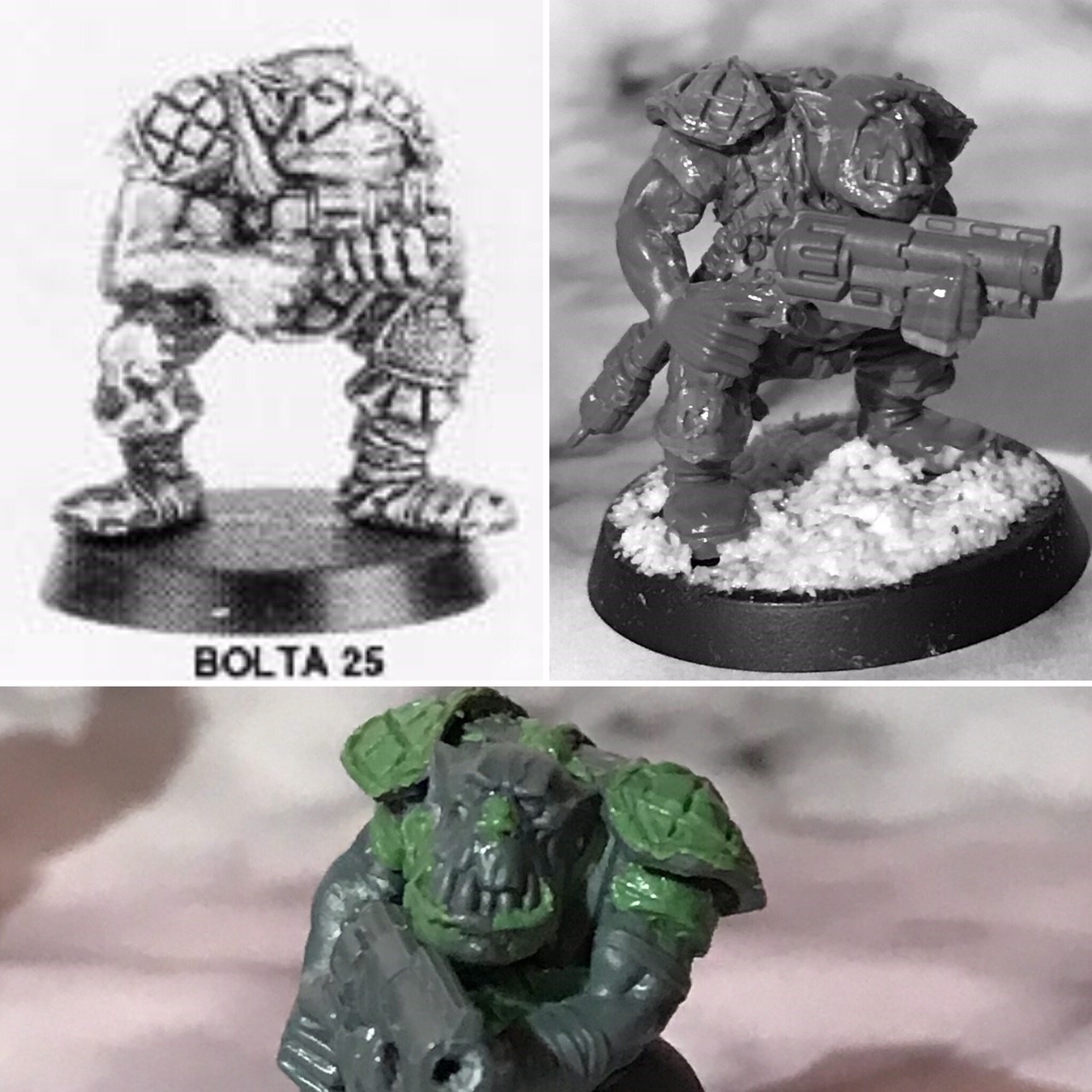
+ Below you can see the first ork. As with Thrugg [+noosphericinloadlink embedded+], I'm taking a period miniature as inspiration; here one of Kev Adam's seminal ork boyz. In terms of the details, I've tried to capture the main elements – the revolver-style gun, baggy fatigues, neck-scarf and quilted flak armour. However, I'm also a big fan of Brian Nelson's version of the orks, so I didn't want to completely lose the brutal charm of the underlying sculpt. +


I've desaturated the top right part to blend the greenstuff work in for clarity, but I've left the bottom part of the picture untouched, so you can see the details on the face. I've added a bottom lip and slightly extended the nose – both very minor details that don't alter Brian Nelson's awesome basic sculpt too much, but do give the figure individuality. +

+ Individuality +

+ This is an important point about non-human figures. You can get away with bare human/space marine (and even eldar) heads being duplicates, because we're familiar with human faces being broadly similar, and are hyper-aware of tiny differences in skintone and shape. As a result, using the same human head repeatedly will seem natural, as the paintjob will inevitably bring out tiny differences that the brain unconsciously reads as details. +

+ That doesn't apply to orks, or other slightly less humanoid figures like Tau, as we're not as attuned to the archetypal face. Thus, seeing the same head will look like masks, giving an unnatural feel. This applies even after paint, as the non-human skintone (green, blue etc.) is equally unfamiliar. To combat this, you need to either make the skintones radically different, really push the visual texture (adding muscular striations etc.), or chop and sculpt around the face. That's the best way to get a sense of individuality back into the models. After all, xenos or not, orks are organic and just as diverse as 'oomies. +

+ As an aside, I think this effect is part of what gives plastic (and particularly CAD-designed) models the reputation as 'less characterful', due to the inevitable repetition of certain parts, and the loss of what can charitably be called the 'sculptor's touch' (and unkindly called tiny errors). Hopefully the minor changes here will go some way to capturing the quirky individualism of RT-era sculpts, without sacrificing the sharpness and quality of the modern plastics. +

Thursday, February 22

+inload: Arcturus +

+ The Arcturus Campaign +


+ The invaders of Arcturus – the orks of the Von Kurtz stars – proved to be a resilient and hardy foe; hardly surprising for a force of greenskins and their assorted mercenaries. The dispirited and demoralised Arcturan PDF were capable of holding actions against the invigorated and aggressive foe, but the counter-attack fell to the supporting Naval fleet and, of course, the Blood Angels Third Company. +


+ Contemporary pict-captures show the force's livery. While broadly similar to the Angels' 41st Millennium heraldry, a number of variations can be drawn out. In fact, given the five millennia difference, it is a mark of the Imperium's jealously conservative nature that the forces appear as similarly as they do. +

+ The era of the Nova Terra Interregnum was a period of intense self-reflection for many Imperial groups and factions, particularly the military. The Blood Angels remained studiedly neutral, and were careful to remove markings that could be interpreted as pro-Terra or in favour of Nova Terra, instead adopting sigils that venerated the Emperor directly, or spoke of their own heritage and history as steadfast, constant defenders of humanity. Of note at this period is the removal of the chest-mounted Aquila – the double-headed eagles that had been borne by the Astartes at large since the Scouring; as it had become a rallying symbol for Terran loyalists. +


+ The chestplate was commonly left blank, though many amongst the Blood Angels retained similar devices, such as the winged skull of the Imperialis (seen here on the combat squad leader's bannertop), or other winged devices, such as precious gems or grails, as on the sergeant's banner. +

+ Keen-eyed observers will also note the archaic uncoloured backpacks. At this period of religious resurgence, it was common for power packs to remain unpainted as a mark of honour to the Machine Spirit of the armour, and to differentiate the human Astartes from their equipment; though this varied hugely from Chapter to Chapter. The Sons of Spectra, for example, painted their power packs in Chapter livery to honour the Spirits as protective penates – a practise that became near-universal after the Moirae Schism. +

+ The Third Company's activity in the Arcturus Campaign lasted two local months (ca. forty-three standard days) until their immediate strategic goals were met – specifically, the systematic destruction of surface gargant factories – at which point the Third were cycled out and limited reserves from the Sixth and Eighth hosts deployed in support of Legio Madoxes, a Titan Legion that had translated in-system. +

Wednesday, February 21

+ inload: Textural painting +

+ Texture, impact and effect +

+ Working on these Blood Angels has given me a good illustration of a technique that I use a great deal in my painting. Have a look at the pict-capture here, which shows the same marine before and after what I call 'pre-shading'. +

+ Here, I used a mix of Liche Purple, sepia ink and flow improver medium; laying it onto the model before swabbing it off the raised areas using various tools – a clean brush, a bit of kitchen paper, and my bare thumb. +

+ The purpose of this stage is two-fold. Firstly, it enhances the tonal contrast. Squint at the image and you'll see that the armour plates on the pre-shaded marine (right-hand side) remain visually distinct as those on the earlier stage start to bleed together. This eventually helps to give the figure more impact, though it does rely on you working back in once the pre-shade is dry to develop the highlights and shades further. +

+ Secondly, and more importantly, it adds visual texture. You'll probably be familiar with greebling, which is covered nicely here: [+noosphreicexloadlink embedded+] and digital effects like bump-mapping. The second purpose of this painting effect is serving a similar duty as the 'time-damage' type of greebling covered in the False Machine blog entry: creating imperfection and suggesting teture. +

+ This visual texture is appealing because it implies greater complexity, holding the viewer's attention; helps to further push the illusion of scale; and also implies that there's something going on beyond the base of the model, giving it a sense of belonging in a scene, rather than being a model figure. It is a painter's story-telling tool. +

+ When to use it +

+ Once applied, you may well need to re-establish your highlights, and further deepen the shading proper; hence why I call it a pre-shade. It's a technique for the middle stages of painting. I establish my initial highlights and shading fairly quickly, apply the pre-shade, then use the effect of that to inform the remaining tonal work. +

+ Pre-shading works very well as a complementary technique to battle damage and weathering – in fact, it can very easily be used selectively (rather than over the whole model) to add grime or oil marks. The latter is particularly effective if you use a glossy chromatic black for a sheen. +

+ The ability to create visual texture on smooth surfaces, without creating physical texture, is also useful during the mid-stages of painting. It means that you can later apply overlaying washes and glazes without the paints pooling or gathering. A good example of this is on the banner of the marine:


+ On the left-hand side, it is clean, smooth and dull. The initial highlights and shading are stark and flat, giving an odd cel-shaded look. After the pre-shading has gone on, there is a sense of texture which helps to 'sell' the piece as fabric. There's subtle mottling, which suggests age and staining, and there's generally more for the eye to see. The highlights are softened (but not eliminated), and the shading deepened and enriched. It's worth pointing out that this technique works best when applied topically – that is, in particular places – and then drawn out and blended away with your brush, rather than applied over the whole area. +

+ Of course, as with every technique, pre-shading needs to be a tool to use when you want the effect. Using a pre-shade will flatten highlights, mute colours, and create visual complexity – compare the initial highlights on the stages above. Those effects are precisely why I use pre-shades, but if your taste is more for cleaner lines, smooth panels and vibrancy, it's not a useful tool. In 40k terms, I'd suggest that it's better suited to more grimy figures – Imperial, Chaos and orks – than to armies like Eldar, Tau and so forth. It would also work well for Tyranids, going a long way to getting an organic, natural feel. +

+ What colour? +

+ The precise colour of the pre-shade is irrelevant – for yellow I use a red-brown, for example; for blue I use a purple – it's more important that the tone is darker than the midtone. +

+ With that said, I tend to use harmonious colours (those close to the original colour on the colour wheel), as using complementaries – those opposite it on the colour wheel – will neutralise the hue. Since the effect is already dulling, this can make your models look too gloomy and murky. +

+ The complementaries of red are orange and purple. I used purple here because it gave a cooler effect, enhancing the idea of distance (owing to aerial perspective) and creating a low-key effect. +


+ The result +

+ Here's a before and after of the whole squad, which shows the effect more strikingly, as it's closer to how the unit will be seen; smaller, at tabletop distance. +


+ The cleaner, crisper effect here is appealing visually. The red is warm, the smooth texture is restful. Here, the Blood Angels look like noble figures, straight off the parade ground, or out of a propaganda film. It's nice, but not what I'm after. +


+ After the pre-shade is applied, the colour is cooled and muted. Details around the helms, torsos and knees start to pop more, creating areas of interest and complexity. There's more of a sense that the Angels are in battle; picking up a slight griminess without overt damage. +

Friday, February 16

+ inload: Blood Angels for the Alien Wars +

+ Blood Angels reinforcements inbound +


+ A quick scale shot of the belligerents of the Arcturus campaign: Deocritic Guardsman, Astartes, greenskin (dominant ork designate), greenskin (slave caste). +

+ I'd dug out the Blood Angel as reference for painting the others in his squad, and thought I'd pop him up with some other figures. Thrugg Bullneck here is a Nob, which goes to show quite how tall the Primaris models are. +

+ The other half of 'The Wards of Furiel under Lord Dahavauron, Prince of the Erelim; 3rd Strateia of the Host of the Angels of the Blood' +

(or Squad Raphael, Third Company to their friends)

+ As mentioned, I've been painting. Minor update, really, but might be of interest. +


+ There's also a couple of loose Devastators (below) alongside Brother Engel. I'm looking forward to tackling the blue helms. How will I get them to fit the Blanchian palette? Might have to take some inspiration from Anders Zorn, an artist who used a very limited palette to great effect [+noosphericexloadlink embedded+]. +


Thursday, February 15

+ inload: sneaky Gretchin +

+ The Alien Wars – Xenos +

As the eyes of the Imperium turned inwards, mutual support fell away, leaving each planet fending for itself. As a result, xenos of all stripes began to colonise and conquer regions of the galaxy that had been in Imperial hands since the closing of the Great Crusade. Perhaps the most widely-known of these aliens to the mass of humanity were the orks.

Orks, of course, have likely troubled mankind since first contact, presumed to be during the Dark Age of Technology, or even before. The Nova Terra Interregnum, however, was marked by the resurgence or emergence of thousands of orkoid petty empires, most consisting of a scattered system or two, but some – like Charadon or the Gemini Region – eclipsing the size of Imperial sectors. From the infamous attack on Rynn's World by Luggub's Drop Legion, to the Massacre of Karad Kar, this period of the Imperium's troubled history history is rife with greenskin aggression

+++

+ 'Orrible little runts +

+ Between Iron Warriors, dwarfs and robots, I've been painting far too much metal recently. I needed a bit of a break, and what better to pick up than my orks? These poor buggers have been lurking unpainted since around 2014: always the bridesmaid and never the bride. +


+ Four little runts were what leapt out of the box. Simple, relatively quick, and allowing me a chance to play around with some green (a colour that rarely troubles my palette), these were just the project I needed for a quiet Monday night. +

+ They're pictured above with Thrugg Bullneck [+noosphericinloadlink embedded+], and will shortly be joined by some boyz who will be converted to have more of a Rogue-Trader aesthetic, to fit in with my Alien Wars project – basically a retro setting that's an excuse to convert new models to look like the older ones. If you think 'what would the Rogue Trader version of hte 40k universe have looked like if it had come out now?' +


+ Painting up the grots let me scratch another entry from my Wargame Hobby Bingo card, too. They were a gift from a pal of mine, who very kindly gave them to me as an incentive to get my ork army on the go. While they were nicely painted, I wanted to give them my own stamp. +