Showing posts with label Word Bearers. Show all posts

Thursday, April 28

+ inload: Age of Darkness +

+ Entering an Age of Darkness  +

+ Burn! +

+ Hobbying has been taking a back seat recently, so apologies for the break in astrotelepathic transmission. In getting back into the swing of things, I've been digging through my backlog. I always find that a better thing to do in the Spring, rather than at the start of the year – perhaps something to do with the better light. +

+ Anyway, on the horizon is a new boxed set for the Age of Darkness – or Horus Heresy setting. Lots of cool stuff that's hitting all the right retrohammer notes, like a sea of beakie space marines. In looking forward to that, I thought I'd dig through some of my work-in-progress Space Marine armies. +

+++

+ Sons of Simargi +


+ Probably the least likely to receive beakie reinforcements are my Death Guard, as they're made up of the gribbly (and awesome) Plague Marine sculpts. These have lurked since the start of the Covid pandemic – I hadn't really felt in the mood to remind myself of plague! – but it was good to go through and see that I'm a bit further along with them than I'd remembered. +

+++

+ Word Bearers + 


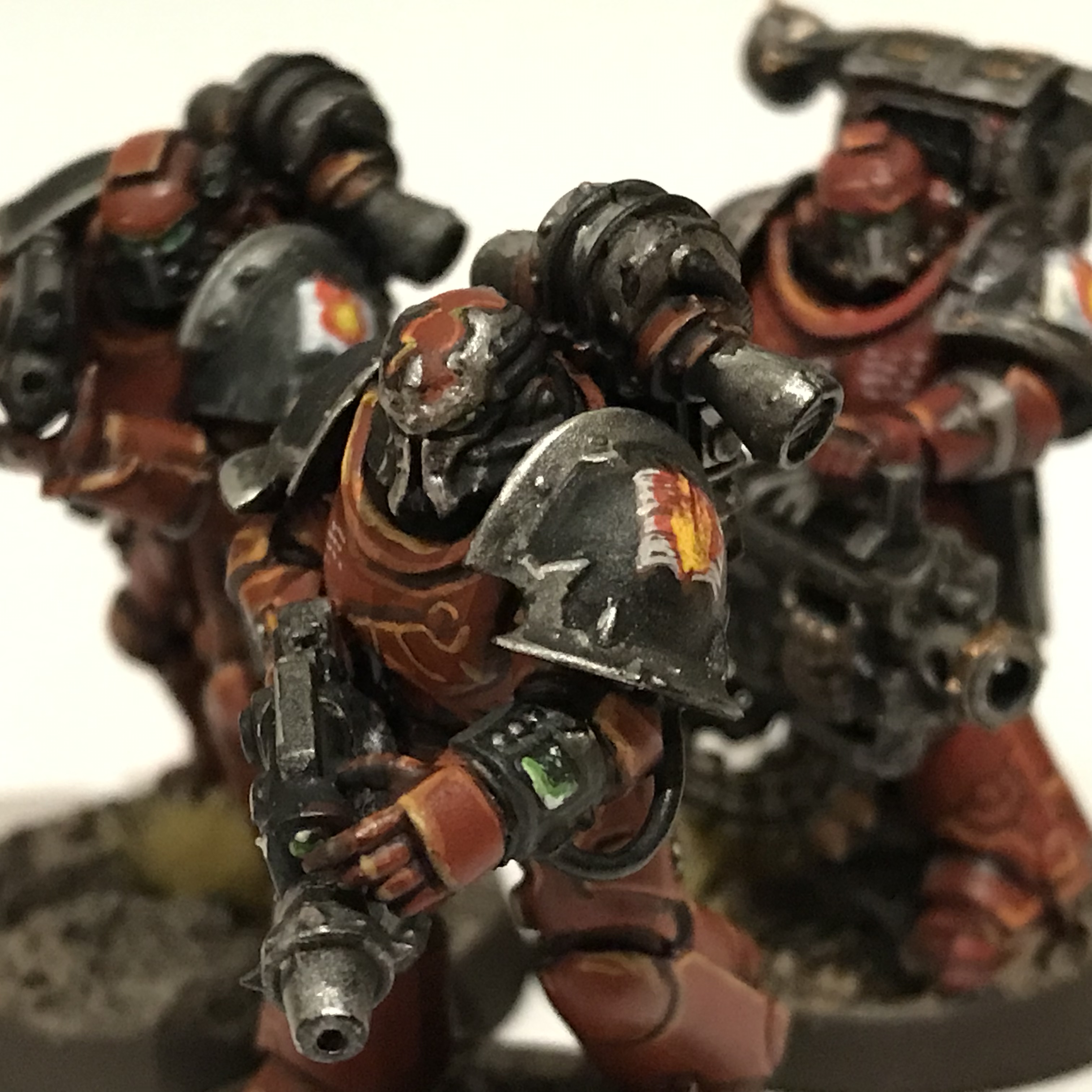
+ Definitely set mid-Horus Heresy, during the Battle for Calth, my Word Bearers likewise stalled mid-way through, though here that was due to the scheme being so similar to the Blood Angels I had been working on. I've been tempted to do a bit more red paint recently, so perhaps I'll dig through and start these up again. Oddly enough, I think the principle block is that they're a relatively small project – just ten or so marines and a Dreadnought. Too much for an evening, but not enough to be worth really dedicating myself to. +


+++

+ Salamanders +


+ With plans afoot amongst the Baraqu group for an Age of Darkness weekend over in Cambridge in September, I thought I'd see whether the muse would let me scratch an itch for Salamanders. The figure above is a loosely blocked-in tester for the army, which will use my trusty truescale marine tutorial [+noosphericinloadlink embedded+] with a couple of modifications. +

+ For whatever reason, I've always had a vision of Salamanders as being slightly bulkier than other marines, and thought that using Heavy Intercessor legs might help suggest that. They'll require quite a lot of conversion and resculpting, and to that end, I thought I'd give casting a go. Hopefully I'll be able to share my findings here! +

+++

Wednesday, April 15

+ inload: Captain Steloc Aethon +

+ Captain Steloc Aethon +

+ [Buildprogressvalue: complete.] +

+ A little greenstuff work to get the pteruges (the little dangly straps below the pauldrons) and add some detail here and there, and the noble Captain is ready for painting. +


+ The Custodes Aquilon Terminator that makes up the base for this conversion (you can find the tutorial here [+noosphericinloadlink embedded+]) gives him great stature. He's suitably towering over the Victoria miniatures baseline human soldier next to him, and he's substantially bulkier than my Astartes, too. As usual with Terminator conversions, my intention is to balance raw size against some measure of plausibility within the universe. Much bigger than this and the Terminator starts to look less intimidatingly large, and more simply a different scale. +

+ To balance this, I try to ensure that the eyeline of the Terminator isn't far off the power-armoured figures – perhaps a touch higher, to take into account thicker soles to the books, but not too much. That said, this particular example has had a slight spacer added between the upper torso and waist; just to nudge him higher than his rank-and-file comrades, so he stands out on the field. +


+ I'm no great sculptor, so the greenstuff work is mainly concerned with adding simple geometric shapes to suggest detail. Paintwork will develop these further. The rough work on the cape means it's perforce going to be painted dark in tone; perhaps a similar leather to my iteration Kurtha Sedd's [+noosphericinloadlink embedded+]. Looks like I need more practice. +


+ Anyway, I hope the resulting figure strikes a nice balance between display and gaming piece, ready for us in the Betrayal at Calth boardgame and in everyday Horus-heresy era 40k. +

Wednesday, February 26

+ inload: Legion symbols and finishing +

+ Betrayal at Calth +

+ *Phew!* That's a wrap – on mission one, at least. Last night I finished re-basing and detailing the squads of Ultramarines and Word Bearers that I'll need for mission 1 of Betrayal at Calth. Now just to find someone to play it with! +


+ Next up for this project – well, after a game, that is – will be Captain Aethon and five Terminators. I'll be making a new model for Aethon, but the Terminators will be a sprucing-up and repaint of my old Novamarines. Painting up the bits for this boardgame is proving a very enjoyable way of consolidating lost projects and satisfying random bursts of enthusiasm... +

+++

+ Your army, your way +

+ In fact, the project is helping me to further shake off the idea of a set of models 'for one army, for one game'. A few years back, I was used to collecting X points-worth of models, generally to a set army list. While this was great for getting stuff done – far less faffing around in my painting then than now – the result was that I always felt a bit restricted, and had a sense that the lists and model selection needed to be polished, or optimised, or refined. Today, I find it better to run with my enthusiasms and spend that time refining and polishing on the models themselves – whether sculpting or painting. +

+ Of course, there's nothing wrong with painting/collecting for gaming in and of itself. Playing competitive or Matched Play style games – and not just 40k, of course – you'll need to toe the line on what you add to your force, and that makes for hard decisions. However, I think the principle of such restrictions apply so far across the tabletop wargaming world that it's become a de facto standard – and that is a shame. I'm a firm believer that there's no right way to play, but when discussion is predicated on tabletop efficiency, rather than that being one of a spectrum of considerations, it's restrictive. +

+ Models built purely to look how I wanted have turned out to be surprisingly (and fittingly for Ultramarines) flexible in gaming. +
+ Using 40k (and 30k) Space Marines as an example, we've seen the premier weapon choices alter from one edition to the next as the rules altered – five man squads with lascannon and plasma gun in 3rd, through to grav cannons in 7th, for example. Again, that's not a problem, but it's a shame when such choices become exclusionary, to the detriment of the visual appeal. I don't think heavy bolters and chainswords have ever been the tournament players weapon upgrades of choice, but they certainly look awesome! +

+ With this in mind, building models with a certain look in mind – rather than a certain game effect – is a good way to surprise yourself. It's an approach I took with my Ultramarines years back, with the happy result that they've remained largely 'edition-proof'. By using restrictions given by narrative and aesthetic – i.e. getting ideas from stories and artwork – rather than by rulebooks and weapon tables, I've ended up with a force that is versatile enough to be usable in virtually any game – from enormous 40k or 30k games to tiny skirmish (or even tabletop roleplaying) games. +

+ Sergeant Aquilla leads his men through the ruins of Numinus City, avoiding TItans of the Legio Suturvora. +
+ I'm likely preaching to the choir here, but I do want to be clear that I don't see any problem with gaming competitively, or in equal points matches – those can be great fun. My point is not only that you don't have to play like that, but that there's a huge world of opportunity and cool games to be played beyond the symmetrical. +

+ In fact, even if you're a dyed-in-the-wool competitive tournament player, you've certainly used a number of forms of imbalance:

  • Asymmetrical table setup
  • Different army lists
  • Different missions
+ These things are built into Matched Play, but they are at root part of the broader scope of playing – in its truest sense. GW provide rules that attempt balance, but they're ultimately never going to be truly fair: that's why there's such an emphasis on discussion with the other player, and the collaborative nature of tabletop gaming. There is an 'inherent social contract' – but really that's just jargon for playing to ensure everyone has fun. +

+ Anyway, back to the models. I'm not suggesting that it's for everyone, but if you are tempted to build or paint something a bit off-the-wall, then go for it. You might not find what it's useful for for ten years – but by then you'll likely have a whole cast of such figures, and that's given you the props you need to tell all sorts of cool stories. Good luck! +

+++

Wednesday, February 19

+ inload: Clotho Harphagos and the Mazzikim +

+ Clotho Harphagos and the Mazzikim +


Following their shift in fortunes on the surface of Calth, the XVIIth were forced to scramble into the subterranean arcologies alongside those whose world they had murdered. The surviving force was substantial, but as organisationally disrupted as their former Imperial allies. Operating on standard battle protocols, the Word Bearers quickly formed scratch-squads – improvising swiftly to remain battle-ready.
As the Underworld War began in earnest, the formidable resilience of Ultramarine Command and Control began to demonstrate itself, and the Word Bearers found themselves on the back foot. Both Legions were forced to reconfigure themselves – and quickly – for neither side could afford the luxury of underestimating their opponents.  
The Word Bearers were, after all, far from broken. Their fanatical zeal remained underpinned by Legionary discipline, and the Ultramarines continued to struggle in their attempt to adapt to the Word Bearers' broad use of warpcraft.
 +++ 

+ The Mazzikim +

+ Typical of the temporary field-squads used by both sides during the opening skirmishes of the Underworld War, the Mazzikim were made up of Astartes from various different Word Bearer Chapters. Individual identification is further complicated by the False Flag operations the XVIIth used to mask and conflate their numbers – a problem that caused the organisationally-minded Ultramarines particular concerns when accounting for their enemy's losses. +


+ At last – a whole squad of Word Bearers complete, ready to rampage and burn down a galaxy they helped to build. This is always a rewarding stage, and I think it's worth enjoying a completed piece – whether a squad, an army, or a single figure – before moving on too quickly. +


+ The new additions are Sergeant Clotho Harphagos, and the flamer specialist Sart Kayi. They're pictured here alongside an existing figure: I usually keep a previous model nearby to ensure some semblance of consistency! +

+ Clotho Harphagos +

+ Having pistol and sword opens up the pose, so I had a lot of fun with freehand work on the sergeant – more astrological symbols and script. Note also the use of more parts from the Chaos Marine kit. I've selected the parts I'm using quite carefully; avoiding the more warped organic/mutated parts and sticking with parts that could reasonably be simple stylised designs – the idea being that the Word Bearers have their own distinctive 'look' that they apply to their armour. +


+ For example, the helmets I'm using within this force are restricted to a particular look: there are three different examples of what looks to me like a stylised Mark IV helm. I've used the one with horns for the Sergeant, as the 'Horns of Colchis' are mentioned in passing in Battle for the Abyss (not a stellar entry in the Horus Heresy series, but it does have some redeeming cool details and naval battle scenes). +

+ To me, it makes more sense for the Chaos aesthetic to have some grounding in the Legions' own choices – simply warped and exaggerated. Models like these help to blur the lines between the clean 'standard' Horus Heresy-era armour and the M41 Chaos Space Marine look in a way I think particularly well-suited to Word Bearers. After all, the Word Bearers got into Chaos before it was cool, so it only make sense that they'd adapt their look. +

+ Sart Kayi +

+ Repetition of the helmet style helps to reinforce the impression that they're manufactured to look a certain way, rather than individually warped – and deliberately restricting the variation to a set group stops things looking too bespoke. Note also that I've tried to restrain myself when using the Chaos Marine parts. Here, I've got a chaos gun, pauldrons and helmet, so I chose an Imperial backpack and a techno-looking forearm to help make sure things don't tip too far into the Chaos visual camp. +


+ Of course, you don't want your figures to be boring, so there's always space for individualisation. The freehand work is a perfect way to add some character within an otherwise uniform look. +


+ Consistency in scheme helps to tie the different elements together. The sergeant has a particuarly opulent backpack, but the use of the same steel-grey makes it look like a heavily decorated – perhaps artificer-made – variant on the others; and helps to mark him out as important. This is good both from a background point of view and a gaming one: along with the horns, it makes him immediately identifiable. +

+ This is particularly important for a boardgame figure, which may well end up being used by someone who isn't intimately familiar with the minutiae of Space Marine legions. If you know the background, hopefully there's some cool bits that you can pick out, but if you're interested in the miniatures simple as particularly complicated counters or markers, then it's good to know it's 'the one with the horns'. +

 + Note also that the backpack is not just heavily decorated; it was selected because the lower part has clearly been based on one of the older marks of armour – compare it with the Mark III and IV packs here, and the lower part looks 'right', for want of a better word. This sort of detail, built-in by the designers, is a godsend when trying to do the sort of visual blending I'm doing here. +

+ But enough of this, let's see some group shots – that's the fun bit of finishing a squad! +


+ Note that I've tried to keep the Imperial helms as uniform as possible – reducing the options here is another attempt to help blend in the Chaos helms. All but one of the 'standard' helms is one particular sculpt, with the grille/vents pointing downwards. +


+ Note that Clotho has the beginnings of the Legion markings, too – I got stuck in on his shoulder pad, and it's proving quicker than I'd feared. I hope the use of Chaos parts on him and a couple of others helps to blend in the more obviously warped Possessed marine. +


+ A nice gunline shot of the squad, just to finish off. +

Tuesday, February 11

+ inload: Calth +

+ Make new friends, but keep the old +


+ It's nice getting near a stage of completion. It might be a squad, it might be the whole army, or it might be all the bits you need for a particular game. The anticipation is often sweeter than the event! +

+ In this instance, I've nearly built up sufficient Word Bearers to play the first mission of Betrayal at Calth – just two more to polish off and I can talk a willing victim volunteer to give me a game. +


+ Of course, such an event is all the sweeter when the element is part of a larger project –  in this case, I'm getting to the stage when I can make some fun dioramas and play some games between my beloved Ultramarines and these new pretenders. +

+ Building +


+ The marines above are more Word Bearers – I've managed to trade for some of the new Chaos Marine bits, so the helms and pauldrons shown above will be dotted through both squads. +


Friday, February 7

+ inload: Objective creep +

+ The Mazzikim – and historical accuracy in a future war +

+ Markings, weathering and a few little details to go +

+ More painting, more progress. While still WIP, these chaps are crawling along. However, with just twenty-one (and a Dreadnought) to paint, they're not an insurmountable project. I definitely find it easier to push myself on a slog when a project has a definite scope. +


+ The WIP shot about shows ten marines, including a couple of specialists (flamer, heavy bolter and possessed), so getting near to being halfway through. The majority of these will likely end up in the Mazzikim – one of two hotch-potch remnant squads fighting in the Underworld War – but at least one will need to join the other squad, in order to create space for a Sergeant. +
  • Sergeant Clotho Harphagos
  • Mugla of the Blasted Cedar – boltgun
  • Kimon of the Inscribed – boltgun
  • Coran of the Blasted Cedar – boltgun
  • Arrian the Medean – boltgun
  • Urka Madis – boltgun 
  • Bac Vorkar of the Third Hand – heavy bolter
  • Vannis Gen of the Inscribed – boltgun
  • Tantal – boltgun
  • Sart Kayi – flamer

+ Emboldened names here are figures that were already ready for play (i.e. they just need finishing touches). I now need to pick who's who for the three in the picture at the top. Since I have some WIP shots, here's a pic of them a bit earlier in the painting process, with just the red done:


+ After this, I played around with some more glazes and final highlights, then painted in the metals. Adding the metals and eyes goes a surprising way to getting these near completion. +


+ Objective creep +

+ We've all been there – you put your main projects to one side in favour of 'a quick sideproject'. It's 'just come off the backburner'; you wanted 'a quick palette cleanser' before getting back to your main project... only it isn't. The side project catches your imagination, and before you know, you've got really deep into the lore, ordered a load of extra bits, and the project's taken on a life of its own. The infamous hobby butterfly strikes again! +

+ Not inherently a problem, of course – and I'm an advocate of running with your enthusiasms where possible. Few things are more tiresome than having to force yourself to paint – it makes your hobby a job. +

+ The problem I do have with this is that indulging the hobby butterfly can mean that early parts of the project end up looking a bit half-hearted. As mentioned in an earlier inload, these Word Bearers were intended as a quick side-project; minimal conversion in order to get them on the table. In practice, I found myself enjoying the process, and have been lavishing more attention on the more recent members. +

+ Here, I think the painting has remained relatively consistent, but the underlying conversion work is gradually becoming more complex, hiding more of the Mark X basis of the figure, and drawing out more of the familiar Horus-Heresy look. Finding a balance between time available and simply getting figures done has become more important for me in recent years, so the underlying figures above have not been converted to the extent that I might once have done, as shown in a couple of examples below. +

+ Mark II Crusade plate – a conversion that led to Praetor plate becoming 'canon'. +

+ Mark IV Maximus plate; full conversion +

+ Anvils of Konor picked up on this on a post I put up on Instagram last night to say that they're not as obviously Horus Heresy-era as they could be. By the time I got back to the picture this morning, it had escalated into quite a heated discussion on the relative merits of what makes a figure fit into the Horus Heresy or not, and it was interesting to see the back and forth. +

+ Altogether simpler – Mark IV Maximus with minimal sculpting. +
+ I hasten to make it clear there's no hard feelings on either side. AoK is a fantastically talented converter and painter, well-known for the care and attention he pays to his miniatures – I'd thoroughly recommend your check out his stuff. +

+ He (quite unnecessarily, but very kindly) got in touch to apologise about what he felt was his slightly abrupt phrasing, and we fell to chatting about 'historical accuracy' within the HH era, a topic that has popped up a few times, and tends to end up with two entrenched camps. He and I are going to put together a future inload to discuss this concept of historical accuracy in Horus Heresy-era gaming, and in wargaming in general. +

+ It's an issue that's got more complexity than the partisan issue of 'rivet-counters' vs. 'lazy modellers' it often devolves into, so I'm hoping we can put together a more nuanced discussion of the topic; one with a vibe that's more 'friendly chat around the fire with a brandy' than 'debate with the enemy'! +

+ Best of all, I hope I'll be able to showcase some of AoK's stunning work here, and share it with you. +

+++

+ Ahead of the article, I'd love to hear your thoughts on 'pseudo-historical accuracy' within wargames in general, in order to get as broad a set of discussion points as possible. +

  • How important is personal creativity and individuality to your hobby? How does that relate to fitting your models in with the established universe?
  • How far do you consider compatibility with others' work when painting, modelling or gaming? 
  • Do you like playing with and against more familiar 'canon' figures and armies, or more unusual and individualistic 'counts-as' forces?
  • How does it relate to the implied social contract of gaming or sharing your work? 
  • Where does the line lie for you between including everyone and setting particular standards?
  • Do you see the official lore/'canon' simply as a starting point, or a common factor to be included where possible?

Wednesday, February 5

+ inload: Bleak Vespers and Word Bearers +

+ We could be heroes +

+ Death Guard +

+ Series 3 of the Space Marine Heroes collectibles were these Death Guard Plague Marines. PCRC packmate TrojanNinja was heading out to Japan, and kindly picked up a box for me. Apparently, Japan applies a 'no gambling' rule to things like collectibles, so boxes of random packs like these have to include every possibility – very useful for me, as it guarantees a box of six contains all six, with no duplicates. +


+ A very enjoyable day of hobbying (and a belated Burns' Supper) with the PCRC lads over at Chateau Stuntwedge gave me some valuable building time. Fantastic models to put together, and I've left them uncoverted save for the head swaps to better fit the theme of my Bleak Vespers Company. For those of you tempted to pick 'em up when they come over here, they're push-fit, come with cool sculpted bases, and – to my eye at least – there isn't much 'filler'; all the poses are cool. +


+ Beyond that, there's not a huge amount to say. They'll make a nice Kill Team as well as being a good – and oddly affordable – source of specialists. While the kits aren't cheap, to get a champion, icon bearer and Plague Marines with flail and plaguespewer from GW would be considerably more expensive. +

+ Word Bearers +

+ The same day out saw me build another couple of Word Bearers, using some Chaos Marine parts that I traded for. +


+ Very simple conversion; little more than kitbashing, really. I've trimmed the kneepad trims and ankle bobbles, removed the Imperial eagle on the chest and reduced the collar height. The remainder is kitbashing – heads and shoulder pads from the new Chaos marine kit fit without adjustment, as do arms from the Revier kit (these lack the forearm reinforcement on the Intercessor kit, if you're being very fussy about 'historical authenticity' – I just wanted them for the cool boltguns with the front handles). The backpacks from the Mark III power armour kit require a bit of additional trimming at the top of the back. +


+ Not quite sure about the horned helm and chaos backpack – perhaps a bit too on-the-nose for Heresy-era stuff – so I might swap a couple of bits on the melta gunner. +

Monday, February 3

+ inload: Word Bearers Possessed +

+ Mekholta Dmalachi, Twiceborn of the Blasted Cedar +


+ Odd what you miss, isn't it? I could have sworn I'd written an inload about this fellow in the dim and distant past, but my mem-banks have seemingly suffered a cascade-fail. Never mind; it's an opportunity to revisit an old model, now that he's been updated. +


+ Possession +

+ Insofar as any warp-related phenomenon is explicable, possession usually implies the dominion – forcible or otherwise – of an alien's life-force (i.e. soul, ba, psyche – call it what you will) over another's physical corpus. Extra-material species such as the Krell use such methods to procreate and spread, their common names of Enslavers or Dominators making their methods clear. +

+ The possessing entity circumvents the host's life-force, either destroying it completely or displacing it to the status of impotent witness. Such are the majority of the known cases of possession of Imperial citizens: an aggressive warp-predator 'taking over' the body of a peon; usually a psyker of some minor talent. +

+ Once in control, the warp-predator or daemon will usually twist and adapt the physical structure to better suit its alien whims, causing rampant physical deformation considerably beyond more regulated mutation. +

+ Possession is usually an involuntary process, but cultists are known to invite warp-entities to possess bodies – usually unwilling victims, but occasionally the cultists themselves. +

+ Voluntary possession +

+ Where possession is voluntary, the inhabitant's life-force may be able to continue to enforce itself upon its body, living alongside the invited entity. If the inhabitant is strong-willed enough, they will gain access to the daemon's strengths – hyperphysicality, extra-sensory perception and so forth – an tempting offer for a typical low-status cultist. +

+ Such co-habitation is usually short-lived, as daemons are rarely willing to co-operate where they can control. Unless the inhabitant is strong-willed and attentive enough to resist the daemon permanently, he or she will almost inevitably be tricked, forced or convinced to drop their guard – at which point the daemon will assume full control. +

+++

+ Astartes and possession +

+ Steeped in the warp, the Traitor Legiones Astartes are known to field shock troops made up of possessed warriors. Some are simply shells of Astartes, while others are hybridised, retaining both their original Astartes strengths and the insights and skills of the possessing daemon; some able to switch back and forth – in essence giving one or other 'soul' temporary control to better serve battlefield conditions as felt appropriate. +

+ Inquisitors of the Ordo Malleus believe this practise dates back to the Horus Heresy, under the auspices of the treacherous Lorgar, Primarch of the Word Bearers. The Chapter of the Serrated Sun was possessed en masse, and they and their possessed successors were fielded in a number of crucial campaigns including the Isstvan Dropsite Massacre, the betrayal at Calth, and the Siege of Terra. Seeing the effectiveness of the 'Gal Vorbak', other Legions soon sought counsel with daemons, leading to other, similar, formations such as the Lupercii of the Sons of Horus, and the Woesmiths of the Iron Warriors. +


+ The Word Bearers treated possession as a form of ascendancy, seeing bodyshare with a warp-entity as a natural next step in their post-human progression, akin to the surgeries that had transformed them from human to Astartes. Their belief was that possession was a necessary consequence for humankind to survive and prosper. +

+ For these reasons, Word Bearer possessed forces refer to themselves as the 'Twiceborn'; believing possession to be a form of second birth into a new life. +

+ Betrayal at Calth +


+ The deep blood-crimson of the Word Bearer's armour came as a shock to XIII Legion forces during the Battle for Calth, though nowhere near as shocking as the presence of the twisted forms of the Word Bearers' elite Twiceborn. +


+ The daemon-ridden Twiceborn were at the Vanguard of the Blasted Cedar's assaults on Trenchant Ridge. It proved impossible to meaningfully quantify the Twiceborn's effacity, as their combat effectiveness seemed to vary substantially from engagement to engagement. +


+ The distinctive sigils of Colchisian script dotted their armour, but much more alarming was the corona of nameless colours that danced around their bodies, crackling and arcing onto the ice and snow of the region. +


Tuesday, January 28

+ inload: Flow, rhythm and composition: army-building for impact +

+ Flow, rhythm and composition: building for impact +


'I love the smell of Calth in the morning. Smells like... victory.'

+ What makes Space Marines look awesome? Puny hu-mans next to them. But why? In this inload, we're going to have a look at (artistically) composing your figures – and how that can relate to the (structural) composition of your army. The idea is to make an army that not only plays well, but looks cool. +


+ As an illustration here, the next three Word Bearers are on the painting blocks, and accompanying them are some 'blessed' unfortunates. We'll kick off here with discussion of composing a squad. +

+ Framing figures +


+ When building squads, I always have to restrain myself from making every model very different and individualistic. Such an approach works well for disparate bands of specialists (such as Inquisitorial henchmen) or ragged rabbles like orks, but with Space Marines, you risk making things look too busy. For this reason, it's usually worth including a few figures in fairly restrained poses, like those above. These work as a frame for your more eye-catching focal figures. +

+ Note that restrained doesn't necessarily mean boring or dull. While these two figures share a basic pose – advancing and attacking – one is reloading on the move. A simple addition that adds some flavour without grabbing the attention. +


+ Note also the variety in helmet and pauldron styles. The figure on the left is showing the incipient signs of the corruption that will envelop his Legion; two teeth emerging from the bottom of the pauldron. This is to provide a visual link between the cleaner lines of the plainer Astartes to the full-bore monstrosities of the Gal Vorbak-based figures [VISREF: Below]. I don't mind a little gap – after all, these are meant to be collections of survivors that have made it into the tunnels, so some distinction between members is fitting (not to mention more interesting to make and paint). +

+ Word Bearer ripe in his corruption +

+ Focal figures +

+ Of course, a frame's pretty boring on its own, so a good squad will have two or three focal figures. I think people tend to have favourite models; generally created without much conscious thought – some combination of bits just seem to work better than others. It's common to load up the sergeant or specialist with extra bits or otherwise lavish more time and energy on them. These are focal figures, they're the ones that the framing figures serve. + 


+ If I have a 'trick', it's simply that I'm just as likely to lavish time and attention on regular grunts as specialists. This fella's a good example. There's nothing inherently different about this figure, but I've selected the parts a bit more carefully, perhaps used some more unusual bits, and generally spent a bit more time composing him. As a result, he's more eye-catching and interesting. +

+ This command group serve to frame the focal commander – but the framing figures aren't boring; just equal in impact to each other, and less than the commander. +

+ Proportions are important here. For a disciplined-looking force, I'd suggest a ratio of 1:4 focal to framing figures – that is, for every focal figure, you should have four framing figures. For more rambunctious-looking forces – orks, harlequins and the like – a ratio of 1:3 or 1:2 is more likely to get the idea across. +


+++

+ Focal, frame and contrast +

+ Having looked briefly at how to make a striking group by distinguishing between framing and focal figures – now let's take that a stage further, and consider how that applies beyond the squad: across the army as a whole. +

+ Contrasts, in hue or tone or size or shape – or any of a thousand other options – are what catches people's attention. Too much is overwhelming, too little is dull. When building a squad, we decide that some figures are going to be the focal points, and others will play a supporting role. There is a sense of contrast created between the two groups, but there's enough similarity between them to create a blend so they look coherent. +

+ No framing/focal figures: All created equal – and thus no-one in particular grabs the eye. The group is elevated over the individuals – perfect for a team. +
+ All focal, no framing. A mix of colours, sizes, textures, and poses. The group is loosely tied together by a few common element including vertical lines (staves, banners, pointy hats etc.), a common muted palette and basing. +

+ It's clear here which are framing models, and which are focal. + 

+ Now, this is nothing new, and you probably already compose things unconsciously – those favourite models we mentioned earlier, for example. When building your army, we can just apply those same principles. Thus, when building a squad, we include some focal figures that are just a little different from the framing figures; and when building an army, we include some focal units alongside framing units. +

+ Composition and scale: Less is more +

+ Centrepiece HQs and tanks are a common concept – and they're an illustration of how the same compositional principles can be applied across an army. By including different squad types along with vehicles and characters, you create visual contrast. +

+ The infantry and vehicles contrast with one another. +
+ In this simple example – an Epic: Armageddon Support Company – the dominant vehicles are the focal figures; the infantry working to frame them. Being different from both focal and framing figures, the Dreadnought offers a complement to the group – similar to how accent colours work in a palette alongside the primary and secondary colours. +


+ The same applies at 40k scale. Here, the Ultramarines squads have both framing and focal figures (an example of the latter is Holion sheltering Cassie at the bottom right) within them at a micro level. At a macro level – that is, considering the platoon as a whole – the infantry all become framing figures, letting the Predator tank and Dreadnought sing out. +

+ Of course, if you look more closely, you'll pick out the focal members of the infantry squads again – but the thing to take away is that the army works on two levels: micro and macro. The principles are thus scaleable, and this can be borne in mind to make a more striking army. By holding something back when creating framing elements, you naturally make more of the focal elements. Less becomes more. +

+++

+ Composition and rhythm +


Repeated elements form patterns. Frames turn out to contain focal features of their own. This concept can be thought of as 'rhythm'. A good painting – or army – has rhythm. +


+ Lucifer216's stellar Adeptus Mechanicus force is a great example of what I mean. Tanks and characters stand out from the infantry, but note that the infantry themselves are varied. Look closely (micro) and you pick out different squad types; but from tabletop (macro), the common palette helps them work together to frame the focal tanks and characters. Look at the tanks and characters as a group, and you'll see that the Dunewalkers cease to be the focus and instead frame the Archmagos. These overlaying points of view are an example of rhythm, and how it can be successfully applied to an army. +

+++

+ Theoretical: illumination +

+ Compare the two forces below. One is more carefully composed than the other. Beyond that, they're very similar – both include Primarchs, walkers and infantry, there's roughly the same amount of figures... but one definitely looks more striking – and it's nothing to do with the colours or quality of the paintwork, but simply how they're arranged on the table. +

+ Low impact +


+ The Ultramarines here appear as an almost undifferentiated mass. There's no space between the figures on the board, so it's hard to pick out different groups. The naturally-focal figures – the Contemptor Dreadnought and Primarch – fail to stand out. +

+ Little rhythm is created, because there are no gaps; and little differentiation between frame and focus. Where focal figures do appear, they're swamped by the imbalance of framing figures, so the eye doesn't hop back and forth. +

+ A general sense of uniformity is created. Nice for certain effects, but it's not giving the drama we'd hope a game or display should have. +

+ High impact +


+ A variety of different sizes here, structured and separated by visual breaks. Infantry, war engines (rapiers, robots) and a large centrepiece (Leviathan Dreadnought) create three tiers of interest, so the eye hops between the groups. +

+ Rhythm is created by repetition – six groups of infantry; three robots; two rapiers. Within each group, there are points of interest. There are different types of infantry; differences in pose and armament of the robots. The eye hops, and lingers, and moves again. The mind recognises patterns and repetition. +

+ Whether in-game or simply for display, having a nicely composed army will improve the look of our collection. +

+ Practical: application +

+ All very well in theory, but what are some practical steps to we take to use this information? Here are some starting points for you to consider.

  • When planning your army, think in terms of focal and framing rather than 'normal' army composition rules.
  • Decide what the main focus will be (i.e. pick a particular focal unit to be your centrepiece).
  • Leave your centrepiece unique – don't have a competing figure.
  • Maintain a proportion of at least three framing units to each focal unit. It's hard to have too much framing, but easy to have too many focal units competing for attention.
    • Remember that framing units doesn't mean boring – they can be exciting and varied within themselves, too.
  • Include a variety of sizes of figures – infantry, medium vehicles and large vehicles/infantry, cavalry, war engines.
    • Within each group, aim to create internal variety, rhythm and repetition.
  • Look at each unit from a micro perspective, and your army from a macro perspective. Does the balance feel right?
+ As in any analysis, these terms – rhythm, repetition, focus, frame – are simply aids to understanding. They're ways to help you identify and discuss things we often already know instinctively. There's no need to get caught up in them; but if you're trying to work out why your collection of beautiful figures doesn't quite hang together, you might look at your army composition. +