Tuesday, September 8

+ inload: Phalangite Polimistes +

+ inload: Phalangite Polimistes +

Tresantes. Coward. Nothing is a worse insult to a Legionary of the IV. The Iron Warriors' central philosophy came to be built around interdependence and subservience of the individual to the group. Perturabo intended his legion to work like a single organism – a machine that was an extension of his will. To betray this through vainglorious individuality was judged poor form – though tolerated if it brought success – but to turn and flee was anathema. +

+ So far, so unremarkable. Warriors through the millennia have shunned those in their ranks whose courage failed. The post-human Iron Warriors took this ideal beyond normal boundaries of endurance, elevating conspicuous stubbornness to the status of a virtue. In the context of the Olympian historical traditions, this virtue took on a quasi-religious form, which survived – distorted and twisted – in the Iron Warriors' own traditions. +

+ Thus the term coward was not simply a sting in the Olympian tradition. It carried with it connotations of oath-breaking, unfaithfulness, a rejection of every group ideal, and left the individual bereft of support; both externally (from soceity) and psychologically. For an Astartes, whose entire life was winnowed down to a tight focus – unleavened by spiritual, marital or moral comfort – it was unbearable. Honour was all. Iron was all. 


+ Little documentary evidence remains of Phalangite Polimistes in the Great Astartes Librarium on Terra. Unfortunately, this means it is equally difficult to say whether this was an accidental loss of information – all too common in the years following the Horus Heresy, or a more deliberate excision from Legion history. This possibility is raised by a number of intriguing hints about these pict-captures. +


Judging from the powerpack (often the best identifier) His armour is mostly Mars-pattern Mark IV, but has clearly suffered some extreme damage at some point, as the torso and helm are unusual and non-standard. Polimistes' combat blade – an easily-unsheathed trench knife – sits on his hip, opposite a Coron-pattern helm, an unpopular and little-used variant which was bulky, prone to autosense-failure, and had exposed piping. It was part of the group of prototypes relegated to replacement and training; and not intended for front-line combat – part of the mongrel plate later classified 'Heresy Armour'. That it is being used here indicates the pressing need for all available Astartes to be in the field. +


+ The standard XIX Muster tactical markings are present, which belies the possibility of censure; though it is equally likely that these markings have been added later. The Coron-pattern helm is more obviously visible here, along with extensive corrosion on the lower legs – possibly rad-damage. Barely visible on the thigh is an oathpaper. While black pseudoleather was commonly used amongst the Iron Warriors (to reduce visibility during trench warfare), these were usually written with white ink. The pure black of this oathpaper might indicate that it has been deliberately obscured – dyed or written over as a mark of penance. +


+ Ultimately, the truth will likely never be known, but the combination of such hints is tantalising. Repentant coward? Twice-traitor? Or simply a soldier fighting with second-class wargear? The contemporary viewer must make up his own mind; and draw their conclusion from the unclear evidence above and – perhaps – the look of furious desperation etched into his features. +

Monday, September 7

+ inload: Watch +

+ Watch +

+ A short story +


+++

A hand, muckily-bandaged, landed heavily on his shoulder. He looked up.
"Long way from the lines, aren't you?" Without waiting for a reply, the older man continued. "Talk you into first watch?" He nodded. "Hm. A kiep's game. You'll end up with the last, too, since it's harvest now."

They both paused and looked up.

The weather was unchanged, and the light was no different than it had been when the boy had arrived many months hence. He had slipped and scuffed the chalk strokes he had made on the post to mark the passing of the watches. None of the other lads seemed much bothered by timings.

"Ship-in?"

He nodded. "Yes, sierzant. Last relief." I think, he added to himself.

"Hm."

The air was still. A haze hung in the air, though it was not particularly hot. One of the others in the garrison had waved his hand vaguely as he talked about the explanation the officers had given for this before they had gone away. He couldn't remember exactly, and no-one had listened closely.

The sergeant remained crouched on the edge of the dugout as the pause lengthened. One hand absently resting on the watchman's shoulder, the other slackly holding the strap of his sling rifle, the older soldier blinked slowly. He lifted his hand to scratch at his jaw, dark with the beginnings of a beard. The ground rose up gently both in front and behind them, leaving them in a broad, dusty valley. The ground was dry, dusty and broken, pocked with old shellholes, half-filled with dust and scrubby grass.

The dugout was essentially just another crater. It was less than a foot deep, though it had a small parapet of unsecured flinty stones on one side. There had been some reeds at the bottom, and then a duckboard, though that had rotted and broken away some time ago. The pooling rainwater that resulted from the occasional light shower had bonded with whatever had been used to seal the wood, and as a result, the dugout never quite drained dry. He had thought of suggesting they move the dugout to a nearby crater – there was one not three yards away that was larger, and deeper, and with steeper sides – but he had seen the whippings the Commissars had doled out at basic training. Initiative was not encouraged in the garrison.


+++

When he had come to relieve the previous watchman, the younger soldier had shaken him awake. Bleary-eyed and irritable, the other man had stood up, clambered out of the pit, and muttered something to him in a language he didn't understand. He began walking away down the valley, answering the young soldier's half-question with a grunt and a vague gesture towards the hills.

The younger soldier had stepped down into the dugout, and laid out his equipment. He carefully placed his knapsack and blanket down to one side of the puddle at the bottom, then fussily lifted them out again when he thought they would slip. He moved them to the other side, and – as had become his custom – he wedged his packet of lho-sticks in the crack in the old wooden post where a sign had once been nailed.

He sat down, neck canted stiffly to keep it below the dusty rockline, and watched the figure receding into the haze. The other soldier had an incongruous dustcoat, the watchman realised jealously. He picked at the thin yellow-brown windcheater he wore over his vest. He had to keep his feet braced against the side of the crater to keep his legs out of the grey-brown puddle.

Occasionally, he would overhear distant gunshots, or feel the dull thump of shellfire far away. When this happened, he would painstakingly etch a cross on his map in the area from which he thought the sound had originated. Writing did not come easily to him. After it had been quiet for a long while, he reached up and drew out a lho-stick from the waxpaper packet, holding it upright so the stale rebacco didn't fall out of the papery tube.

He lit the stick, absently sheltering the glow with his cupped hand as he had been taught. It was quiet. The sky was a bleached yellow-white, despite the brooding blue mass of Profundis overhead. After a while the lho-stick was finished. He rolled the end across the flinty stones, watching the embers turn grey, then flicked it away. It hit the soil a yard or two away and bounced slightly. He looked at it, face blank.


+++

The older man took his hand away and stood up, staring off into the middle distance. The watchman scratched the back of his neck and turned to look in the direction the sergeant was looking. There was nothing there but the hills and the haze.

"Sierzant?"

"Yes?"

"No-one told me where the enemy are."

A hint of a smile crept in at the corner of his mouth.

"It's not that kind of war, son."

The younger man took a breath, as though preparing to speak, but paused.

"That's good." he said, eventually.

"Yes."

There was another pause.

"Do you have any ammunition, sierzant?" the younger man queried.

"Of course."

"Should I have some? I mean -"

A sharp crack, nearby this time, interrupted him. Both men tumbled into the foxhole.

"Blast! Did you see-"

"Was that a rifle?"

"Get your notebook! Get your notebook!"

The two lay in a tangle of webbing and ochre fatigues. The butt of the sergeant's rifle was jammed against the side of his knee. His own rifle had slipped from his grasp and lay in the inch of so of foetid water at the bottom of the foxhole. He awkwardly fumbled his map pocket open, drew out the little leather notebook and handed it over.

"Did you get eyes on it?"

"No sierzant. I think it came from over there." He pointed over the flint parapet. The sergeant's face screwed up.

"Forget it. Those hills are ours. The patrols have got turned back again."

The younger man blinked. He had been watching those hills warily.

"The enemy - ?"

"No, nothing like that. It's just..." the sergeant trailed off as the watchman mournfully inspected the muddy end of his rifle's barrel.

Looking up, he followed the sergeant's gaze. In the sky, the blue planet hung over them like a cataract-ridden eye. He had been told – though he could not recall when, or by whom – that the light and dark patterns were made by clouds. He had accepted this blankly. He wondered if the thin yellow clouds in the sky here looked blue from the top, like those on brooding Profundis.

It must be windy there, he thought, watching the patterns shift.

"Throne. Again."

"What's that?"

"What's that, sierzant." the older man said, irritably.

The sergeant didn't expand on his curse, nor respond to his quiet apology. They sat awkwardly hunched for a few minutes more. Eventually, the sergeant poked his head up over the side.

"Hm." he said. He lifted himself out of the foxhole and sat on the edge. He pointed at the packet of lho-sticks wedged in the dry old post.

"Those your szlugs?"

"Yes, sierzant." the younger man said. Sitting up, he pulled the packet free, tapped it on his leg and offered it to the other. "Would you -?"

Wordlessly, the sergeant took the pack. He watched as the sergeant peeled the waxpaper back and drew out three of the four remaining sticks. He placed one in his mouth and tucked the other two into a breast pocket.

"Long walk back." he said, by way of explanation. He handed the watchman back the packet. "Light?" The younger man pulled out a match from the book, lit it, and proffered it to the sergeant. As the other man knelt and leaned in, he tucked the matchbook back in his pocket and buttoned it protectively. If the sergeant took any notice, he gave no sign.

'We'd have to requisition it."

"I'm sorry?"

"The ammunition. We'd have to recquisition it. Pain in the arse. Have a look around, that's what we usually do."

He looked around. The thin soil revealed no hidden caches of laspacks or bullets.

The older man stood up, placed his hand in the small of his back and stretched. He gave a small grunt of pleasure and breathed out a slow plume of smoke. The colour matched the haze of Profundis exactly.

"Well," he said "Best be off. Carry on." He began to walk away, and the watchman stood up in the foxhole.

"Wait! Sierzant! Don't you need my map notes?" The other man kept walking, soon disappearing into the haze.

He sat back down. He opened up the packet of lho-sticks to inspect the lone remaining stick. He blinked. It was full.

He looked up at the blue planet again. It had not moved. He could not remember it ever moving.


+++

+ inload: Phalangite Ërnach Koinos +


+ Ërnach Koinos of the Iron Warriors 242nd +


+ During the battles of the Horus Heresy, Hyoidites (communications specialists) of the Iron Warriors were assisted by a Second. These individuals were non-specialist Phalangites, who had received no additional training. Their role was to record transmissions and relays, serving as a back-up in case of the Hyoidite's injury or death. +


+ This pict-capture shows Koinos bearing a farscope, forearm-mounted calculatrix-apparatus and a head-borne occulix. These were used for arithmagick and info-loading; creating raw data for the Hyoidite to utilise and transmit to command. While non-specialist, such seconds were still Astartes, and would have received communications and command/control training. Often such individuals were being groomed for further training; but such was the Iron Warriors' instinctive proclivity for mathematical talents, there was never a shortage. +

+ Many, like Koinos, bore equipment on behalf of the Hyoidite. This served the dual purpose of unburdening the Hyoidite, and giving him a responsive and mobile scout from which to refer. Rather more grimly , this made the specialists harder to pick out, at the expense of the Phalangite second. +


+ The Phalangite has removed his helm. The pict-capture might be thought to show him in a non-combat situation, but close inspection shows the popped rivets on the Mark III helm's reinforcing 'brow'. Perhaps damage has rendered the autosenses unusable. Fortunately for our purposes, this reveals the underhelm. Commonly formed synthseal like the rest of the undersuit from post-Terran Mark II onwards, earlier versions designed for fighting in the opening years of Unification were made from pseudo-leather – or even stuffed horsehair in some archaic examples from Thunder Armour suits. +

+ The underhelm is a common but optional part of the flexible bodyglove an Astartes soldier wears beneath his plate. It provides comfort, a small measure of additional protection, and helps to clamp corpo-cables in place, speeding up integration with the plate. In later marks of armour, the armour cables are drawn into the ports on the Astartes' head and spine as the underhelm is slips over the head. This allows greater Communion with the armour by projecting the armour's runic display on the wearer's retina, giving them aid in the visual fields. This is referred to as 'bringing up the armour's hood'; a term believed to have ritual significance for those instructed in technomancy by the adepts of Mars. +


+ This image highlights another of the non-standard elements of Koinos' battledress: the heavy segmented section of armour between the legs. This was more commonly seen worn by artillery crew and engineers, where the 'apron' helped protect bystanders from accidental detonation or shrapnel during mine clearance. It also lowered the Astartes' centre-of-gravity for additional stability – which is likely why it is used by Koinos here. +


+ The amount of equipment borne by Koinos begins to make sense here, as the vox-comms unit integrated into his backpack reveals he is also operating as the unit's signalman. It is unusual for him to be performing both roles, and this is likely owing to battlefield circumstances. Perhaps his armour's machine spirit integrates particularly well, or perhaps he is simply precociously capable? The answer will likely never be known, as Koinos was decapitated by an Imperial Fist mine during the closing stages of the Siege. +

Thursday, September 3

+ inload: Phalangite Tolga +

Tolga's lungs felt like crispy paper bags. He breathed out raspingly, a pink cloud of aerosolised blood emerging from his helmet's vent-grille. That answers that question, then, he thought ruefully. His armour had let in some of that gas. No time to find the pharmakon – and in any case, the apothecaries had more on their plates than a cough. After that last drive, most of the third Line Company had come limping back with shattered limbs, shredded internals or dragged back unconscious in recuperative sus-an states. 

The latter group were especially fortunate – most casualties were left in the field as a matter of expediency. The Siege was making monsters of everyone. Learning that those loyal to Horus would attempt to extract injured comrades, Imperial Fist recon teams and Mechanicum vis-strike groups had quickly established a tactic of immbolising live casualties and making corpses of any forces attempting to retrieve them. Extracting fallen comrades had essentially become suicide. 


+ Phalangite Tolga +


+ Mark IV plate was readily available to the traitor legions owing to the Warmaster's forward planning. As a result, many amongst the Iron Warriors had inherited a new set of armour, though far from all. Many held on to older customised suits, while others had simply adapted to the peculiarities of their Mark II or III plate. Further complicating this was the high attrition rate of the Isstvan campaign, as the supply of the advanced materials and specialisatoin required for the correct maintenence of Mark IV dwindled. As a result, many suits, Tolga's included, utilised older parts. In this example, the lower legs and pauldrons are older Mark II sets. Judging by the heavy damage to both, they may well be taken from Tolga's own old set of plate. +


+ While not completely interchangeable, the various marks of power armour were (and remain) largely compatible. The adaptation and refinement of armour to personal preference was particularly marked in the IV Legion from the very first, and Tolga is pictured with additional plates to help cover the exposed soft armour of the undersuit at the hip joint. Legionary warfare was a famously close affair, and the covering of a potential vulnerability such as this could make the difference between life and death. +


+ Tolga has sustained heavy damage to his right pauldron, with a clear shearing stroke – likely made with a powered blade – cutting through the plate and rim of the shoulde rpad. The benefit of simple markings becomes clear, as the bold vertical yellow stripe still marks him out as a member of XIX Muster. +


+ Tolga's trailing leg bears an honorific Legion skull and scroll on the knee area, marking him out as a veteran of the Rock of Judgement campaign. He bears a standard Tigrus-pattern boltgun, an advanced and compact boltgun whose only minor drawback was the relatively short magazine, which bore just twenty-five bolt rounds. +

+ A treatise on Mark IV +

+ Although some Legions, such as the Luna Wolves, had been using Mark IV extensively even before Ullanor, the mark was still relatively new by the outbreak of the Horus Heresy. The armour was intended as a complete replacement for all Astartes – a new beginning following the hard years of Crusade that benefitted from the hard-won knowledge of the Crusade. Mark IV incorporated all of the innovations retrieved by the Mechanicum over the course of two centuries, and performed better in almost every respect to earlier marks, even taking into account specialist suits such as the tunnel-fighting suits of Mark III. +

+ In addition to practical matters, Mark IV was to be a propaganda tool. From Ullanor onwards, the vision was for all Astartes to wear gleaming, uniform Mark IV, whether serving as a tactical squad member, breacher, recon, assault or artillery specialist. From one spiral arm to the other, Imperial Maximus armour was set to become iconic imagery known by Imperial and Xeno alike. +

+ To this end, Kelbor-Hal, the Fabricator General of Mars itself, issued a Bull that all Mark IV was to hold a uniform visual pattern design, regardless of the Forge World from which it was commissioned, or on what planet it was manufactured under license. Such was the control that the Imperium commanded over galactic communications immediately post-Ullanor that the new armour mark saw fewer variations than any other, even taking into account its short existence. +

+ The superior nature of the engineering and materials used in its manufacture mean that the Mechanicum could follow the standing orders and disguise changes under the standard chassis, maintaining visual uniformity. The advances and rediscovered knowledge from the lost Forge Worlds returning to the folds largely meant that this was possible, though it added considerably to the complexity of the armour and made its manufacture slow, particularly in galactic backwaters and far-flung Forge Worlds. +

+ As a result, shipments of the plate were only gradually replacing the earlier marks in use by the Legions – including the more bespoke variants developed by individual Legions, such as the Ultramarines' Praetor-pattern plate, or the Sing-pattern recon suits of the White Scars – as hostilities began during the Horus Heresy. +

+ The dream of galactic uniformity amongst the Astartes' was never realised. At the time of the Isstvan III atrocity, barely half the Astartes Legions had received shipments. Even amongst those issued the advanced plate, the fine engineering work caused by the adherence to a visual design meant that it was difficult to repair and maintain, and as a result local versions of the suit sprang up almost immediately. These bastardised versions, often made from inferior locally-sourced material, or backwards-engineered and jury-rigged from existing supplies were jokingly referred to as 'Mark V' suits. The appellation stuck. +

+ inload: A Helping Hand +

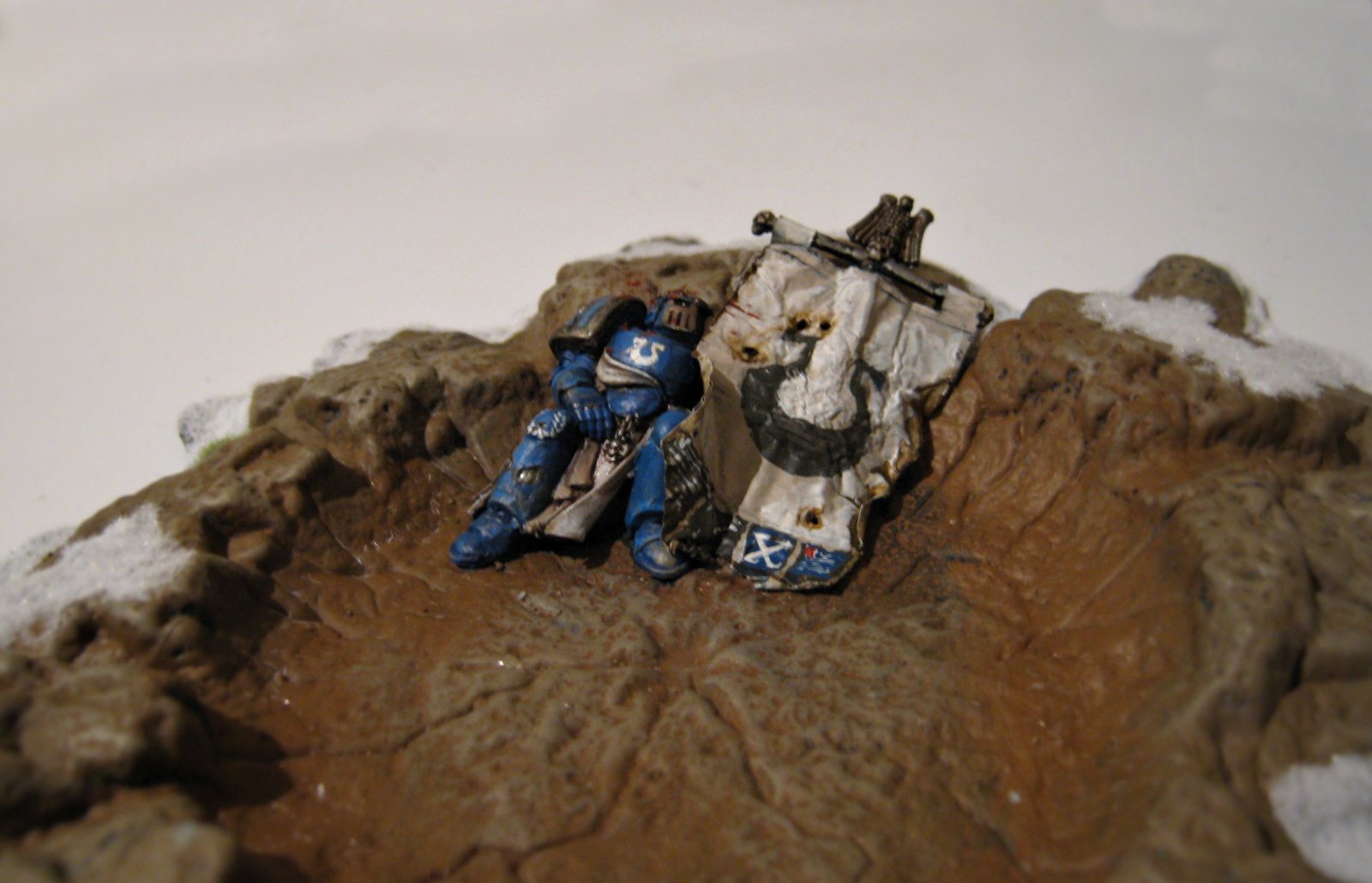
+ Space Marine casualties +

+ The black soil of Isstvan V claimed the lives of hundreds of thousands of Astartes; the single largest loss of Space Marine up to that point in history. Three loyal Legions – the Raven Guard, Salamanders and Iron Hands – suffered ruinous, catastrophic casualties. However, they did not sell their leaves cheaply. Even given the advantages of surprise, encirclement and foreknowledge, the Traitors were bloodied. After all, the enemy were Astartes, and they do not die easily. +


+ The bulk of the Iron Warriors fought on the Eastern part of the Urgall Depression, the low valley selected as the now-infamous drop site. Here they were met by the X Legion. Many thousands fell on both sides. The image above shows an Iron Warrior supporting an injured comrade. +


+++

+ Casualty markers +


+ While Astartes armour is good, there are plenty of things that can crack it open. It also strikes me as fairly unpleasant that Astartes have so many redundant organs and damage-mitigating alterations made to them that they're unable to fall into shock or pain-relieving unconsciousness at even the most horrendous wounds. War certainly is a grim affair, and in the darkness of the far future, sometimes in some surprising ways. +

+ I enjoy making casualty markers like those above, as they offer the chance to show another side of the Space Opera conflict we see; and add a sense of consequence and drama to the unfolding battles we play. +

+ They are perhaps a little morbid, but I find creating a convincingly injured figure a great exercise in posing and structuring. The slumped shoulders, staggering gait and similar postures are a world away from the combat-ready poise of most figures, and modelling battle damage is a great challenge. +


+ Because the armour is often badly damaged, it's a good opportunity to try out your sculpting work or new painting techniques. If it turns out a little rough, there's no harm – these figures are more for atmosphere and background than anything else. That said, they do make excellent objective markers; so you might like to think of them as terrain. I find that takes any pressure or expectation away from them. +

+ Work in progress +

+ I'm working on an unusual casualty type at the moment – walking wounded. 

+ The bulk of the structure is there, though some tweaks are still likely, particularly on the torsos. Both sets of legs are from the Space Hulk set, which provides for some unusual and dynamic poses. Oddly enough, I've found running poses often much better for converting into the slumped or resigned postures of the injured. In this instance, the injured marine is leaning on his comrade, so his trailing leg has little weight on it. As a result, the other marine has to have a strong centre of balance. +

Mark II 'Crusade' helmets


Mark III 'Armorum Ferrum' helmets

+ I'd love to put them on a combined base, as that'll give some space for some more interesting rubble and reinforce their connection. I'm in two minds about which heads to use. I've had a little play around with different heads (including bare heads), but I think I want to emphasise the similarities and should use as many bits which link the two as possible. Which do you think looks best? +

Wednesday, September 2

+ inload: The Footsore 242nd Cohort +


+ Forming part of the 4th Grand Battalion, the 242nd Cohort (sometimes termed the 242nd Grand Company) was raised – as with so many others – as an amalgam of other formations ravaged to the point of near-extinction during the Isstvan Campaign. As a result, the Iron Warriors of the 242nd exhibited a dizzying array of specialisms, equipment marques and loadouts; its ranks including combat engineers, recon teams and breachers. By far the greatest numbers were made up of line Legionaries; blank-eyed killers hollowed out by decades of grinding warfare in some of the most backwater worlds of the nascent Imperium. +

+ The potential advantages of this grouping – flexibility, adaptability and lower support requirements – were largely outweighed by the complexity of resupply, inter-muster rivalry and conflicting regimes, protocols and beliefs. The Iron Warriors were a gritty and determined Legion, but the alloy created at Isstvan was sometimes brittle. The more fractious or antagonistic members of the Legion might once have faced punishment or chastisement, but Horus required every Legionary at his disposal; and impressed upon Perturabo such a request. +

+ The 242nd served as a dutiful (if unremarkable) Cohort, with elements serving at some of the major conflicts of the Horus Heresy including the Tallarn, Dheneb and Cygnus campaigns. They were, along with virtually the whole rest of the Legion, also present during the dark days of the Siege of Terra. +

+ Congnomen and sub-groups +

+ The 242nd, as a newly-drafted formation, had no official designation beyond their number. By late in the civil war, some had taken to calling themselves the Immisericordia – roughly transliterated into Low Gothic as Pitiless; though the name 'Footsores' – a faintly derogatory term placed on them by rival Grand Companies – took up wider recognition through the Legion. The term was drawn from the lack of transport vehicles and shuttles issued to the reserve battalion, which meant that they were either frequently overloaded, slow to embark or simply forced to advance on foot. +

+ Some veterans of now-extinct Grand Companies of great heritage chafed against the supercilious taunts of their peers, but the name became firmly associated with the Grand Company after the Dheneb Campaign, where the 242nd were deployed against a stronghold fortified by the Iron Hands. Huge minefields stretched for countless miles around the broken ground, which resulted in ruinous numbers of casualties caused by injuries to the lower limbs. +

+ Taking a perverse pride in the insult, the commanders of the 242nd petitioned the Trident to permit an alteration to their heraldry, adding a tripartite leg element to their quartered bull's head and fish standard, as a symbol of their tenacity. + 

Legionary Tallisus, pictured during the Rosestone Massacre during the Dheneb campaign

+ The Cohort struggled to bond and enmesh during the initial campaigns following the Isstvan Massacre, a failing put down to poor leadership and the conflicted spirit of the Legionaries. This was to change during the Battle of Phall, when the Footsores – spread across a number of ships – began to demonstrate the advantages of their bullish, inward-looking behaviour. United by hatred and spitefulness towards the Imperial Fists, the 242nd began to fight in a more cohesive small-unit manner. +

+ While never achieving anything beyond mutters of approval within the Legion, the 242nd's small unit drill became something of an unofficial specialism; with groups detached for duties as wide-ranging as recon, assassination and simple sentry duty. It was during the Siege of Terra that this mode of employ would prove of greater interest to the Legion, as Perturabo himself tasked the 242nd with a dreadfully onerous – some might say monstrous – duty. +


Tuesday, September 1

+ inload: Restrictions and inspiration +


+ Centurion Zariçus Cjarn +

+ 242nd Company, IV Legion Iron Warriors +

+ Part of the struggle of putting together a themed army is trying to work out what to include, and what to leave out. Restrictions are often seen in a negative light, but they can be useful. Necessity is the mother of invention, as the old saw goes, and you can enrich your army's background and find surprising new angles by bouncing off something else. +

+ My Iron Warriors army is set up as an opposition army to those of my friend Stuntwedge’s Imperial Fists, both of which are themed around the Siege of Terra. As a result, I had a basing scheme and time period in place. In addition, that casts my army in the role of the baddies. +

+ The Horus Heresy can be seen in black-and-white terms, but I find it more interesting to explore the 'pathetic aesthetic' of 40k, and look at the factions in more morally neutral terms. Those who follow Horus end up as monstrous villains in 40k, but in 30k, there are far fewer differences between the sides than it might appear. + 

+ So, riffing on that theme, I was struck by the idea of a well-intentioned Iron Warrior who had made bad decisions while trying to come up with an idea for my leaders. Essentially, what if straight-laced Loken (the protagonist of Horus Rising) had decided that his loyalty was to the Imperial Truth, rather than to the Emperor as a figurehead. It's easy to see that an Astartes raised to believe in secular truth and told that the Emperor had strayed from the path might have misgivings. If his misgivings were nurtured by those loyal to the Warmaster, we might see his take his first steps towards rebellion – or in his eyes, ensuring the continuation of the Imperium, with a new, more worthy leader on the Throne. Zariçus Cjarn was thus envisaged. +


+ Perhaps the most obvious part of this figure is the twin axes. One, held behind him, represents his loyal Imperial side – this is in the past, and held more loosely. The other axe is a twisted chaos blade, held aggressively in front of him, and painted with eye-catching warm colours. This represents his future. In addition to the axes, I added an Iron Halo, but inverted it and attached it to his torso as a collar. He is destined now to become a slave to Chaos – a fallen angel. It's also a nod to the classic Franzetta-inspired spiky bits aesthetic of the Chaos marines. +


+ Other than the axe and collar, Cjarn could easily pass for an Imperial officer. His armour is slightly more elaborate than a regular marine (the lower half is Forge World's Lufgt Huron, his right arm from the Minotaur's Chapter Master). I followed this through on the painting scheme, keeping it stripped back and sober, as befits an Iron Warrior. + 


+ Returning to the theme, his name was suggested by the Polish knight Zawisza Czarny, a model of virtue who came to a sad end captured by his enemies. This is a subtle little nod to the Siege, with a twist – the real Czarny was an ally to King Sigismund of Hungary. Sigismund is also the name of the Imperial Fists' First Captain, who was noted as having slain a number of Chaos Champions during the Siege. I thought it would be fitting to have Zariçus Cjarn have some sort of connection with Sigismund – rival, friend or noted duellist, perhaps. I'd like to explore this in his background, and Centurion Cjarn is thus fated to fall on Terra to the Emperor's Champion. Hopefully we'll see this happen in-game sometime! The cedilla in his first name is a bit of a retro nod to the mëtäl ümläüts and similar accents that often turn up in Chaos names (like Khârn the Betrayer). +


+ I was half-tempted to remove the Imperial Eagle on his arse-flap (probably not the technical name), but decided in the end to leave it in place. It reinforces the idea that Cjarn is misguided rather than evil, and hopefully adds to that sense of moral greyness over the whole army. +


+ Of course, it's important not to make the villains too relatable. Cjarn is still a monster, even by this point. I wanted to hammer that home with a face streaming with blood and distorted by a terrible howl of rage. Fittingly – and with a hint of situational irony – the Imperial Fists' Breacher squad provided the head. He is grim, and horrible: a twisted mirror for the noble Sigismund, just as Perturabo is a mirror for Dorn. +

Wednesday, August 26

+ inload: Detecting a theme? +

+ Painted a bit more last night, to bring the Iron Warriors a bit further along. I have a game based loosely on Space Hulk to play tonight, so hopefully we'll see a few of these in action on this blog soon. +

+ Phalangites Eucon and Chalkaspides +

+ Not a huge amount to say about these chaps, except that they used to be Novamarines. I think the updates and alterations – new backpacks, boltguns, a combat blade in hand for Chalkaspides; and of course the additional bulking of the upper legs – has improved them a little. +

+ Phalangite Tolga, Palatarch Songul and Phalangite Munin +

+ The two on the left are similarly updated Novamarines, the third is a completely new model. While there are differences in the technique, I think the paint scheme goes a long way to binding them together. +

+ It's probably worth noting that a dark metallic scheme like this allows quite a bit of leeway in repainting – and probably hides a multitude of sins! +

Tuesday, August 25

+ inload: Phalangite Radoslav +


'Adtactus!' 
Radoslav was on his feet, heavy footfalls slamming and skewing on the treacherous dusty marble. he dashed a dozen yards or so, then threw himself down, his dull iron armour skidding him along into the dubious cover of a statue. The pediment was shattered irrecoverably, almost as though it had burst, and the statue itself – a titanic figure, twenty foot or more high – had fallen lengthways. His boltgun tucked firmly in one hand, Radoslav began crawling quickly along the length towards the head.

Alongside the sudden roars and heavy crack-boom of boltguns, and beneath the steady high-pitched rattle of rotor cannon fire, there were the smaller sounds of war. The drizzle of brass shellcases onto marble floors, the crunch-fluid scrabbling of sand and rubble, and the rising hum and buzz of auto-reactive power armour.

Two more Iron Warriors skidded in behind him, their backs to the statue. The first, an unhelmeted figure with a nose not so much broken as smeared across his face, nodded to him. His eyes gleamed, mischievously and his grin revealed a mouth full of broken teeth. As one, the three rose up, boltguns in hand, firing as soon as they crested the statue. 

It was good cover. 

It was not good enough. The lower half of the statue vanished in a sudden cloud of marble dust that billowed like clapped board dusters in a scholam. 

The Larraman's Ear was intended to allow an Astartes line warrior super-sensitive hearing. His autosenses worked in concert to cut out damaging auditory input; ensuring the best of both worlds. For this reason, Radoslav felt the explosion more than heard it, though such was the power of the impact that his armour itself rang like a bell. The rigid armour plates rippled, cracking and crimping. He felt his left hand being pulped, and the armour straining to hold his leg straight to prevent major joint breakage.

A secondary function of the Larraman's Ear – implanted into the skull in the space vacated by the scooped-out and discarded pulp of the inner ear – was to ensure the Astartes was almost impossible to disorientate or confuse. It was this, and this alone, that meant Radoslav was immediately able to scrabble backwards and avoid the second, third and fourth detonations which brought down the roof of the building.

Demo charges. Demo charges. The Fists were destroying the Palace itself to keep them out. Battered and bleeding, Radoslav slunk back to the lines to find an apothecary.

+++

+ Phalangite Ignace Radoslav +


+ Blue eye-lenses gleaming, Ignace Radoslav is clad in an entire suit of Voss Prime-pattern Crusade armour, augmented by Sol Militaris pattern bracers, and a greave reinforced with molecular bonding studs – possibly a field adaptation made during the Siege. A final flourish is the helmet, a common artificer-altered type that combines reinforced forward plating with a stylised version of the Legion symbol. It was a common and popular variant amongst the Iron Warriors, who were well-known for customising and improving their issued plate. +


This shot shows a holstered umbra-pattern boltpistol, indicating his thigh plate does not support magnetic locking. It is possible that Radoslav is a void-war specialist, though this is not confirmed by his current tactical markings; presumably updated between the Battle of Phall and the ground war on Mars. +


+ Many believed the Iron Warriors to be clad in unpainted ceramite, but as this shot shows, there is a subtle difference between the duller metal of the rear-facing hooped armour and backpack (both simply sealed ceramite) and the brighter iron finish of the plate. Ferrous compounds were bonded with the ceramite and burnished to give a bright reflective finish before issue. These were almost invariably hidden beneath layers of grime and soot during active combat, though some Iron Warriors did march in gleaming ranks. +


+ Radoslav is believed to have survived the War on Terra, as a number of sightings marked him as being a combatant during at least two campaigns of the Great Scouring; conducted by the Blood Angels and Raven Guard. +

Monday, August 24

+ inload: Into the Breach! +


+ Spent a bit of time building over the weekend, so I've a few new marines nearly ready for paint. +


+ Really pleased with the pose on this guy. The base is Vulkan's. Can't decide whether to trim it down to 30mm, or leave it as-is. +


A new boltgun-armed marine. After some umming and ahhing, I decided to leave the Cataphract details in place on the legs. I usually trim 'em off, but I'm finding the metallic Iron Warriors scheme benefits from more detail than the Ultramarines to help accentuate tonal changes.

...and a potential Praetor/Centurion. 

I wanted to get across the dual 'not-yet-Chaos, not quite Imperial' feel; so there's a mix of Imperial Eagles and spikes/stars. He's intended to be fighting for an Imperium with Horus enthroned – that way the Iron Warriors will be forgiven for the actions on Olympia. 

Sadly (for him at least), we know that isn't how things turn out. 

Chaos is an ever-present danger for humanity in the grim darkness of the far future. It's a subtle and tempting proposition for everyone; and doubly so for those who are desperate. 

No-one can truly master Chaos. Enslavement, madness and horror accompany the power and freedom it promises.

I wanted to reflect this in the model; so alongside a furious head, he's got an inverted halo on his armour that hints at a collar. Held behind him  is an Imperial power axe, while held in front of him is a new power axe with traitor symbology such as the Eye of Horus and eight-pointed star. He's leaving his past behind, and marching unwittingly into horror.

Not quite finished yet, though additions will be fairly minor. Probably a banner, pouches etc. I really like this head, but am not sure it's quite right here. I'm sort of tempted to make his head swappable – the Mark III helm I had there earlier looked brutal, and I liked the faceless quality it gave; but equally I like the raw emotion of this desperate howl.