Showing posts with label modelling. Show all posts

Monday, March 2

+ inload: Adding character to your models through customisation +

+ Raising a God-Engine +

+ Evoking character through customisation +


+ A hobby-horse inload today, on why making your models your own matters – and some ideas for where to start. +

+ While the principles can be applied to any model, I focus here on a Titan for three reasons. Firstly, they're lovely big centrepiece models. Secondly, they can be intimidating to adapt; and thirdly, because I haven't done any Adeptus Titanicus stuff for a while, and it's nice to show off work you're proud of! +

+++ 

+ Theoretical: Why modify the basic kit? +

Model kits are designed to be built a certain way, and anything you do to make your version stand out can help to add interest and impact to the model. Since both tabletop wargaming and painting for display imply some form of social interaction or having an audience, modifying and customising your kits is a great way to make your stuff stand out. Vive la difference!

You might do this purely for functional reasons – the tournament you're attending requires you to build and paint models rather than use paper stand-ins, perhaps; you might do it for your own pleasure or as a challenge; or you want to demonstrate your skills and imagination to other people – or just yourself.

In all likelihood, the impetus to modify your kits is driven by some combination of the three. And in turn, how much time and effort you want to put into converting and customising is down to your taste. Here I'll outline a few starting points.

+++

+ Practical: Where do I start? +

First things first, if you paint your model after assembling it, you're already modifying the kit. There's nothing inherently scary or intimidating in personalising your work, so we can get over at least that hurdle immediately.

+ Posing +

There are lots of simple ways to make your models your own. Perhaps the simplest is reposing it. For some kits – like this Warlord – reposing is easy, as all the parts are separate. This is both a blessing and a curse for personalisation: it makes things easy, but as variation in pose is baked-in, it's that much harder to make a pose stand out – after all, every version of this Warlord kit will be slightly different, even if you opt for the 'factory standard' pose.

I've exloaded before about reposing Titans (go check out this article about reposing Reavers' legs, hosted on Maximal Fire [+noosphericexloadlink embedded+], for example) so suffice to say here that (with fully-posable models) taking your time to consider the pose you want and executing it carefully will go a long way, while physically modifying the kit can further emphasise your customisation. 

+ Re-posing +

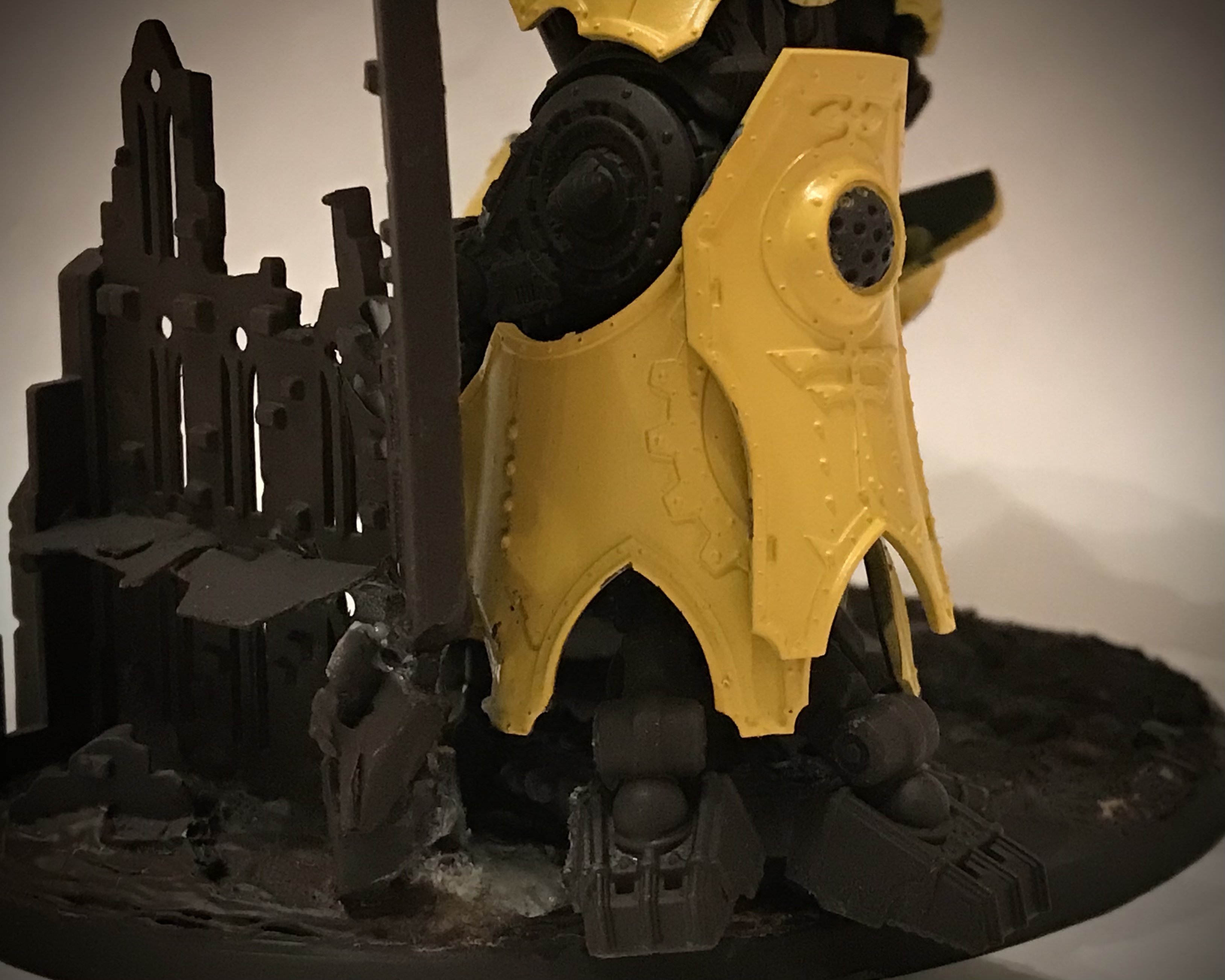
The feet on this Warlord are single-piece, and so the relatively simple job of trimming off and refitting the toes at angles here adds to the sense of weight and ponderous movement.


Changes like this – that require physically modifying the base kit – are what's normally considered conversion, and it's one step on from posing.

The big hurdle for trying this is psychological. Trimming or cutting into a piece to modify it from how it was designed is stepping into terra incognita – but fundamentally it's the same skillset as trimming something off the sprue and assembling it as intended. If you can do the latter, you can do the former. 

Again, having a strong idea of the pose and effect you want before you begin is important. A strong plan will help you – but don't let planning paralyse you. Trust your skills and give re-posing a go.

For kits that have a single set pose – tanks; the more modern 'multi-part but fixed pose' infantry from GW; old-school one-piece metal figures etc. – your effort is more immediately obvious, and you need do less to make your model stand out.

+++

+ Kitbashing +

Posing and simple conversion work will add a little character and personality to your model, and that's just while sticking to what's in the kit. Once you go beyond that, you can bring in extra parts from elsewhere.

Using parts from one kit to alter another is called 'kitbashing' – and it's distinct from conversion in that the parts are usually broadly compatible, and require little or no modification to do. Things like swapping heads from one kit to another are classic kitbashing, but it also applies to bringing in third-party bits, like the gun – or indeed head and armour plates here, all from Battle Bling [+noosphericexloadlink embedded+].


+ Conversion +

Throwing money at the problem isn't necessary – and while it's lovely if you can find a third-party element that you really love, functionally such changes are replicable. If you're looking for a genuinely unique custom job, then you can combine the skills from kitbashing and re-posing to make your own parts from others – or from scratch.

This graviton cannon combines a modified Taro Modelmakers [+noosphericexloadlink embedded+] part from another scale (a 40k Knight) with some spares from the leftover Warlord armour plates – keep useful looking bits in your bits box!

+ Basing +

A good base is a key part of creating a sense of belonging to a particular setting or place, and will help to (literally) ground your model. A few scattered additional bits and pieces here (from Varus Miniatures  [+noosphericexloadlink embedded+] and Battle Bling again) create scale and enhance the character of the piece. Wordlessly, the fact the figures are facing in the same direction as the Titan suggests they're allies – it really can be as simple as that.

It's also a great example of narrative and story. Anything that you can do to grab the viewer's attention is worthwhile – but holding onto that attention relies on you respecting the audience and giving them something involving. Include some details that reward lingering on your model, that make the viewer ask what's going on – it's more rewarding for both your and the audience.


+++

+ How far? +

This, of course, is up to you. Changing your model to better reflect the character you've come up with can involve complex or complete resculpting – either traditionally or with CAD and 3D printing – but it can be as simple as making a minor tweak. 

Neither approach is 'right', but I tend to find the more effort I put into a piece, the more I feel connected with it, and that is always a win. After all, you spend a lot of time and energy on these models, and they'll last as long as you want them around.

Give yourself a break if the result isn't perfect first time – refinement will come with practise – and ultimately, you only need to please yourself.

With all that said, I think you'll find that developing the character of your model, planning out how you'll execute it, and giving it a go is very rewarding indeed. Good luck!


Wednesday, June 21

+ inload: Preparatory work for 10th edition Salamanders +

+ In the Dust of Armageddon: Preparing to play Salamanders in 10th edition 40k +

+ A slightly disingenuous shot (owing to the difference between – or lack of – bases) showing a comparison in proportions between using the Gravis armour legs as the basis, and Tartaros Terminators + 

+ With 10th edition not just on the horizon but bearing down on us like a tank shocking Land Raider, it's apparent that Salamanders (for the moment at least) won't have any particular special rules differentiating them from other Chapters. Part of me is a bit sad; another part is relieved – picking up a new edition is always a little bit complicated, so one less set of exceptions to learn early on suits me fine. +

+ I've always preferred Space Marines to be 'Space Marines first, Chapter second'. That applies across the board – I think Chapter ought to add flavour and spice, not change the dish entirely. +

+ Let me be clear; I think the distinctive cultures and appearance of the Chapters in the lore (and models) is crucial to their appeal – but I don't think that that needs to lead to exceptionalism in terms of rules. This is particularly so for Chapters that don't have much tabletop reason to be different for the sake of difference. +

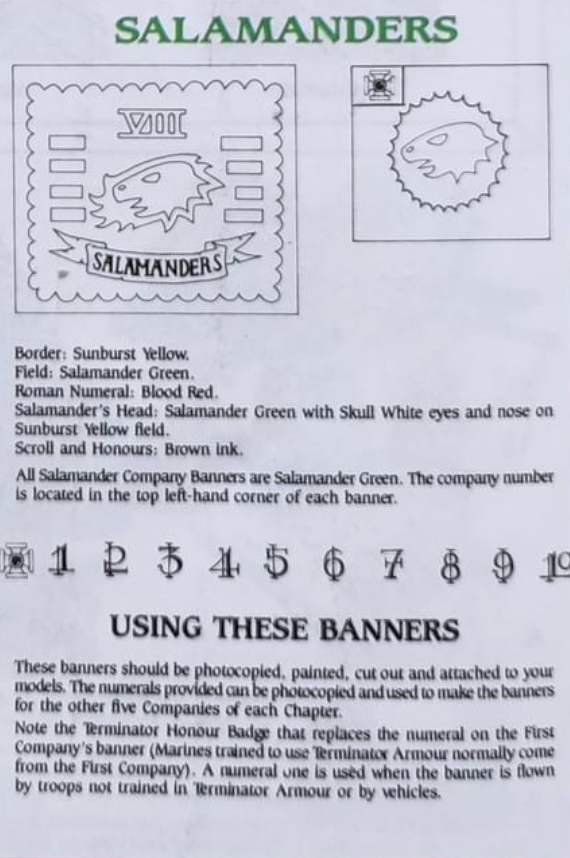
+ There's a lot of flexiblity in how you choose to paint your models. This sort of material, I think, is what really caught my imagination. The actual rules were stripped-back and you reflected the character of your army through the unit choices and way you played, rather than in the list. +


+ Food for thought in painting. This early material, from the Space Marine Painting Guide shows the germs of what would come. It's not all gold; but it's interesting to see where the ideas stemmed from. +


+ The Salamanders are a good example of this. Giving them a Codex supplement simply to match those of the other First Founding Chapters was fun, but unnecessary. Again, let me clarify that by making clear that I think a supplement of artwork, lore exploring their history, organisation, and ideas for the Chapter (and indeed other Chapters, Craftworld, Regiment, Dynasty etc.) would be awesome, but it doesn't need to create a whole set of exceptions to the rules. +

+ That's notable in particular now because the long-standing restrictions placed on army building (the force organisation chart and successors) have fallen away; so without them, no additional exceptionalism needs to be built in. +

+ Am I sad that the Salamanders have lost their Warlord traits, artefacts and strategems? Partly yes; but mainly because the names and ideas helped shine some light on the Chapter's character. Not having the nagging feeling that one's chosen army is unfairly advantaged or hindered by imbalances or unintended consequences in the rules is a relief. +

+ Lots of cool little ideas I can poach for my project here. +

+++

+ Theoretical: army lists +

+ Anyway, back down off my soapbox – what's this got to do with the In the Dust of Armageddon project? Well, the new system of making an army is now clear and the Index has been released. I think the inherent flexibility of the army-building process has opened up lots of possibilities, and wanted to scribble down some loose ideas I'm working up. +

+ The Space Marine Index [+noosphericexloadlink embedded+] is a giant pile of options (For easy reference, the points values are here [+noosphericexloadlink embedded+]). As with the previous edition of the game, I think a lot of these could be consolidated, but that's another discussion. +

+ At this point I have quite a few Space Marine armies, and want to try something a bit different to my usual 'Thirty Tactical Marines and then start thinking' approach. As it is, I started going through and working out a vague army list based on models I had planned, and with an emphasis on using 'normal' Space Marine rules (i.e. not Primaris; I'll refer to the old marines as Astartes from here). That looked like this:

+ Adeptus Astartes-themed list +

  • Captain with Artificer Armour – 80 + 10pts
  • Lieutenant – 80pts
  • Librarian – 85pts
  • Tactical Squad (10) – 175pts
  • Infernus Squad (5) – 90pts
  • Rhino – 85pts
  • Terminator Squad (10) – 400pts

+ A neat 1000pts – and as an aside, I rather like the simple points system. Makes for quick, easy army lists. +

+ That list is simple and straightforward, and since Primaris and Astartes are now identical in terms of stats, there are fewer weird mental gymnastics to explain why these Space Marines are twice as resilient as these Space Marines – something which always niggled at me since the introduction of the Primaris idea. +

+ Sadly, there are still a few odd bits. The Rhino can't carry the Infernus squad, because they have the 'Tacticus' keyword – presumably the 41st Millennium version of wearing trainers to a nightclub. Secondly, Tactical Marines (for some reason) can no longer split into 5-man combat squads, either – a shame, because at this points level, I want as many squads as possible, rather than fewer, bigger squads. +

+ I don't want to lose the Infernus marines primarily because I have a squad winging their way to me. They could join the Gatebreakers, but the idea of flamer-wielding Salamanders appeals too much! +

+++

+ Primaris-themed list +

+ As an alternative idea, I wondered what it would look like if I took the opposite approach, and used exclusively Primaris rules with the same models:

  • Primaris Captain with Artificer Armour – 80 + 10pts
  • Primaris Lieutenant – 75pts
  • Librarian – 70pts
  • Intercessor Squad (5) – 95pts
  • Intercessor Squad (5) – 95pts
  • Infernus Squad (5) – 90pts
  • Rhino – 85pts
  • Terminator Squad (10) – 400pts

+ First observation: the Primaris officers are generally cheaper than their Astartes equivalents – weird. Perhaps due to fewer options? Secondly, the Rhino is completely useless here. It could, at a push, count as an Impulsor (95pts, with the extra 10 coming from losing the Captain's Artificer Armour), as the weird Space Marine grav-tanks can't fly or anything like that. Doesn't strike me as ideal, though. +

I could, of course, drop the Rhino and sub it in for something else, but I rather like the classic Space Marine tanks. Frustratingly, the Drop Pod and Land Raider, for some peculiar reason, don't have the restriction on who can get in them. Perhaps at higher points levels, I could swap out the Rhino for a Land Raider. +

+++

+ Option 3: And now for something completely different +

+ Okay, so both of those options have something weird going on. Rather than try to twist the list into being something GW clearly want to make awkward (a mix of Primaris and Astartes in the same army), I thought I'd try to make a virtue of the GIANT PILE OF OPTIONS and make something completely different. +

+ Once I'd decided to try this, it suddenly opened up the option of having a Space Marine army that plays completely differently to any other I have, which has obvious appeal. I plumped for an all-Gravis-armoured list, on the basis that the models are big and bulky enough to be clearly something different, and slow and tough fit the Salamanders' theme well. Apart from anything else, my conversions are based on Gravis armour anyway, so it seemed fitting  to go for that as a theme:
  • Captain with Gravis Armour and Artificer Armour – 95 + 10pts
  • Apothecary Biologis and Bolter Discipline – 55 + 25pts
  • Heavy Intercessor Squad (5) – 110pts
  • Heavy Intercessor Squad (5) – 110pts
  • Heavy Intercessor Squad (5) – 110pts
  • Eradicator Squad (6) – 190pts
  • Aggressor Squad (6) – 220pts
  • Scout Squad – 70pts
+ That tots up to 1,000pts on the dot. Completely different to the other forces, but looks like it'd be very different to play, too. I rather like the idea of army-wide Toughness 6(!), and the idea of hosing down hordes of the enemy with a few heroes. +

+ The list is necessarily very limited, as there are only five Datasheets with the Gravis keyword. There are a couple of Chapter-specific characters, and if this proves fun, perhaps I'll try a counts-as character using Iron-Father Feirros' rules as some point. +

+++

+ In all honesty, I don't think any of these will end up as the absolute final list – planning is all very well, but I just get dragged about by enthusiasms and ideas while building to promise anything. Theoretical list-building like the above is fun, but I use it mostly to help guide my thoughts and discover what I'm actually enthused about. Almost like consulting the Emperor's Tarot! +

+ Practical: Modelling +

+ In any case, there's no army without soldiers, so building is continuing. +
 

+ Above are three sets of legs from the Heavy Intercessor kit, which I'll be working these up into Mark VII armour. At this stage, I'm most interested in cleanly cutting away the excess detail, so there's a clear surface on which to sculpt. I've taken away the crenellated toecaps, reshaped the ankles, trimmed off the cables at the back and left off the hip thingies. Perhaps most obviously, I've also removed everything above the belt, as this will be replaced with a Terminator waist gimbal. +


+ The overall silhouette is still thick-set, but now free of the heavy reinforcing that's so different from Mark VII. The detail that remains in place is largely greebling. The legs are now ready for greenstuff work to get them looking like this: 


+ The work on the front is essentially blending in the additional plating on the thighs to make them a single integrated piece of armour. You could instead file off the raised plates, but I prefer to add bulk to the upper legs. It creates a great sense of power and stability. +


+ The back likewise requires surprisingly little greenstuff work; and that mainly confined to extending the calf armour down slightly. You'll note that the additional greenstuff on the thighs is mostly on the front – that's to stop the legs simply looking podgy. +


+ It's at the sides that the majority of the work is done, and event that is largely filling in the gaps at the hips and reinstating the corner of the ankle. As you can see, my work isn't the cleanest – something which I'd like to improve – but I think it'll suffice for this project. +

+++


Friday, February 24

+ Painting the Partisans: Marines Saturnine +

+ Painting the Partisans: Marines Saturnine +

+ Warzone Pao Fung is active – read more about the challenge event in this inload [+noosphericinloadlink embedded+]. The challenge revolves around the Marines Saturnine, and today's inload looks at how to model and paint them. +

+ Silver Star (left) by me, and Marines Saturnine by Tom K +


+ Tinctures, glyphs and details +

+ Tom's tutorial at the bottom of this post handily explains how to do the underlying armour colour for the Marines Saturnine, so I'll focus on highlighting a few details that you might like to reflect in your take on this prognostic Chapter with its idiosyncratic command structure. +


+ As Partisans, the Marines Saturnine frequently bear the image of the Caputmori – the skull-headed eagle that served as the False Primarch's icon. +


+ A diagnostic detail of the Chapter is their use of hex-like scale lamellar armour. This can be cast or converted from a number of Necron models, and will go a long way to identifying the figure as belonging to the Chapter. +

+ With generally good relations with the other Partisans, the Marines Saturnine occasionally use non-standard wargear, such as this bascinet helm, perhaps inherited from the Wormwood Sons. This might provide you with some inspiration!.+

+ While the Marines Saturnine don't use a Codex-standard organisation, they still have access to all the awesome equipment of any other Chapter, so feel free to go mad with Terminators, assault marines, tanks and support of all sorts. +

+ On the heraldry in general, Index Astartes: Marines Saturnine has the following detail:
'At first sight, the alabaster of the Chapter's heraldry bears all the hallmarks of unpainted ceramite. Likewise, trim is rendered to resemble bare adamantium – or, depending on the hue, may indeed be untreated. The livery of the Marines Saturnine thus pointedly reflects their nihilistic outlook; signifying their belief that their time serving the Imperium is fleeting. To the Marines Saturnine, to decorate oneself with gaudy colours is unnecessary and ostentatious.

'The Marines Saturnine deviate extensively from Codex markings, instead using sexagesimal glyphs to denote the Sataba (their equivalent to Company) to which the Marine belongs; and entirely disregard squad insignia.'


''The Chapter symbol is an hourglass, presented upright and completely filled with sand. '

+ The hourglass symbol can be rendered in a more or less complex way. It can be almost iconic:

+ Or you can choose to render/model it more elaborately, as shown:


'For the Aegis, the Oracle and the Lamassu!'

+++

+ How to paint the Marines Saturnine +

+ghostys_neon_rust was kind enough to work up a step-by-step, so over to him:

[+exloadspool begin+]

+auth: Tom K – @ghostys_neon_rust

1. Undercoat the model with Wraithbone. Randomly sponge on Bubonic Brown (or a similar ochre colour) across the miniature.


2. Sponge on White Scar randomly across the miniature. Feel free to sponge on top of the bubonic brown; it adds depth to the mottling paint scheme.


3. Dilute Gryph Charger Grey (contrast paint) 50/50 with Contrast Medium, then cover all the power armour in it. Wick away any areas where it begins to pool.


4. Add additional wear and tear. Using where the sponged bubonic brown is a guide, add patches of black Templar, snakebite leather, or bestial brown (mid brown) across the armour. You can also use this technique to cover any tide marks that appeared during the contrast stage. Admittedly I went a little overboard on this example; less is more here.


5. Edge highlight. I mixed a combination of contrast medium diluted gryph charger grey and white scar to create an off white. Edge highlight all the armour plates, and around the edges of the wear and tear (this helps it look 3D and not painted on). You can also use this highlight paint to add scratches and other discolouration to the armour. And you’re done!

I hope this helps all of you who’re interested in either making some Marines Saturnine, or perhaps wanting to decorate Pentarchy bases with their bodies. 

[+exloadspool CEASE+]

+ Weapons, lenses etc. are typically red, as you can see in the finished tutorial pict-capture: 

+++

+ Good luck with your own builds and painting – and do feel free to share WIPs on Instagram or Facebook. I've done my best to make navigating things a bit easier by setting up a Linktree [+noosphericexloadlink emebdded+]. Please do spread the word by using the #riseofthelamassu and #warzonepaofung tags. +


Friday, January 20

+ inload: Warmaster Battle Titan +

 + Legio Validus: Warmaster +


+ A recent game of Adeptus Titanicus, and the promise of another in a few weeks, has got the old Titan interest flowing once more. While I'll likely be taking Legio Sumer-Nikator [+noosphericinloadlink embedded+] out to play, I was more in the mood for modelling than painting, so dug out a problem: my hobbled Warmaster Titan. +

+ The Warmaster Titan is a huge and complex kit – and a perfect example of how even experienced modellers can get tripped up by over-confidence. As noted in my earlier inload on building this kit [+noosphericinloadlink embedded+], I'd ended up with the pistons of the foot canted in such a way that I couldn't get the armour plates on. +

+ Cue some 'minor adjustments' – which involved a bit of brute force and ignorance. After a little pulling, twisting and trimming, I've managed to get the foot back into a place where the small – uh – toe armour(?) plates will fit. +


+ The revised version. It's funny how something so minor can really niggle, but I'm very glad I finally decided to quite prevaricating and fix things. In all, it took about half an hour, and now I've got a Titan that I'm really pleased with. +

+++

+ Variance +

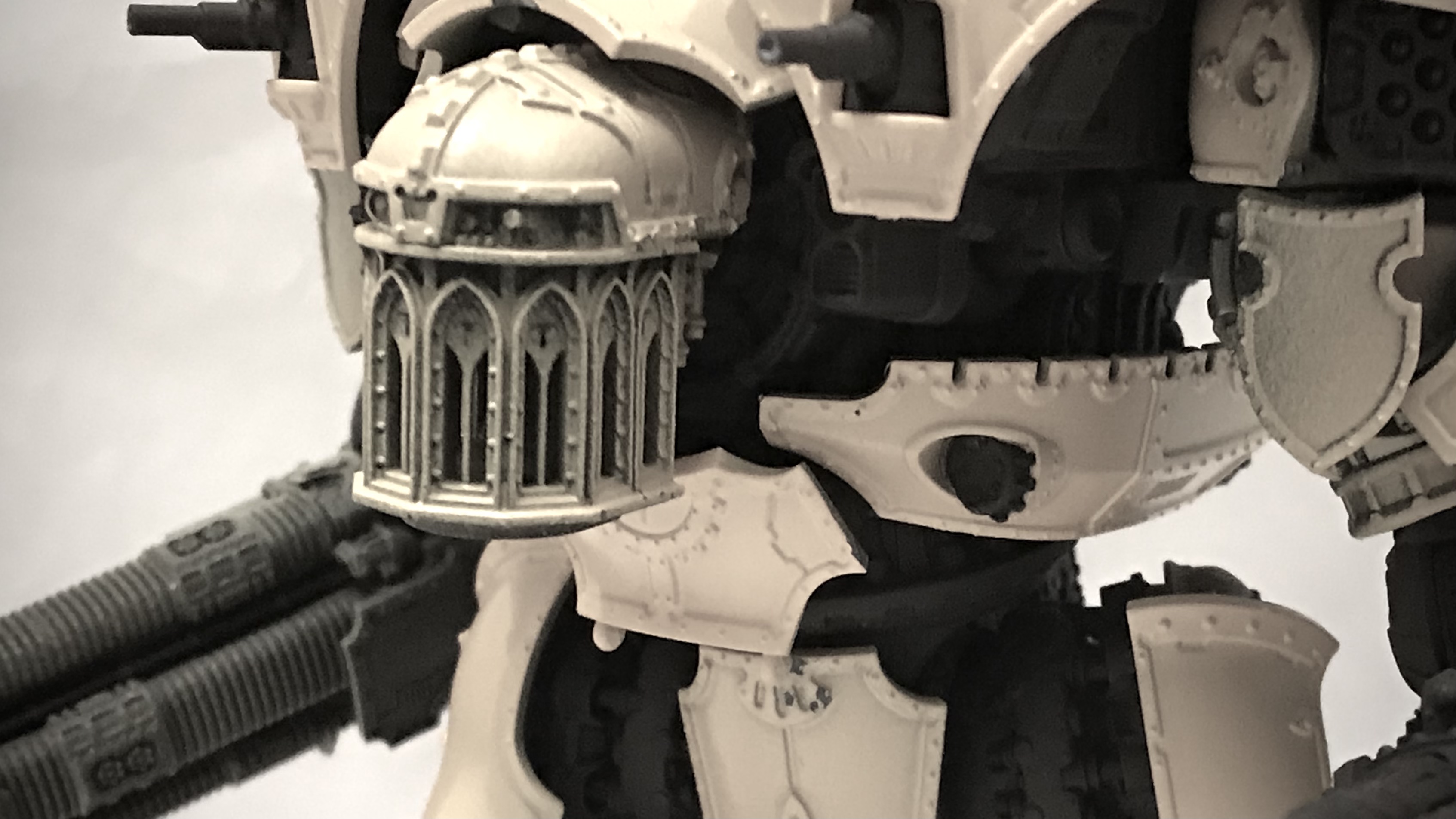
+ Unusually, this Titan isn't magnetised. I think it fairly unlikely it'll see much table-time, so decided I'd make my life easier and fix it in position. Since I've used some Battle Bling [+noosphericexloadlink embedded+] bits – most obviously the head, but also the Devotional Bell, groin armour plate and their giant Super-Gatling Blaster. +


+ In all likelihood, this'll just count as the same as the plasma weapon (Suzerain-class Plasma Destructors). Perhaps I'll see if there are any fan-made rules to playtest anywhere, but I'm not too fussed. +


+ It's a big imposing model, and while I'm quietly glad I decided to experiment with spraying for the armour plates, it's still an intimidating project to begin. Still, every journey, and all that, so perhaps I'll make a start and get the quick and messy metals in. +


+ Pictured here alongside its stablemate, the Reaver Martialis, the Warmaster is strikingly bright and glossy. That's intentional, as I'm planning on using oils to knock that back, as described here [+noosphericinloadlink embedded+]. I need to start very bright, so it doesn't end up too muted. +

+ I'll also need to be careful about incorporating enough blue. Martialis is almost completely yellow – not a problem per se, but I don't want the Amber Kings get muddled up with Tiger Eyes. +

+++

Wednesday, March 10

+ inload: A constellation of Silver +

+ Look up to the Stars +


+ A quiet few days on the blogging front – though do be sure not to bypass the [+noosphericexloadlink+] to + Some Things Are Best Left Forgotten +, where I've been able to collate some of the amazing work people are conributing. Thanks in particular to those brave datascribes and inloaders who have contributed images and stories from here: they're very welcome. If you would like to contribute, pop over to the Facebook groupnode and I'll let you know how you can. There are no entry criteria beyond enthusiasm! +

+++

While I've been editing and uploading others' material there, I've also got quite a lot of my own painting and modelling done, so thought it'd be nice to show 'em off here.

+ Silver Stars +

+ Firstly, progress has continued on this are-they-aren't-they Legion of Space Marines. As with my M42 Chapter, the Gatebreakers, I'm delighted with the scheme. That always helps with my enthusiasm – nothing more draining than plugging away on a model whose colour scheme you've grown tired of. +


+ The figure front and centre here will be the model used for the Silver Stars' upcoming Index Astartes, which will (partially) explain the meaning behind some of the badges, logos and sigils here. +


+ A very messy shot of the desk that shows a few odd bits that are work-in-progress, from techpriests and Titan Princeps to Gatebreakers and Imperial Guard; not to mention a couple of more esoteric figures. A pile of Silver Stars is on the right of the image, which is the front of the desk. I often keep a couple of odd figures nearby, just to avoid getting burnt out on batch painting. A change is as good as a rest, after all. +


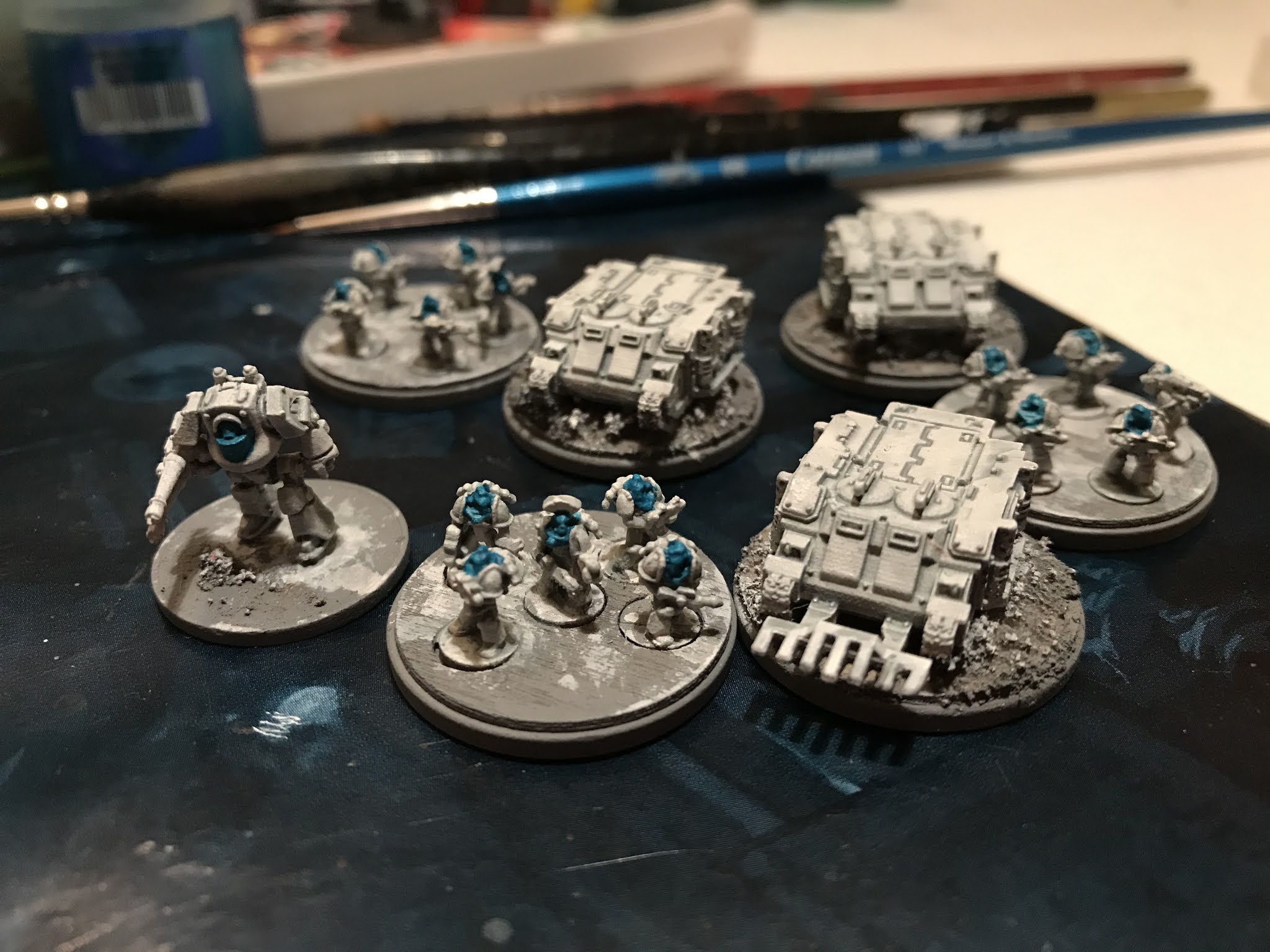
+ ...and the War of the False Primarch is not constrained to one scale – I've been painting up a detachment of Epic-scale marines for use in dioramas and scenic shots, in the style of the very old Adeptus Titanicus promotions in White Dwarf. +

+ Of course, there won't be any reason that I can't use these to play games – and I'm hoping against hope that I'll be able to get some tabletop gaming in against the PCRC at some point. Miss you, lads! +


+ A Deimos Predator – plucked from the Cupboard of Shame Opportunity – has been given a big 130mm base. Bit of a gamble this, but after experimenting with the base on my Blood Angels Rhino [+noosphericinloadlink embedded+], I've decided I really like tanks on bases. For whatever reason, it makes me feel that they belong a bit better. Perhaps this'll be something I make a more general part of my planning. +

'We are Legion' [citation needed]

+ As you can see, the Silver Stars are swelling to be quite a force. The scheme [+noosphericinloadlink embedded+] is relatively time-consuming, though a lot of this is down to drying times. Those with keen occulobes will spot that I've worked the white up on a lot of there, rather than starting with the black, as I suggest in the linked tutorial. A lot of my 'recipes' – particularly those of Space Marines or other heraldic scheme [+noosphericloadlink embedded+] can be approached in any order, as the parts are effectively separate: you just need to be careful and neat after the first stage is down. +

+ For that reason, I decided to start with the white on the majority of these – because it uses one of the new Contrast paints (Apothecary White), it's inherently a bit messier (as you need to slop it on). Better to go back and tidy any splodges with black and turquoise than add light on dark. +

+++

Tuesday, November 27

+ inload: Blood Angels plans +

+ Musings, ideas and plans +


+ One of our datastream exloaders, Paul von Bargen, had a couple of great questions about my Blood Angels that got me thinking; so I'd like to expand a little on my answers here; mainly because I find it fun to overthink these things!
'may i ask why you left the chest bare of any decoration? Especially thinking about the baroque nature of the Blood Angels i would like how you decided upon this?'
+ I replied: 
+ The short answer is simply for differentiation. Since I want the army to be set in M35, I needed to find some visual shorthand to differentiate them from 40k and 30k models; and the chest eagles are an obvious point of differentiation. In terms of the in-universe reason, the eagles have been removed as a mark of neutrality – the double-headed eagle is a symbol of the Old Imperium (as opposed to Constantium's Nova Terra) – and the Astartes as a whole are neutral in this conflict. + 
+ There are some real-world considerations. The original inspiration (Tim Prow's force from WD139) didn't pick out the winged jewels (the equivalent), but painted the torsos plain red. It's a nod to that as much as anything. In addition, the models of the time were much simpler. Since I want to make the force identifiable as the same army, I wanted to simplify the details to aid recognition. +
+ To expand on that, the visual simplicity of the army is part of the appeal, because it gives such immediate impact. It's the very lack of the later ornamentation that helps root the army in my (less spiritual, more Rogue Trader) Nova Terra Interregnum setting. +

+ ...and finally, I wanted to make sure that I left myself some [design] space for veterans, Lieutenants and so forth. These will likely have considerable amounts of freehand. +
+ A shot of the inspiration can be seen above, in conflict with the insidious Eldar; and I think that it shows quite nicely how the impact of the red and black is strong partly because it isn't diluted by a large accent area (the chest eagle). +


+++


+ Blood Angels markings, and painting for the period +

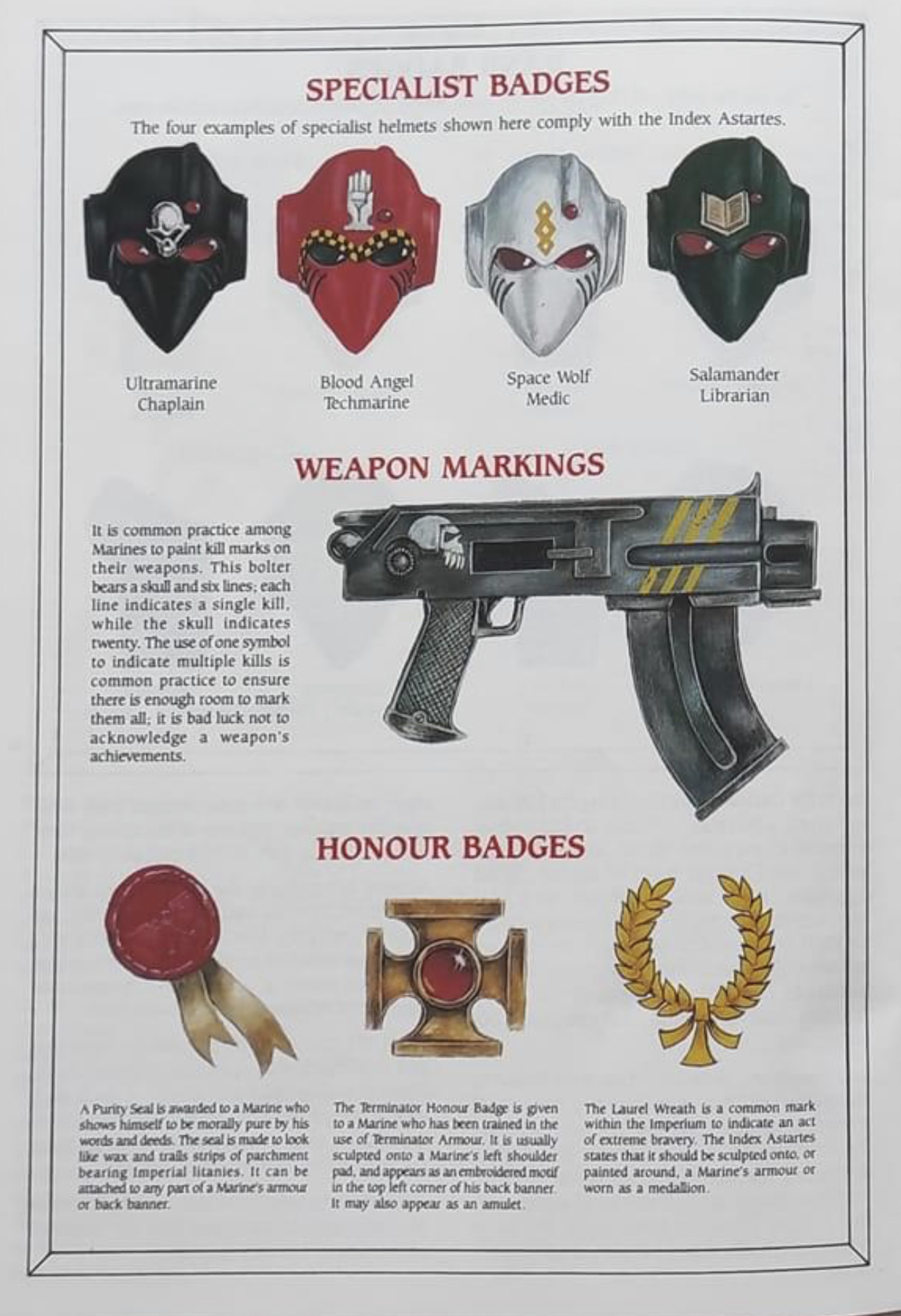
+ In doing some 'research' (browsing the noosphere and asking questions on Blood Angels fora), I've turned over some interesting notes on the markings. Turns out that Blood Angels have some really quite in-depth material on markings, mainly from 2nd edition. By the looks of things, this army, which pre-dated 2nd edition by just a few months, served as a point of inspiration for the more developed guidance on markings. As an illustration, the white skull on black kneepad shown here:


+ ...which is directly taken from the WD139 army and noted simply as an honour marking; turns up in Codex: Angels of Death (the 2nd ed. Codex that contains the Blood Angels alongside Dark Angels) as a more formalised squad designation. +


+ Here it denotes the first squad; while in WD139, it was used for the second. I quite like this inconsistency. I usually try to avoid getting caught up in 'rivet-counting' and slavishly following the suggested paintschemes, but here I'm deliberately trying to emulate a very particular period, both in the real world and in the background. +

+ The schema above appears in the latest Codex, too (see pict-capture below); and it's interesting to see how much the modern formal approach has changed from the WD139 origins, and how much remains the same. +


+ The Codex Astartes dictates that commanders should vary and alter their markings every so often, to throw off the enemy. This serves both as an in-universe 'get out of gaol free' card to let painters do what they like, and is also a nice way of explaining why these Blood Angels (set in M35), differ from the more common M41 period. It's obviously a more subtle difference than between the Horus Heresy (M31) era and M41, but that works well, to my eye. +


+++

Paul also asked how big the army is likely to get. My reply was:


[...]the initial idea is to replicate the army as it appears in WD139; though I've also added a few little bits and bobs that turn up either in pictures of the period, or in the written army list. Beyond that, who knows? +
+ An expansion that I've already included is the Dreadnought; which I've justified as a result of this image (a detail of the pict-capture above):


+ The model there differs from my Dreadnought (owing to the missile launcher and short legs), but I think the principle is there. +


+++

+ A descent into madness +

+ As with all projects, some continue to grow on you. When I first started out, the Blood Angels were essentially an excuse to paint a pile of Primaris I had from the Dark Imperium box; with relatively simple conversion work. As I've carried on, it's got more and more involved. +

+ Last night I bit the bullet and decided to try to emulate the second Devastator combat squad much more closely than I had in the first:


 + Here's the inspiration. +


+ And the resulting figure. He differs from his earlier squadmates in having a properly-sculpted torso (rather than just trimmed down), reshaped kneepads, and his boltrifle has been replaced with a more fitting boltgun (thanks for the boltguns, PCRC squadmates – I'm not sure whether to thank or curse you for indulging my obsessions!). +

A comparison of the other Mark VI marines in the force.
+ This inconsistency could easily annoy you. I'm certainly wavering on whether to scrap/rebuild the existing Devastators with this more developed approach (hell, whether to replace the boltguns across the army), or not. Currently, I'm erring on the side of slightly revising the Devastators, but not a wholesale rebuild. The reasons for this are twofold:

+ Firstly, the mantra 'never let the perfect get in the way of the good'. I'd rather have completed models that I can later supplement than continually cannibalise perfectly serviceable figures – it's demoralising to be breaking up finished figures. Secondly, I'm rather warming to the 'blending' effect across the army that this creates. In the same way that I've added a few Mark IV parts here and there to the otherwise Mk VII Tacticals, having some 'full' Mark VIs along with some hybrid ones helps to soften the complete disjunct in model styles the original army had. +

+++

+ Fire support, now! +

+ Of course, Devastators are mainly known for their heavy weapon wielding soldiers, not their boltgun-armed squadmates. Since I had the time, I also built the second missile launcher marine for the squad last night. +


+ A small part of me finds it slightly galling to spend ages sculpting detail that you then hide (the arm across the chest detail, in this example); but sometimes just you knowing it's there makes it worthwhile! +

+ This shot also shows the difference in size between the Rogue Trader-era power pack (left, in beige), and the more modern ones. The Primaris ones are larger again. +