Monday, March 12

+ inload: Alien Wars – Anatomy of the enemy I: Orks +

+ Anatomy of the enemy I: Orks +


It is said – perhaps apocryphally – that when mankind first stepped into the stars, the first species with whom the pioneers made contact were the orks. After a short pause, the two species immediately settled into an eternity of conflict. 
Extract from All Human History – Inquisitrix Barbari Kills, Ordo Xenos

Greenskins have plagued the galaxy since time immemorial. Their origins are uncertain; with competing theories placing them as the degenerate descendants of the long-extinct krork; as a naturally developed form of galactic hygiene; as a genetically uplifted and manipulated slave species that outlived its creators; and – perhaps predictably in these times – as the scourge of God-Emperor, sent to test mankind's worthiness.

The truth is that nobody knows for sure; least of all the orks. Their culture is as ramshackle and resilient as their biology, but not predisposed to recording events. Most tribal groups maintain an oral history of sorts, but this seems primarily geared towards encouraging social grouping, rather than the transference of acquired knowledge. Most Imperial scholars agree that orks inherently have 'built-in' knowledge; a sort of precociously complex and deeply-based instinct. It is a part of their biology that underscores their culture, their actions, and even their mindset.

With every ork – and their precursor organisms and slave caste – seemingly containing the underlying structure of the entire culture, it becomes clear how the orkoid's robust civilisation has spanned the stars for time immemorial.

Typical orks – belligerent, aggressive and seemingly enjoying the events of war. These specimens belong to a sub-group of the Charadon empire; a force which translates as the 'Drop Legion of Luggub'.


+ Orks during the Nova Terra Interregnum +

Across such a timescale – the Nova Terra Interregnum now entering its fourth century – and span of the whole Imperium, it is impossible to do more than touch upon the broadest generalities of the ork encroachment on previously safe Imperial space.

Whatever their origin, orks have infested the whole known galaxy. Rogue Traders, explorators and pioneers almost always inevitably meet with greenskin pirates or isolated ork settlements when travelling known routes – it seems orks are drawn to shipping, whether Imperial or otherwise. The species as a whole is nomadic, always seeking to expand and move on; though individual warlords are known to settle a particular system or region and fortify it as an empire. Such empires include Jagga, Charion and Charadon in the galactic east; the Calverna dominion which straddles Segementum Solar and Tempestus; and Gathrog and Dredruk in the north of Imperial territory. The two latter empires are most familiar to Imperial scholars, being unusually willing to trade with, and for a few isolated and celebrated periods, to have allowed cultural exchanges by Imperial observers. For this reason, the guttural dialect here is most familiar to the Imperium.

Nor is Nova Terra immune. The secessionists must contend with the Cromart empire in their northern marches, while the orks of Mastag Prime sit on the borders between the Western Imperium and Prime Imperium. These long-established empires are the exception, rather than the rule. While belligerent and aggressive, these empires are largely predictable [+appendnote auth. Unfortunus Veck – This complacency was to be rewarded with the near destruction of the Chapter Astartes Crimson Fists and the devastation of Rynn's World in later years, so perhaps the learned Inquisitrix's advice must be taken cum grano salis, as a product of her time.+] and mostly concerned with internal affairs. 

With the Imperium split, many sub-chieftains and hitherto unknown ork forces seem to have taken the opportunity to begin raiding. Where once they would have been swiftly countered, the Imperial Navy and Guard were largely concerned with internal patrols, leaving border regions and wilderness space unpatrolled. Fortunately, most Imperial Commanders proved capable of directing their own forces to counter most small-scale raids, though many dozens of border worlds were undoubtedly lost to the greenskins as a direct consequence of the Imperial division. 


+ Orks, Space Marines and The Alien Wars+ 

Nevertheless, disrupted and aggressive greenskin tribes are a sizeable threat, and no world could afford to be isolated. The Interregnum might have proven disastrous – even an existential threat to united humanity – had a purely defensive, inward-looking strategy been pursued by the Twin Imperium against species exemplified by the orks. It is fortunate, then, that the bulk of the Adeptus Astartes proved willing to begin prosecuting attacks and intercessary assaults on alien species in wilderness space.  

Novamarines struggle against power-armoured orks during the defence of Cypra Mundi against the orks of the Dregrak Dominions
As a whole, the Astartes stood aloof from the underlying events of the Secession – most Chapter Masters were either philosophically unwilling to be drawn into Imperial politicking, or recognised that the increasingly religious fervour of the Imperium made direct interference potentially deadly; inviting suppression of the arguably heretical Chapter Cults. 

With the exception of a few Chapters – notably the Imperial Fists and Chapter Castellan, who openly arrayed themselves with Terra; and the Consecrators, high profile successors of the mercurial Dark Angels, who declared open warfare on Nova Terra for reasons unknown – few notable Chapters openly declared in favour of Terra or Constantium (as Nova Terra was then known); instead prevaricating, citing constitutional technicalities that prevented them from interfering with Imperial policies, or simply withdrawing. To the common man, it would have made little difference, but to the Imperial nobility, the Space Marines' reduced communication must have seemed like the withdrawal of a protective aegis. 

Iron Hands Clan Trago fights the orks of da Shooty Boyz
Fortunately for humanity, the Space Marines were not sitting idle. They were, in many ways, more active than they had been in years; taking up the slack of patrolling the wilderness regions, and launching isolated, preventative assaults on xenos strongholds to degrade their ability to launch assaults on humanity. 

These wars were fought galaxy-wide, and were often unnoted beyond the individual Chapters' own records. The patchy histories of these largely unsung wars were later gathered into the period known as the Alien Wars, the name drawn from an early campaign launched by the Blood Angels Chapter Master of the early period, Formosus. Despite the name, the xenocidal campaigns of the Alien Wars lacked a unity of focus; most Astartes Chapters understandably wary of associating even with their closest cousin-Chapters, for fear of being honour-drawn into later censure, should their allies later decide to declare for Constantium or Terra.

An overview, then, tells of a thousand separate wars fought in isolation; of the Astartes fighting a leaderless crusade against the foes of humanity, largely free of favour or political affiliation. The Alien Wars tell of glorious victories and horrible defeats, but as the saying goes, for every battle honour, a hundred heroes die alone, unsung and unremembered. 

While these wars were fought against hundreds of species – the Q'orl, Shint, Eldar, Krell, Janii, and Muspella to name but a few – the wars against the orks were undoubtedly the most numerous. The struggle between ork and space marine on long-forgotten worlds, far beyond the borders of human space proper, has thus become entrenched as the enduring and iconic image of the Alien Wars.


+ The orkoid mind +

The 'deep instinct' of their inherited knowledge is perhaps the most alien part of these creatures' mindsets to humans; and what sets them apart in success and longevity than so many other species, who are similar or superior in physical stature and cultural nuance. Despite their outward actions mirroring the most base level of feral primitive or hive scum criminal; it is dangerous to think of them as inherently inferior. Their mental actions and processes are direct and uncomplicated, in their uniquely alien manner, but this is not to suggest uncomplex. 

While typically robust rather than innovative, ork technology is often surprisingly complex. Ork field technology, in particular, is of a level far in advance of modern Imperial ability to replicate. Some xeno-archeologists suggest it is in advance of such species as the Uive and Eldar. GIven their obvious technical prowess, why assume the orkoid mind is any less capable of extremes?
It is almost impossible to imagine how an ork's brain develops in cognitive terms, and it is arguable that an ork has no 'mind' as a human would perceive it. Perhaps the closest one an Imperial citizen might come to understanding it is through the relatively familiar concepts of hypno-indoctrination and injected learning: methods through which a human mind may become familiar with a language, skillset or set of knowledge. 

However, this is a very crude metaphor. The human mind is a blank canvas for such additions, whereas an ork seems to have nothing beyond such blocks. To extend the painting metaphor, while a human mind builds sedimentary layers of paint to inform his personality, the ork's mind is a series of interacting layers of paint, constantly swirling and bubbling; ever in motion. Even this does little justice to the nature of the greenskin, for far from being mental blanks or unthinking drones (like the drifting, locust-like biomechanical hive-mind creatures newly-discovered near Ultramar), each greenskin evinces personality, individuality, and a uniquely complex series of drives that propels him forward. 

Ork of the Bloodsuns Cluster, a minor ork Empire on the borders of Capricon Worlds.

Orkoid biology informs their mental space; and just as their bodies are resistant to physical damage, their psyches are concomitantly resistant to warp-interference – though overload will kill or derange them just as surely as a human; just as a sufficiently powerful firearm will kill individuals of either species.

+ The orkoid body +

Despite their seemingly rooted, unchanging nature, orks are superbly adaptable, in a manner similar to humans – though perhaps to a lesser degree. While humanity has shown capricious biological adaptation to new challenges, leading to numerous subspecies and stable abhuman strains, orkoid biology remains constant across the centuries. There seems to be an inherent biological conservatism to the orks, though this does not apply to individuals, who happily modify, alter and 'improve' their station through the creative use of bionics, augmetics and boosters.

Much has been written about their fungal nature, though is is easy to overstate this, and picture them as some form of mycoidal creature. In truth, orks have a physical structure broadly similar to Terran animals like hominids and humans; with robust osseous bones overlaid with muscle-like sarcotic fibres and tissues. These core tissues have an overlaid fungal banding which serves to increase physical resistance, bind and stem damage, and provide additional storage and provision for energy. 

Rear shot of an ork group – ork morale is excellent as long as they believe they are winning a conflict. While fierce, most orks retain survival instincts of some form. If you can convince them that the tables are turned, most orks will flee. 
This fungal banding has no direct relation to any human structure, though Magos Aro-venn made a strong case in early M34 for this mycoidal fungus serving a similar purpose as the embedded mitochondria in most Terran animal life – an endosymbiotic relationship that helps to provide energy to the cells. That Aro-venn then went on to claim that this was evidence for ancient genetic manipulation – and eventual raving about sleeping gods and apocalyptic deathless beings – was part of the reason he was later excommunicated and driven into exile; meaning that this interesting path of xenobiology has remained unpursued in the centuries since.

+ Fighting orks one-on-one +

Orks are tough; that much is indisputable. What will render a human a casualty will likely leave an ork unaffected, or at least only inconvenienced. Their physical robustness extends beyond physical trauma to a certain resistance to disease and exhaustion – their animal-like biology likely assisted or augmented by the symbiotic fungus-like structures. However, this should not be overstated. While the typical ork is bulky and fierce-looking, their physical strength is still comparable to that of an extremely fit human adult, rather than clearly superhuman. A typical ork is likely inherently stronger than a typical Imperial guardsman, but not to the extent that every physical contest is without doubt. What an orks gains in raw strength and bulk, he loses in agility; a trained guardsman can undoubtedly win one-on-one in close quarters – if he is sufficiently motivated, equipped and trained, that is.

It ought to be noted, by any Imperial military force, that this is no cause for complacency. The effect of even incremental superiority in raw strength is amplified by resilience – where a man might fall when bayonetted, an ork may be able to ignore the wound sufficiently long to maul his opponent – and by the ork's inherent seeming love of conflict. 

The rude, individually-crafted technology of the orks underlies their problems with supply chains; necessitating constant raiding and attacks. Of course, for the ork species as a whole, this keeps them mobile and driven.


+ Ork skin and blood +

Quite aside from their brutal, heavy visages and hunched, loping postures, the most obvious identifying feature of an ork is the colour of their skin; which has given rise to numerous derogatory terms amongst Imperial forces and beyond – the Semmel xeno-forms of the Gothic subsector are known to refer to the orks by a term which translates (albeit awkwardly) as 'the monsters who are the colour of our ancestral plains-vegetation but that sow death and ruin instead of bringing forth plenty damn them for their horrid colour.'

Typical green skin tone owing to the combination of blue and yellow pigments.
The green of an orks' skins is a result of their biology; a combination of yellow xanthin-like pigments and blue-black structures a little like the xantophores of ancestral terrestrial fish. In different proportions, this gives rise to orks coloured in a range from grubby green-browns to dark, petrol-like blue-greens. All are murky and earthy. However, the range of colours is further complicated by structural coloration – that is, the scattering and uneven refraction of light owing to the shape and structure of the skin cells. In a similar manner to long-extinct terrestrial mandrills or butterflies, these structures reflect and refract light, extending the potential range of apparent colours to include much more vivid, brighter greens under certain conditions.

More vibrant greens are possible under bright light; though some orks seemingly lack the physical structures that alter coloration, and remain earthy-brown-green in tone under all lights.
Injured orks bleed red; a fact which often comes as a surprise to novice guardsmen or agents, who expect their blood to match their skin. Orkoid blood system analogue still maintains iron as the oxygen carrier, though this is complemented with haemocyanin structures, meaning that an ork can survive and even fight (albeit at a compromised level) in low oxygen environments. In such circumstance, ork blood will take on a purple-bluish tinge. 

This is further complicated by the mulitple redundancies of biological systems, which conflate the endocrine, renal and digestive systems – that is, an ork's blood helps to fight infection, break down pathogens, and even digest food (in a minor manner). As a result, their blood will be affected by recent nutrition, ranging from a bright orange-red to a thick, murky maroon-black.


+ Lifecycles and lifespans +

With a typical lifetime running in the low decades – few orks live beyond twenty – one might suppose that the greenskins are inherently shortlived. However, the average is dragged down by the fact that orks take little time to mature and grow, and vast numbers are killed in internecine fighting. The more successful the ork, the longer he will typically live.

This is not to suggest, as certain sensationalist xenobiologists have hysterically claimed over the years, that orks are functionally immortal. Even those outliers that can be dated with anything approaching certainty rarely find orks of an age beyond fifty standard; with most specimens of that age showing signs of muscular stabilisation – if not atrophy – and general malaise. Given the highly competitive and physical nature of the ork social structure, failing to keep up will almost inevitably see them 'weeded out'.

Ork veterans 'Goranhuwl's skarboyz' of the 'Black Kuttaz' minor orkoid force.
Exceptions, as with humanity, are manifold. Reports exist of ork leaders living for many decades – even centuries – and while this is likely exaggeration or misreporting of an inherited title (such as the 'Grand Warlord of Morscar's Star', a title known to have been borne by over a dozen successive warlords), it is not beyond the scope of the greenskins to have manufactured similar life-extending technology as Imperial juvenat treatments; or some more esoteric solution, such as portable stasis-chambers or chrono-reversing fields.

The whole of ork culture aggrandises physical conflict as the solution to all of life's problems, and this feeds into the fact that, far from being permanently incapacitated by injury, orks thrive on it. Given sufficient time and nutrition, orks can heal from virtually any trauma short of decaphalisation; and if reports are to be believed, even this is not inherently fatal: ork spines will heal over time to correct paralysis, so a beheaded ork can survive through surgery.

Orks continue to build muscle and bone over time, with the effect accelerated through minor trauma. Ork squabbles and pitfights thus benefit any ork involved; with minor injuries serving to accelerate growth, and the sense of victory releasing growth hormones. Ork veterans – colloquially known as 'scar-boys' by the Guard – are thus slab-muscled and broad-backed, their already rubbery skin losing its elasticity and toughening like hide. 

Ork skin becomes thicker and coarser with age. Truly old orks are typically green-brown or even black, rather than the more vivid earth-greens seen in new-born orks.

+ Orks, subspecies and slaves +

While they are perfectly capable of creating their own armaments – and indeed, owning a unique firearm or piece of equipment hand-crafted and refined by their engineer specialists is a mark of honour and pride for an ork – such production is limited and slow. Most orks will instead be armed with armaments looted from enemy forces, or created by slaves in conquered industrial areas.

Orks prefer armaments that are designed to fit their anatomy – their long, sturdy fingers and rangy limbs struggle with human-sized weaponry – and most ork-controlled manufactories will be generating copies of a weapon or piece equipment first created by a 'mekboy' to make best use of local materials. Thus ork forces typically enjoy the benefits of short supply lines; with ammunition and materiel common across the force; while the numerous exceptional one-offs are readily replaced once depleted. This is part of the reason that orks – particularly officers – will commonly carry a back-up weapon or sidearm; giving rise to the common image of ork bands carrying piles of mismatched weaponry.


Orks are famed and feared galaxy-wide as slavers. In isolation, ork-held planets will have this need served by gretchin, a subservient caste of orkoid well-suited to repeated manufacture. Gretchin are, in fact, a precursor species – they will develop and arise in an environment before the orks themselves – but will be exploited and enslaved in short order once the environment allows their larger relatives to emerge from their fungal spawning pits. Gretchin themselves have a form of low cunning – their base intelligence is survival driven, and sometimes exceeds that of typical orks, though it falls behind that of their specialists.

Gretchin, being relatively tough, nimble-fingered and subservient, are favoured slaves, but orks will employ any species that they can force into labouring for them. Indeed, Imperial records know of numerous planet-bound species (that is, that have not developed interplanetary travel) that serve only as slaves to the orks; their original culture and achievements brought low.

A final note ought to be made here of ork mercenaries. The events of the Alien Wars saw a great deal of ork warbands selling their services to isolated human worlds; fighting alongside and under Imperial commanders against other species' attacks. Orks bear humanity no inherent ill-will, and are willing, with sufficient payment in weaponry and motivation, to fight alongside almost anyone. Such practises are to be avoided; as the orks' demands for payment and weaponry steadily increase until the inevitable occurs – the common enemy are defeated and the orks turn on their employers.

+ The orks in summary +

As mentioned above, The Alien Wars were a time of splintered actions across a whole galaxy. This history has merely touched upon the general actions of the orks at the time; and may give the impression that the orks lacked ambition or the ability to effect change on a galactic scale. Nothing could be further from the truth.

The very existence of the Segmentum Obscurus was in doubt for a number of centuries owing to raging wars with various orks subfactions, and was part of the reason that Terra was unable to divert punitive forces to deal with the secessionists of Constantium (Nova Terra). Similarly, the abhumans of the galactic core saw ork forces beyond anything they had seen for many centuries, and the allied Leagues record this time as the Embittering, when huge swathes of territory were lost forever.

The romantic impression that the Astartes held back the orks should not be overstated, either. At least two dozen Chapters were mauled irrevocably, either being lost entirely, or being unable to launch new strikeforces for decades afterwards.

This is only to mention the orks' assaults on the Imperium. While many minor species were content to reclaim ancestral territories lost during the Great Crusade, or to launch punitive raids against the latent, withdrawing forces of humanity, the greenskins attacked everybody. My own limited contact with the Eldar indicates that these ancient star-sailors fought terrible wars of destruction with the orks, and the atomic-scarred worlds of the Castal Rim show the indelible results of the battles between the festering K'Nib and the greenskins.

What little we know of the chrono-shifting Hrud indicates that a number of established settlements were driven into migration by orks invaders, and the Thyrrus of Segementum Ultima were utterly exterminated in a series of brutal campaigns.

What conclusions can we draw from this within the Inquisition? Simple: that while we hate the orks, the orks themselves fight war without prejudice or favour. Humanity is simply another foe for the orks – and long may it remain so; for the orks unwittingly fight our wars when in conflict with other xenos; and every ork killed by the aliens remains one less to threaten our divided borders.


In closing, I trust my candour here may prove of service to you, brother or sister Inquisitor; whatever your political inclinations. The Imperium may be divided, but humanity itself must remain united under the Emperor; or we will perish.

I remain, at your service; Inquisitrix Barbari Kills.

Friday, March 9

+ inload: The Alien Wars setting +

+ Background to the Nova Terra Interregnum +

In retrospect, the broad history of the Nova Terra Interregnum is one of Imperial ambition, division and decline. The preceding centuries had seen the Ecclesiarchy enjoy a rise in influence, culminating in the recognition of the Emperor as a God; followed by the gradual reassertion of the Administratum. Such tension inevitably led to conflict. Few historians would have realised how massive the convulsions would be, or how radically they would redraw the Imperium's path.

The conflict between these two pillars of Imperial power was, of course, complex and multi-layered. Some histories paint the Nova Terra Interregnum as a conflict between the neo-rationalism of Nova Terra against an increasingly theocratic Imperium, while others identify the Ur-Council as the acceptably bureaucratic face of a fundamentally religious movement. The truth probably lies between these poles: the scale of events is simply too vast and complex to summarise neatly. 

While later records boldly state that an Imperial Segmentum – Pacificus, to the galactic West – broke off from the Imperium, this is only true in the broadest sense. The immutable borders of Pacificus, established during the Great Crusade itself, may obey human reason; but the galaxy is a messy place. Five thousand years of gradual astral movement have shifted the locations of stars and systems, and new worlds are being re-discovered and lost all the time. 

+ Nova Terra +

Certainly the world of Nova Terra became a beacon for visionaries, dissidents, malcontents and dreamers. It was a beautiful and highly influential planet; at the hub of a reliable web of warp-transport and well defended from attack. Nova Terra was well-placed to influence Imperial politics. Five thousand years of wise diplomacy, investment and demonstrations of loyalty ensured that it radiated a sense of Imperial power and certainty that had gradually been lost from Ancient Terra itself amidst fifty centuries of petty power struggles, megalomaniac government and panicky, reactionary rule.

The period immediately prior to the Interregnum saw the High Lords of Terra lost in petty internal squabbles that saw the Imperium as a whole stagnate. After a number of assassinations, counter-insurgencies and open warfare on Terra, the Adeptus Custodes declared that the High Lords would have to be represented in absentia in order to ensure the safety of the Emperor's person; and governance of the Imperium became even more bureaucratic, disjointed and delayed than usual.

In exasperation, many systems turned to Segmental government; regarding the High Lords as too distant. Nova Terra was an obvious choice of regional government. It was well-regarded and admired by both the Administratum and Ecclesiarchy, and enjoyed considerable support across the sector owing to it acting as a bastion for stability during the War of the False Primarch in M33.

Nova Terra declared its Ur-Council  as the highest point of authority in the Imperium at some point in M34 – supposedly reluctantly, though it had rapidly and unashamedly gathered support and declarations of loyalty since its formation some two centuries prior. 

The Ur-Council of Nova Terra 
The Ur-council was a group of the great and good (or at least powerful and ruthless) of the Segmentum, with many similarities to the High Lords. Present on the Ur-Council were seats for representatives for the Inquisition; Adeptus Ministorum; Administratum; Adeptus Mechanicus and Imperial Navy. Indeed, a number of the figures were ex-High Lords themselves, including the Master of Assassins – who had resigned his seat on Terra in disgust.

Events began to spiral quickly after conflicting order from Terra caused elements of Battlefleet Pacificus to variously deploy and disarm; an embarrassing state of affairs that saw a number of oppportunistic worlds rebel in the face of Imperial inaction and equivocation. Hydraphur, the seat of the Segmentum Navy, declared that henceforth it would only obey orders from Terra once they had been ratified by Nova Terra. 

Conflict with Terra was all but inevitable once the Imperial Commanders of Colcha and Guryan, famed seats of resistance and bywords for loyalty owing to their actions during the Plague of Unbelief, immediately followed suit, drafting a proposal that stated that – while Ancient Terra should be respected as the birthplace of humanity and seat of the God-Emperor – Nova Terra was the obvious choice for temporal power to be focussed; as the Ur-council could provide more stable and clear-sighted leadership than the corrupt and discredited High Lords.

+++

+ Shifting loyalties +

One after another, countless worlds and systems came to declare for Nova Terra. Within a century, fifteen thousand systems had openly rejected the High Lords' rules; and by the time the numbers reached one hundred thousand systems – roughly a third of the Segmentum, with the remainder remaining pointedly neutral, Nova Terra made an official edict that Segmentum Pacificus would dissolve its connection with the rest of the Imperium. This was, of course, couched in diplomatic language, but the intent was clear.

The High Lords' response was weak and vacillating; with the bickering chamber unable to come to a united response. A number of small fleets fought isolated actions, but the skirmishes were limited and lacked coherence – not to mention the forces' understandable reluctance to engage supposedly friendly Imperial forces. 
None of this is to suggest that Nova Terra's governance was in any way less labyrinthine or complex than Ancient Terra's. The edict had only come to fruition through blackmail, hidden influence and a number of assassinations. As the saying goes; power corrupts. Absolute power corrupts absolutely.

+++

Tuesday, March 6

+ inload: Alien Wars inspiration I +

+ Fancy writing for the Alien Wars? +

+ A little colour text today, to (hopefully) provide a little inspiration for your #alienwars projects. The Twin Imperium of five thousand years is a broad palette, and I'm looking forward to shining some light on it with you all. +

+ I'm enjoying exploring a few different alleyways of the big picture, and will be posting up more short pieces of colour text like this to fire your model-making neurons, but I'd love to share your ideas, too.

+ If you'd like to contribute and have your Alien Wars writing posted up here, let me know in the comments (or on the Facebook page [+noosphericinloadlink embedded+] +

+ [inload datastate request] +

+ Submissions should be no more than 1000 words, clearly themed around the Nova Terra Interregnum, and ideally in *.Docx format. Submissions accompanied by model pictures will be prioritised. +


+++


+ Studies at an Alien University +

Sedimented, ancient dust cascaded from the book as Herm turned the cover back, releasing the aroma of the Haahon along with the creaking and cracking of some form of leather. The scent was stale, of course, but not unpleasant. They hadn't died to protect this. The fleecy, phytotic aliens had fallen back in good order, their study-space packed with double-blind alleys. Even the Pragsimal Rifles – elite, urban-trained soldiers – had to take their time squirrelling out the Haahon from the airy, coral-coloured buildings; clearing room after room. The crackle of small arms fire still echoed through the xenos university; but distantly. Herm's armsmen stood watch; but not at full alert.

The word 'book' sold it short. It was most definitely a tome. Thick and solid, it had a pleasing heft to it. The cover, like the book – like the architecture of the study – was triangular. Screened by a dome of some glassy, semi-transparent substance, daylight fell through to the study generously, easing any sense of danger. Even with the broken panes above, the scattered rubble and the distant smoke visible across the bay, this was an oddly comforting place, thought the Inquisitrix. She shrugged, privately. Xeno-holds usually felt subtly wrong. Even amongst species similar in broad proportions to humanity, surfaces were often at unexpected heights; objects at strange eye-levels.

Not so here. The Haahon were peculiar in this way: they venerated humanity. Emulated it; despite their biology being so grossly different. Some brief contact during the Great Scouring – a mere smear of cultural crossover – seemed to have led the ancient Haahon into a cargo cult of sorts. The Inquisitrix pictured them. Strand-dwelling groups; lurking near mist-haunted sea-shores, quivering as the humans emerged from their glittering craft.

It had made an impression. Five thousand years later, the Haahon stood at the brink of interplanetary travel. They had built a paradise of airy coral-coloured buildings, and colonised their two moons. And all this, the Inquisitrix thought, inspired only by material lost or discarded during some long-forgotten Rogue Trader's brief landings.

She allowed herself a satisfied smirk, as she leafed through the pages of the tome. They were illegible to her; though Maron was capable of deciphering it. The thought banished her satisfaction. How much have we lost, she pondered, that we are forced to steal our knowledge back from children-species?

She drew a hand slowly over her bestubbled head, a habit she had when gathering her thoughts. She would kill a dozen – a hundred – such species to restake humanity's claim on the stars. Terra may have stagnated and turned inward, but the Ur-Council was ascendant. Nova Terra had ambition. They had ideas – and best of all, they had worlds pledged to their cause of rediscovery and rebirth. Twenty thousand worlds. Herm's eyes glittered. Twenty thousand worlds today; and more tomorrow. This is the future of the Imperium; united under the Emperor, with a clear view of the past and the future.

Herm's eyes hardened as she swept the book up and turned to leave. Her scribe, Maron, bowed; as did Vonreuter and Cleme, her Pragsimal armsmen.

'Back to the ship. We have what we came for.'

'Another piece of the puzzle, zir-mam?' queried Maron.

She nodded.

'Just so. We will piece our heritage back together; if it takes another five thousand years. We have let things slip. Too much has been lost already under the suzerainty of small-minded Terran scribes. The Ordos already see the way the wind is blowing,' she said, darkly.

+++


Monday, March 5

+ inload: Ork squad leader +

+ inload: 'An Ork Called Hruk' +


+ Ident@ pict-capture ref: Muphrid theatre – ork sub-commander and slaves +

+ Hruk is another personality from the Rogue Trader scenario Battle for the Farm. Hruk is introduced in the ork player's brief, which reads:
'You are Thrugg Bullneck, an Ork Commander of the Charadon invasion force. [...] During the initial fighting, you led your troops against a small farm where you slaughtered the human defenders before firing the buildings. During that fight, you and one of your squad leaders (an ork called Hruk) discovered a cache of jewels. Not wanting to alert the rest of your command about this highly desirable loot, you buried the jewels [...] You don't trust Hruk and, to be fair, he doesn't trust you. You have both spent the past week watching each other very closely indeed.'

+ Who's Who? +

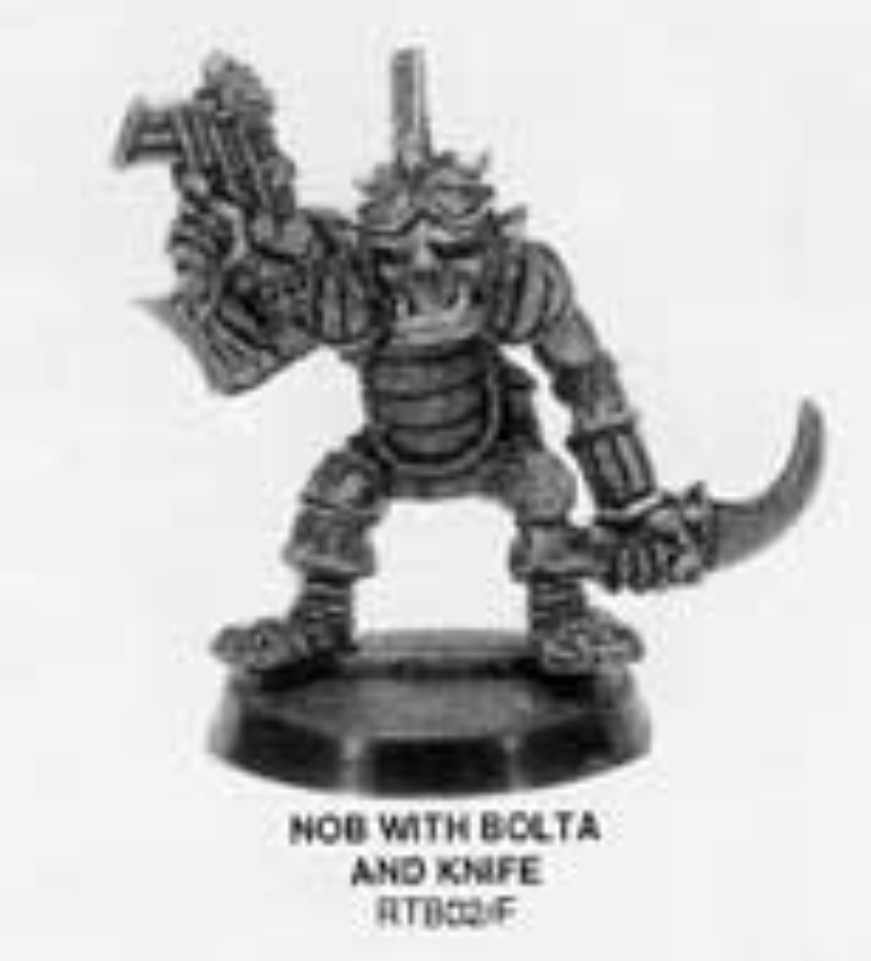
+ Identifying which of the original models is Thrugg and which is Hruk proved a bit tricky. The models are based on the RTB02 'Space Ork Raiders' box, which can be seen on the Stuff of Legends website here: [+noosphericexloadlink embedded+]. The artwork on the cover seems to show the ork I'd identified as Hruk in the dominant eye-catching position, while the one I thought was Thrugg is lower down and on the left. The advert also emphasises the 'Hruk' model, putting him front and centre of the personalities (though Thrugg is in the centre of the main shot). +

+ I thought I had solved this when I spotted that the paper counters at the back of Rogue Trader (intended to let you try out the game) showed Hruk wearing the distinctive helmet and armour of the model above. Unfortunately, having painted the model, I then ended up idly looking at the Collecting Citadel Miniatures wiki, and found that the models themselves solve this: the tabs listing 'Thrugg' and 'Squad leader' – as you can see on the wiki here [+noosphericexloadlink embedded+]... The only problem then is that the other ork personality is labelled 'Hruk' – d'oh!  I should probably have seen this coming, as the equipment lists in the scenario indicate that Hruk has a bolt pistol, something only present on the third personality. Obviously Thrugg is right to be suspicious, as Hruk is clearly dead sneaky! +

+ That minor [SCRAPSHUNTERRORABORT] aside, I'm pleased with the result. This chap will likely be renamed something else once I've got the 'real' Hruk built and painted, but in the meantime, here's a rundown on this squad leader. +


+ Painting: Theoretical +

+ What better colour to use for one of the Arch-Arsonist of Charadon's armies than Charadon Granite, one of my favourite colours? Sadly, my pots of that are quickly getting diminished. Figuring that orks are a good opportunity to play around with colours (slight variation and discolouration between models is a good thing for orks, after all) I took a punt at a replacement; IV-02 [+noosphericexloadlink embedded+], from a company called Instar. I'd not used this company before – I think they're a new start-up – and I'd like to do a more full review in future. Suffice to say that the colour match is excellent – you can see it here on the ork's armour plating/padding. +

+ Getting the pseudo WWII feel across was important, so I added a range of muted browns to the palette, brightening and warming things up with a splash of accent orange, Solar Macharius Orange. A muted palette like this can stand a couple of accents, so I also used a mid blue for the goggles. I like my orks to look a bit grubby, and these colours can all be mixed together in various proportions to produce a great range of subtle hues. +


Image from Rogue Trader

+ I definitely wanted to add some period-appropriate symbols, so decided to add some freehand. The scenario contains some ideas for painting the orks, which I thought would work well – the Rogue Trader symbols have a particular brutal sci-fi aesthetic that is quite distinct from 'modern' orks, and would be perfect for this slightly more militaristic take on the greenskins. In particular, I wanted to incorporate the Luggub's Drop Legion symbol (a knife through a skull in a circle) somewhere. +


+ Painting: Practical +


+ Large areas of browns and grey can look a bit dull, so I livened up the model with some freehand; a couple of kill stripes on the shoulder pad, a subtle smiley face on the gun – things like this are fun, but I didn't want it too distracting from the focal point of the face – and a bit of freehand on his chest armour. +


+ This shot shows the wood effect on the stock of his gun; and also highlights his chainsaw-crested helmet. The original had an odd triangular ornament on top of his hat; I thought I'd update it to be a little chainsaw, made using a Forge World chainsaw bayonet as the basis. +


+ A side view shows a back-up shotgun, and a skull of an unfortunate enemy/rival – scrawled with 'runt' as a final orkish insult. +


+ I've incorporated a couple of bits from the original plastic ork release. The shoulder pad had some sculpting on top to add some detail, but the pouches at the back are straight from the box. +

+ He might not be Hruk, but he does have style. Let's see how this squad leader gets on! +


+++

+Bubbling under +

+ The Alien Wars project – labelled #alienwars – seems to be ticking along – I've had half a dozen or so inquiries about it; and some very intriguing work-in-progress pictures appearing on Instagram, too. All very heartening; I hope it continues to tick over. +

+ For my part, it's got me enthused, so I've been cracking on with more greenskins; a pair of Sisters of Battle; and some Titan crew... +


Sunday, March 4

+ inload: Painting ork skin +

+ Green iz best +


+ This technique should work well on orkoid/goblinoid skin, or anything that requires a similar scheme. You might wish to use lighter-tones for gretchin, goblins and the like; and darker tones for older or bigger orks/orcs. For this example, I'm demonstrating on a model I'm using in an army for my Alien Wars project, so other bits of him are painted; you can ignore these. +

+ I've posted before that I really enjoy painting skin. I think it's one of the most rewarding parts of painting a model, and deserves a bit of extra care and attention. This applies as much to orks (or any other species) as it does to humans. There's a lot of variety in human skintones, as mentioned in an earlier inload [+noosphericinloadlink embedded+]


'I like to add diversity to my skintones – they're hugely variable even in an individual: quite aside from big differences such as ethnicity, conditions such as sunburn, sickness or even being out of breath can change people's skin colour quite dramatically. Adding touches of blue to the skin mix for stubble and bags under the eyes, touches of scab red to the mix for lips, cheeks and fresh scars, or a dilute wash of Olive Green for feeling poorly can make the difference between a cool-looking model and a believable individual.'
+... and I think that doing a similar thing for orks is a good way to add a little more realism to your work. +

+ Greenskins are interesting from a colour theory point of view, as green and red are very similar tonally; and as a result, we can use similar techniques – and even colours – as we would use for humans to paint them. This also allows us to create varied 'ethnicities' for orks. In a similar way to human skintones all drawing from various proportions of red, yellow, white and brown; all ork skintones can be made from blue, yellow, white and brown. Swapping the red for blue naturally creates green mixes when combined with yellow. With that said, just as I use hints of blue when painting humans (to mute the orange mix of yellow and red for eye bags, shading etc.), I also use hints of red when painting orks for precisely the same reasons: red is the complementary of green, so it mutes the colour and makes useful mixes for shading. +

+ A lot has been made of orks being fungus-based, but I prefer to think of them as basically red-blooded animals (as in the Waaagh! the Orks background), which have a green tinge as a result of a symbiotic fungus; as opposed to literally being mushroom-beings. As a result,I use reds and purples to show thinner parts of the skin, and keep the greens I use relatively muted. Just as humans appear browny-yellowy-pink rather than literally black or white; I see orks as basically having an extremely olive green-tinged human skintone. This also leaves a lot of space open for natural variance, which adds to the naturalism. +

+ Preparation and priming +

+ Clean and assemble your model/s and stick it/them to a base. Undercoat the models with a light undercoat of grey. I use Halford's car primer. An undercoat should cover every part and recess of the model evenly and lightly, obscuring no detail. +

+ Painting +


+ I_ Apply a dark-toned basecoat. I've used a mix of Doombull Brown and Incubi Darkness for this example. Ultimately, however, the basecoat doesn't really matter too much as long as it's dark.


+ II_ Once the basecoat has dried, add some Death World Forest and Averland Sunset to the mix on your palette to create a midtone. Apply this over all the skin except the recesses. +


+ III_ Mix a little Screamer Pink (or similar red hue) into the skin mix on your palette, then paint the nostrils, lower lip, inner ears, fingernails and elbows – essentially anywhere the would have blood near the surface. If you can do this while the paint on the model is still wet, all the better. +


+ IV_ Add some flow enhancer medium to a fresh version of the midtone mix (Death World Forest and Averland Sunset) and establish your initial highlights. Note that the colour will be lighter-toned than in step II, as it is not mixed with the paints from your initial deep tone. When placing the highlights, start to create a sense of form. Highlight areas like the bridge of the nose, brow ridge, chin and so forth; while avoiding the recessed areas under the cheeks, in the inside of the elbows and between  fingers. +


+ V_ Punch up the impact with finer highlights. Add Flash Gitz Yellow and Vallejo White to the midtone mix and apply this sparingly; concentrating on the face, and applying it sparingly elsewhere. +


+ VI_ The yellowish tint may well look unnaturally vibrant, so you can knock it back with a purple wash of Druchii Violet (or a glaze of purple).  You'll note I've painted in the teeth and eyes at this point, too. This is a good stage to do it, as the light-toned teeth give a good anchorpoint for getting the balance of tones right later. +


+ VII_ Once the wash has dried, apply sparing touches of Elysian Green as final highlights. +


+ The result +


Friday, March 2

+ inload: The Alien Wars and Hruk +

+ The Alien Wars +

+ There's been a little flurry of activity around the Alien Wars project, which I've opened up to anyone who'd like to get involved – feel free to dive in with the #alienwars hashtag. There's a little info on the new tab at the top, and here's a [+noosphericinloadlink embedded+] for anyone on mobile. + 

+ I have expanded that tab with some further ideas – and will be adding pict-captures of other people's models – but the short 'brief' is simply to make a model (or more) that fits into the Nova Terra Interregnum of M35, a period of instability in the Imperium that saw the resurgence of Xenos threats. +

+ This is a broad brief; intentionally so, because there's very little written about this period of 40k history. There are a few hints here and there, but it's very open for your ideas. I've expanded on those through the link above. +

+ In with the Old +


+ For myself, I've been shamelessly immersing myself in nostalgia, tying the project together with an urge I've had to update the models that caught my youthful imagination – namely the Blood Angels of White Dwarf issue 139, and the orks of Luggub's Drop Legion, who turned up in the first Rogue Trader expansion, the Book of the Astronomicon. The unseemly looking chap above is an update of Hruk, the ork second-in-command from the Rogue Trader scenario The Battle for the Farm. The Kev Adams original is up there for comparison. +

+ ...and Also With the New +

+ But there's no need to restrict your explorations of the Alien Wars to revisiting old models. Here are two plastic Sisters of Battle, for example, ready for paint. +


+ How do I get involved? +

+ If you'd like to share your model – or models – you just need to use the #alienwars hashtag on Facebook or Instagram. However, I'd be delighted to share your models here on Death of a Rubricist, to collect the #alienwars models together. +

+ If you'd like to showcase your work here, please either drop a comment below, or get in contact via Facebook [+noosphericexloadlink embedded+]. +

Thrugg, Hruk... and an ork boy who's about to get a bashin' for wandering into the bosses photoshoot.

Friday, February 23

+ inload: The Muphrid Disc Clearances +

+ The Muphrid Clearances +

After their actions on Arcturus, the Third Company's next deployment was to support the elements of the First and Fifth companies during their clearance of Muphrid, a binary star system rimwards of Arcturus. Muphrid's swollen primary star, a red-giant, was planetless, though the system's large accretion disc contained numerous habitable, if inhospitable, planetoids.

The Order of Solar Ascendant maintained a number of isolated priories and missions here, which had historically been the lynchpin of Imperial defence as ork pirate raids increased in frequency. The Sororitas had successfully launched punitive raids on encroaching greenskins that had made landfall on the many Imperial mining operations, but they were stretched thinly; and their naval support was woefully inadequate. Much to her personal – and far from private – chagrin, Prioress Al-Achsasi was obliged to request help from the wider Imperium.

Battle Sisters of the Order of Solar Ascendant
The answer came from Master Formosus of the Blood Angels, who notified the Prioress that the a large element of the Blood Angels fleet would perform an interdiction and extermination campaign to sweep and clear the Muphrid Disc of xenos vessels of cruiserweight displacement or greater. When Al-Achsasi asked for consultation on behalf of the Imperial local command, she was rebuffed with a dismissive explanation that the Astartes required no assistance in this matter. Bristling at this perceived insult, the Prioress and Chapter Master's relationship proved strained throughout the campaign; a matter worsened by the region's close and vocal ties with Nova Terra.

It is a mark of humanity's hatred for the xenos that both the fanatical and studiedly neutral were able to put aside their differences to fight the orks – albeit under duress. It was fortunate indeed for the Imperium here that they were able to avoid internecine conflict, as the forces here and on Arcturus proved to merely be the vanguard of a building ork crusade from the smouldering Charadon region.

Ork commando of Luggub's infamous Drop Legion.
On at least two occasions, the forces of Solar Ascendant and the Blood Angels were required to work together in hulk clearances. While Formosus and Abelard avoided deploying their forces alongside potential heretics, Tycho of the Third followed a more pragmatic path, though communication and interreliance between the forces was strained at best.


+++

+ Building +

+ Well, that was a productive evening! I started to build the boyz for my ork force. As I think I've mentioned before, the Alien Wars/Nova Terra Interregnum setting I'm developing is essentially my iteration of the Rogue Trader (RT) era. I think the RT background is a lot more dystopian, with more emphasis on the desperate, floundering scale of the Imperium. There are perhaps fewer existential threats – modern 40k has a 'five minutes to midnight' feel of apocalyptic scale and gods walking the galaxy; whereas RT concentrates on the million, million smaller wars that burn across a galactic empire collapsing under its own weight. +

+ If 8th is Ragnarok; RT is a World War. It might not be the literal end of existence, but it's bloody unpleasant for those involved, and no-one can escape. RT also has less of a definite sense of good and evil. While the orks are nominally 'the baddies', the Imperium are hardly good guys. The shades of grey in RT are much closer. +

+ I'm trying to get this across in my orks by downplaying the more exaggerated features and adding more military-style fatigues and armour. RT background originally had the orks as slavers; their equipment definitely manufactured rather than individually built, though there was still a (small c) chaotic sense of individuality. Basically, I want the orks to look like a tough, hardened militia. +

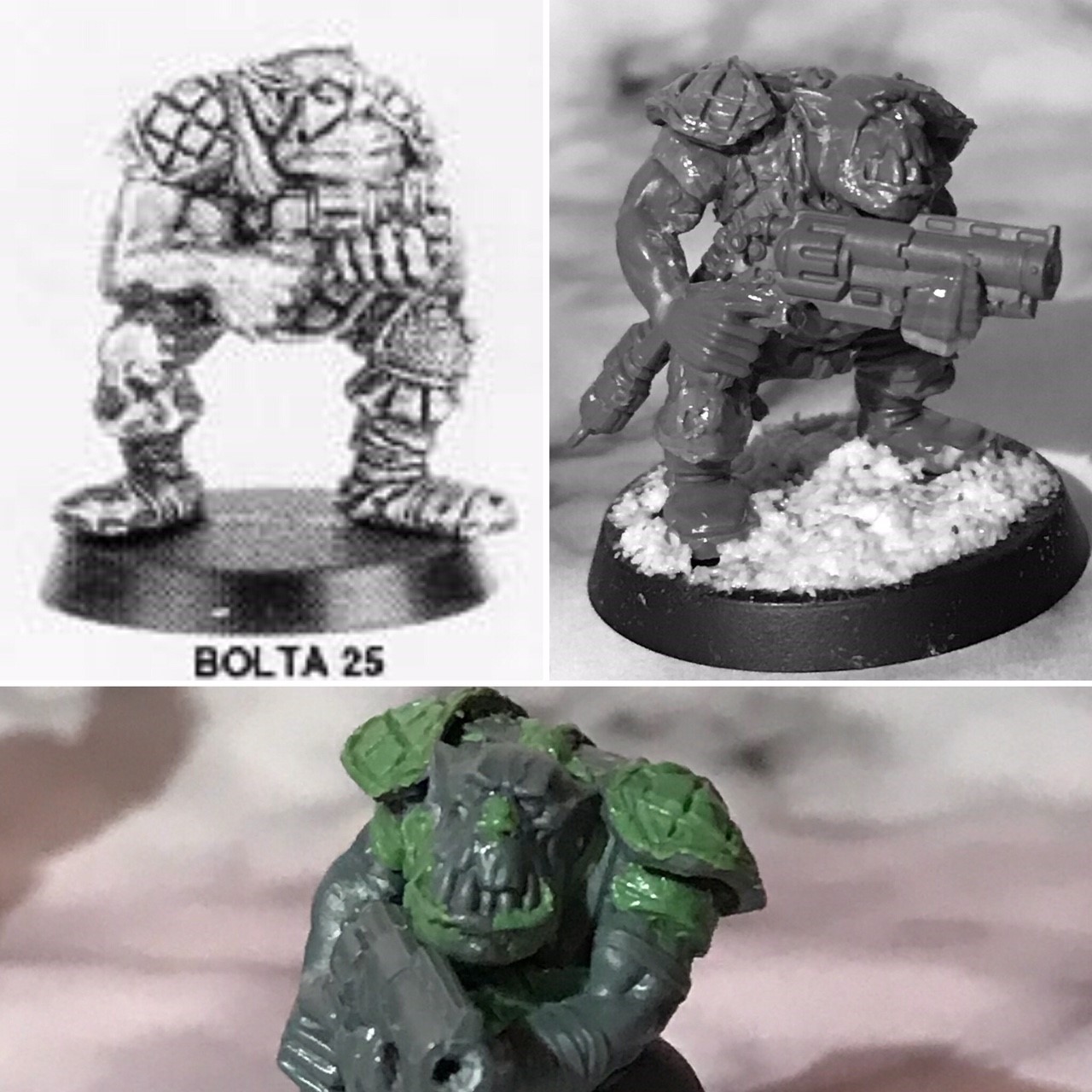
+ Below you can see the first ork. As with Thrugg [+noosphericinloadlink embedded+], I'm taking a period miniature as inspiration; here one of Kev Adam's seminal ork boyz. In terms of the details, I've tried to capture the main elements – the revolver-style gun, baggy fatigues, neck-scarf and quilted flak armour. However, I'm also a big fan of Brian Nelson's version of the orks, so I didn't want to completely lose the brutal charm of the underlying sculpt. +


+ I've desaturated the top right part to blend the greenstuff work in for clarity, but I've left the bottom part of the picture untouched, so you can see the details on the face. I've added a bottom lip and slightly extended the nose – both very minor details that don't alter Brian Nelson's awesome basic sculpt too much, but do give the figure individuality. +

+ Individuality +

+ This is an important point about non-human figures. You can get away with bare human/space marine (and even eldar) heads being duplicates, because we're familiar with human faces being broadly similar, and are hyper-aware of tiny differences in skintone and shape. As a result, using the same human head repeatedly will seem natural, as the paintjob will inevitably bring out tiny differences that the brain unconsciously reads as details. +

+ That doesn't apply to orks, or other slightly less humanoid figures like Tau, as we're not as attuned to the archetypal face. Thus, seeing the same head will look like masks, giving an unnatural feel. This applies even after paint, as the non-human skintone (green, blue etc.) is equally unfamiliar. To combat this, you need to either make the skintones radically different, really push the visual texture (adding muscular striations etc.), or chop and sculpt around the face. That's the best way to get a sense of individuality back into the models. After all, xenos or not, orks are organic and just as diverse as 'oomies. +

+ As an aside, I think this effect is part of what gives plastic (and particularly CAD-designed) models the reputation as 'less characterful', due to the inevitable repetition of certain parts, and the loss of what can charitably be called the 'sculptor's touch' (and unkindly called tiny errors). Hopefully the minor changes here will go some way to capturing the quirky individualism of RT-era sculpts, without sacrificing the sharpness and quality of the modern plastics. +