Friday, July 11

+ inload; Repurposing models +

+ inload: New jobs for old models +

+ The sun sets on the Primarch and his Honour Guard outside the walls of Macragge. +

+ Re-using or repurposing models from one army to another is something I do quite a bit. A fresh paintjob can work wonders in livening up a figure, and is – obviously – considerably cheaper and quicker than making another. 

+ The three Honour Guard figures above are a good example of figures that are good candidates for re-use. They received quick paintjobs for a specific campaign weekend, and don't quite fit anywhere in the way I now see the Ultramarines. +

+ The three started out life as Imperial Fists (see left), a short-lived project that eventually got swept under the carpet. They were pressed into service for the Ultramarines when I was hard-pushed for time, but have languished, virtually unused, in my army case since that campaign weekend. 

+ I can't get too excited about elite troops; I much prefer the down-and-dirty line infantry. For this reason, I decided that the Honour Guard would be re-used to help integrate the new Ultramarines (the 190th) with the old Ultramarines (the Praetors of Calth. +

+ The Praetors of Calth are an army of which I'm very proud, but the later models didn't quite fit with the original image I had for the army for one reason or another. With the thirty core troops in place, I flitted from expansion to expansion; adding five Vanguard or Recon troops... and then pulling them apart and repainting them when they didn't quite fit. + 

+ The 190th are an attempt to breathe new life into the army as a whole. With the release of the Forgeworld Horus Heresy range of bits, it's become a real possibility to create the army that I wanted. The first step was to build a relatively substantial force of the new models; I have a bad habit of breaking apart perfectly useable old models with the intention of updating them, then getting distracted by other projects; leaving me with fewer than I had before! +

+ So, with a large squad of new marines complete:
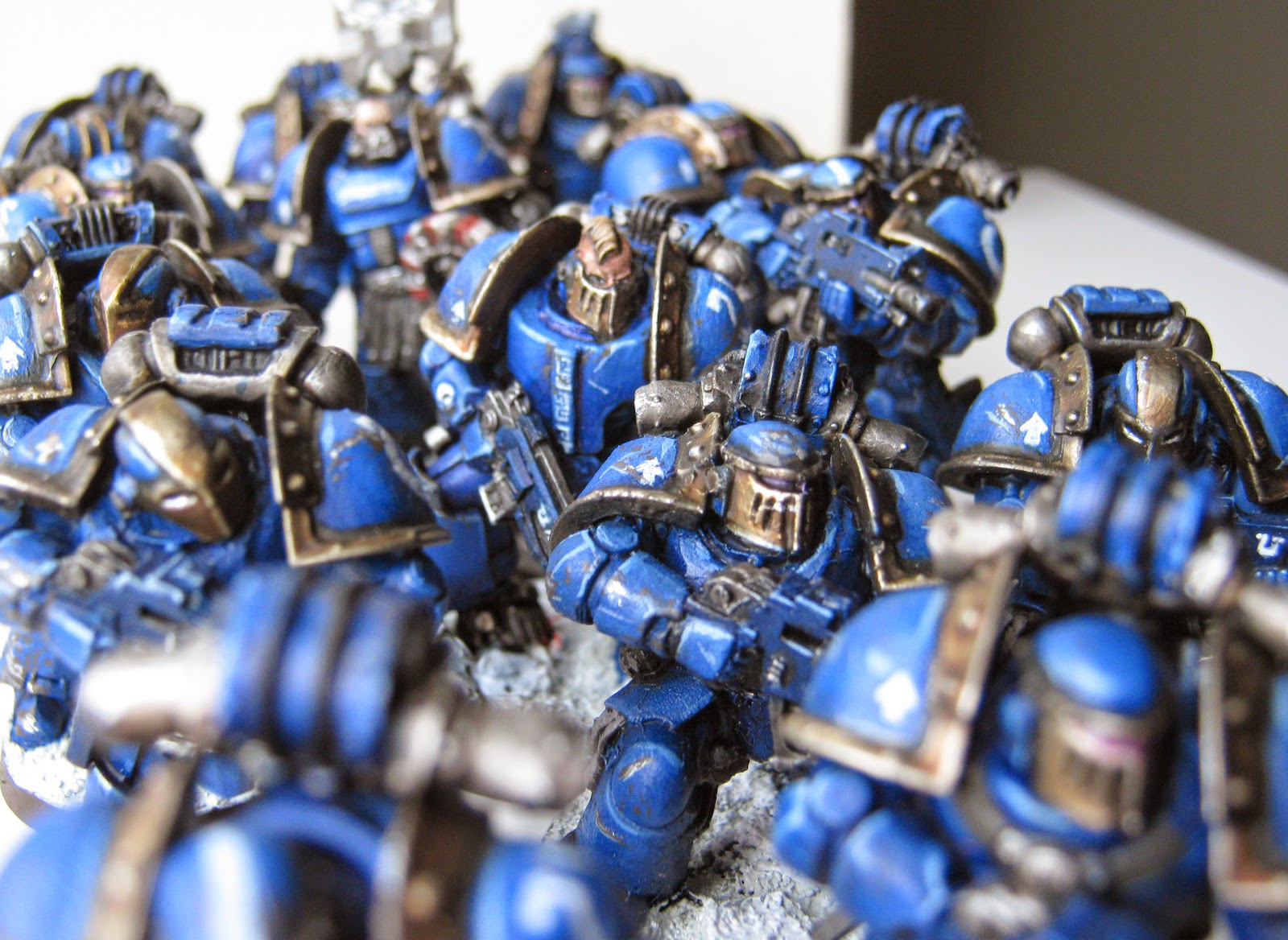


+ ... it was time to look at updating the older models, with the intention of creating a mixed squad of Breachers that would bridge the visual gaps between the older models and the newer ones. I started by creating some completely new models, being sure to add visual links to the newer models like updated FW helmets, equipment, and legs (taken from Tartaros Terminators). +


+ I then broke up the Honour Guard and rebuilt them with a mix of the older and newer elements:


+ Notice that the focal points of the Breacher marines (weaponry, helmets) are updated – this is relatively quick work that really changes the feel of the models. I also updated the backpacks (as these are a strong visual identifier for the period, but the majority of the work was removing the excess decoration on the originals. +

+ I like to think that these are perhaps the same marines; simply at an earlier stage of their careers. By the time of the outbreak of the Horus Heresy, the rest of the squad must have been killed or promoted away, leaving just these three grizzled survivors. +

+ As a group, I hope the newer and older models fit together well. In particular, the mix of newer and older shoulder pads in the squad (probably the most distinctive visual part of my particular method of making larger marines) links the unit both to the older and newer models. With a quick spruce-up of the paintjob – I think they deserve my best efforts –  I think they'll work well. +


+ While talking about the Breachers, note the additional marine in the back left of the image above. He's a 'transition' marine that combines elements of the older and newer aesthetics in unique ways: his backpack and shoulder pads are neither the new style nor the standard old style; instead being a unique mix that combines elements of both to assist with the unit blending together.

+ He required a bit of reposing. Here's the original construction (he's at the front):


+ While it's a pose I liked, it didn't fit with the squad. I'm being very careful with the 190th to make sure that they look good en masse; and that means occasionally sacrificing individual poses for the good of the group. With the new poses (and bits – his legs and right arm have been removed and are already the start of a new marine), the squad looks much more cohesive. +

+ This concentration on the group rather than the whole also makes the most of limited resources. I only have eight Breacher shields and seven of the gladius-style shortswords. By planning ahead and scattering appropriate-looking chainswords (see the fifth picture from the top for an example) in the squad as it's built, I'll gradually work in these divergent bits of equipment on models that otherwise stick closely to the group aesthetic; further building on the integration of the squad as a whole. +

+ On this note, it's part of the reason why one having something special (a bare head, a cool pose, a weird bit of equipment) often looks best on a model if it's set off by a group of standard marines – then the divergent bit becomes a point of interest in the overall arrangement as well as the individual figure. +

+ Anyway, enough pontification! To end this post, here's a final shot of the Breacher squad from the front. +


Tuesday, July 8

+ [mark: -136.57.07] +


+ Dug out the Ultramarines again, and got highlighting. This group is near complete now. The following bits to be done:

  • Weathering and scratching
  • Eye lenses
  • Base drybrush
  • Base rims
  • Final check
+ Not much at all. That'll bring them to the same stage as these chaps:


+ It all seems a long way from 2008; and hopefully that shows in the painting. +

+ Long live the 190th! +


Tuesday, July 1

+ inload: Brother Veridias +


Opening the helmet's grille, he exhaled raggedly. A mist of aerosolised blood hung briefly in the hot still air under the void shields.


Blinking to clear his head, he chewed the side of his tongue thoughtfully; a childhood habit that hypno-docrination had not removed.


He took a tighter grip on his boltgun and looked down at the counter on the back. Seven rounds remaining. Sufficient.


Scarred and pitted, his armour wheezed and creaked as he turned to move out; its slick motions reduced in parts to juddering, squealing protest.


Still. The walls must be held. Sacrifices must be made. He chewed the side of his tongue.

Wednesday, June 18

+ 'These hands are not mine' +


+ A melancholy quote that the novel, Wrath of Iron, attributes to Ferrus Manus, Primarch of the tenth legion. A little more of it:
'Hatred of what is natural, of what is human, is the first and greatest of the corruptions. So I record it here: when the time comes, I will strip my hands of their unnatural silver. I will instruct my Legion to recant their distrust of the flesh. I will turn then away from the gifts of the machine and bid them relearn the mysteries of flesh, bone and blood. When my father's Crusade is over, this shall be my sacred task. When the fighting is done, I shall cure my Legion and myself. For if fighting is all there is, if we may never pause to reflect on what such devotion to strength is doing to us, then our compulsion will only grow. Already I see the madness that path leads to, and so I shall excise the silver from my hands. In doing so I shall weaken myself and my sons, but nonetheless it must be done. The hands are strong, and have created great things, but they are not mine.'

+ I like the Forge World version of Ferrus Manus, but for a few reasons, it just didn't quite hit the spot for me in terms of capturing what I had in my head for the Primarch; so I decided to build one myself.

+ The base model is from Heresy Miniatures. I started by using pure greenstuff to add the flexible power armour undersuit for the joints (always work outwards), then began sculpting the basic shapes of additional armour on top using a mix of ProCreate and greenstuff:


+ With that in place, I continued to bulk up the armour plates. +


+ Next, I'm going to begin the armour on the arms – just the uppers – and begin thinking about the embellishments in more detail. +

Monday, June 16

+ Engine War power generation +


+ Continuing from the previous inload about Engine War, (+noospheric inload link+: http://apologentsia.blogspot.co.uk/2014/06/concept-inload-engine-war-zoggin-eck.html), I thought I'd write a little bit about the power generation system of the game – mainly as an excuse to post the cool Gary harrod artwork at the top of this post! +


+ Basic thoughts +

+ When writing any rules, I aim to strike a balance between character and simplicity. My personal preference is for very abstract and hands-off mechanics; so that there's maximum freedom for putting your own interpretation on the events, and minimum space for confusion or complexity. 

+ For example, while there's a lot of pleasure in long tables of mutations or weapon malfunction effects, they do slow down the game, which can make things drag. Besides, however many D1000 tables you write to explain the effects, you can never quite match the creative possibilities that a simple 'hit' result can entail in the player's imagination. 

+ However, in a game involving only three or four models, there needs to be something to do. Warmachine is fantastic for balancing complexity (managing the 'Focus' system) with a clean ruleset. It was an obvious source of inspiration. 


+ Differentiation and initial approach +

+ Imperial, Ork and Eldar forces fight very differently in Epic: Armageddon. They share common rules, but also have a few well-picked unique rules that help create the flavour of the army. As mentioned in the earlier post, I didn't want to have just one basic system for the different factions; but for each to work differently; so I worked out each type simultaneously.

+ In Warmachine, a Warjack can (mostly) be given a maximum of three Focus points per turn. This works nicely, as that's generally not quite enough to do everything you want to do, which makes for an interesting resource management system. In Engine War, I wanted to get a similar balance of not quite being able to everything you want to do. 

+ The game differs from Warmachine in that the models are creating their own 'power', rather than drawing from a single leader – a process that tends to mean you have to have a hard limit to allow for the fine balance of Warmachine. 

+ In Engine War, a typical model have far more weapons than the typical two a Warmachine model has; so more power is needed for each model. Typically, a War Engine of the Battle Titan class we're looking at initially will generate between three and six useable power a turn; with the orks having a much greater variance, and the Eldar a hard limit. 


+ Imperial Titans +

Power generation During the Control phase, generate power for your War Engines as described.
Plasma reactor: Generate 1D3+2 Plasma counters during in the Control phase, if the Plasma reactor system is not crippled. If this system is crippled, the War Engine generates no Plasma counters.
+ Imperial Warlord Titans (the basic Titan) will use these Plasma Reactor rules to generate Plasma counters; which can then be spent in various ways. (When I add the other Titan types, I'll adjust the general rule to be generic, and add the specific number to the Titan type rules – smaller Reavers will generate less, for example).

+ This system works in a very similar way to the Focus mechanic. The Plasma system can be used to improve the aiming of weapon fire, fire additional shots (from suitable weapons), increasing damage and regenerating shields, amongst other things. It's the most basic of the systems. 

+ Unlike Focus, not all of the Plasma Counter will be removed at the end of the turn. Instead, they will overcharge the void shields, and potentially provide a reservoir of power for the following turn. There'll be a 'safe limit'; above which the Titan will start getting overheats and problems. This will hopefully create a balancing act between holding plasma enough to protect yourself and act as insurance against an unlucky low roll the following turn; and using the plasma to cause more damage, regenerate shields and generally be useful.

+ Damage to the Titan's plasma reactor will result in a drop-off of power and the safe limit. Eventually, I'll add rules for critical damage – and the amount of plasma left in a generator will affect any resultant earth-shattering kaboom! +

+ Eldar Titans +

Infinity Circuit: Generate 3 psi-counters during in the Control phase, if the Infinity Circuit system is not crippled. If this system is crippled, the War Engine generates D3 psi-counters.
+ More reliable than Imperial's roiling plasma reactors and ork's atomic boilers, Eldar Titans draw power from the warp via the the Titan's Infinity circuit. The Infinity circuit acts as a safety valve to the warp. For important cultural reasons, the Eldar are very wary about making use of the Warp, so always operate within very tightly-reined safety limitations. Should the Infinity circuit become damaged, it collapses the link – so there's never the risk that the system will cause a warp rift. 

+ At the end of the turn, the psi-points are bled away. Eldar Titan shields don't work on damage resistance or amelioration; so there's no need to hold onto power.

+ In game terms, this means Eldar Titans generate less focus than the others; though this is balanced by the fact that their basic stats are better, and also that Eldar Titans have fewer weapons in general, so less need to use power points to activate them. The system is also generally more reliable than the Imperial or Ork systems; and won't result in a catastrophe that damages nearby friends. This becomes important when you see the interaction between holofields (which encourage the Eldar player to bunch up). 

+ On the other hand, while it means Eldar Titans will almost always be able to do what you want, they're never going to surprise you with being better than you expect – exactly as a haughty space elf might deign to help you. 

+ This system is much simpler and cleaner than the others; and this is in part because Eldar Titans will have to concentrate much harder on manoeuvre and rationing their power in the movement phase. +

+ Ork Gargants +

+ Right, these are more complicated than the others! This is for a number of reasons:
  1. Ork technology is less refined and sophisticated (though no less advanced or capable) than the 'pink species', and I wanted to capture the sense of tinkering that should warm the heart of any good mek.
  2. I wanted to introduce a risk mechanic. Gargants will require far more micromanagement, but with the reward that they will be far more puissant than an equivalent Titan. However, that'll need to be balanced against the threat of overcooking things, which'll make the Gargant far worse than the equivalent.
  3. I didn't want ork tactics to be one-dimensional. Since their weapons are typically shorter-ranged than Imperial or Eldar guns, I wanted to ensure that the ork player had some interesting and fun choices to make in the early turns.
  4. Gargants tend to have lots and lots of secondary weapons. I wanted to ensure that the ork player had the potential to fire them all; as well as their primaries.
+ So, there's the reasons; here's the execution: 
Atomic Furnace: Nominate a number of undamaged Furnace boxes in the Control phase, then roll an number of D3s equal to the number. Generate a number of Steam counters equal to the result. For every undamaged Furnace box not nominated, remove a Steam counter. 
Steam counters are not removed during the Maintenance phase. If the number of Steam counters exceeds the Threshold at the end of the Control phase, roll on the emergency vent table for every point over the Threshold.
+ For reference, an undamaged Great Gargant has six furnace boxes, and a Threshold of twelve. This provides a few interesting calculations. An undamaged Great Gargant can potentially generate 18 Steam Counters; but would then have to roll six times on the emergency vent table (tune in next time for information on this) – virtually guaranteeing that the Gargant will blow its boilers, start a load of fires and lose all of its Steam Counters.

+ A more wily Warboss will order the riggers to generate from just four Furnace boxes; which will get him 6 Steam Counters on average (4 x D3 = 8 - 2 for the venting boxes). +

+ Steam Counters will build up – i.e. they won't be removed at the end of the turn – which will prove at the heart of maintenance. After a surprising high roll one turn, the Gargant commander might generate from just two furnace boxes; generating 2D3 and bleeding off 4; for a net gain of 0. 

+ At the start of the game, the Gargant commander will be able to use Steam Counters to boost his Power Fields and movement; keeping his defences up as he closes with the faster, longer-ranged Imperial or Eldar opponents. As he closes, Steam can be diverted to the multiple secondary gun decks to allow them to fire a blistering broadside; plus to boost the primary weapons' power. Ork guns are going to have fairly unimpressive stats, so they'll be well-advised to use the atomic furnaces to boost their power. On the other hand, they'll have far more guns as standard than opposing Titans, and access to more potential power; so close-up, they should be intimidating.

+ If that sounds scary to potential Imperial or Eldar players, the fire mechanic should provide some relief. I'll look into this a bit more next time, along with more information on defensive systems. +

Monday, June 9

+ inload: Brother Medardus, Psi-cursed of Clan Trago +


+ Sometimes you have to run with your enthusiasms. My friend Chris, who has an excellent Blood Axe army (Nuzzgrond's Shooty Boyz; though currently being used to represent an M37 force under the command of Og Throatchoppa), asked to play a game of 7th edition over the weekend. I'd recently built myself a gaming table, and thought it'd be great to do it properly and have two fully-painted armies playing over some nice terrain.

+ Obviously, the best idea was not to use any of my painted armies, but instead build and paint a whole Iron Hands army in the two days preceding the game. Cue much panic-painting!


+ The force ended up being ~900pts strong in the end; a testament to just throwing models together and ending up with some combinations of wargear that were rather questionable in terms of effectiveness, but it was great to just throw together models that I liked the look of, instead of meticulously planning everything. +

+ I'll be showing some more of the army as I finish off a few details on them, but for today I'd like to show Brother Medardus, an Iron Hands librarian:


+ I'm really pleased with how he came out – I was going for a 'Doctor Doom' vibe (the Iron Hands aren't very nice!), and ended up with what I think is a very menacing model that owes as much to other comic book characters like Magneto and Iron Man.

+ At the same time, I hope that there's enough 40k in there to tie him in as a character that fits into the universe. When converting with an outside source (like comic book characters) as your inspiration, it's easy to get carried away and just make a version of that character that doesn't fit into the universe. 


+ The model is mainly made from the Forgeworld Mk III Iron Hand pack (torso, legs and head); with one plastic bionic arm and a hand from the Sanguinary Guard kit, I think (I bits-ordered it from eBay ages ago), and the other arm taken from the Dark Angels librarian in the current 40k boxed set. It might seem extravagant to use a model like that for just one arm, but there's loads of him on eBay for ~99p! The backpack is from the mail order exclusive Captain, the remainder of which was used for the basis of my Clan commander (of which more in a future post).

+ I trimmed a section out of the helmet's grille to give a more threatening look, basing it on the helmet from Gladiator. +


 + The name is drawn from a book called The Devil's Elixirs, a Gothic novel I'm enjoying reading. The character doesn't really relate to this Iron Hand, but I thought it was a great name. His forename, Cyle, is a throwaway joke based on my choice of telekinesis as his psychic discipline. There are some great mechnical-type powers in the list, which I thought were most appropriate. Besides, hovering in the air as he is, telekinesis seems pretty important! +


+ Kneel before the Hands of Iron! +

Tuesday, June 3

+ Concept inload: Engine War +

Zoggin' 'eck!

+ A slightly tongue-in-cheek title for this. I've been musing about scratching my giant robot itch ('you can get a cream for that') recently, and ended up thrashing out a set of rules to adapt the excellent Warmachine ruleset to work with the gigantic War Engines – Titans, Gargants etc. – of the 41st Millennium. 

+ I really like the Epic: Armageddon ruleset, but one thing that it doesn't do particularly well is Titans. The obvious thing would be to use the old Adeptus Titanicus or Titan Legions rulesets, but I enjoy writing. Besides, this is a fun project, even if it never becomes more than a theoretical exercise.

+ The abstract +

+ Write a set of rules that convert Warmachine to allow the use of Epic-scale Titans and Gargants. The ruleset should:
  • Be easily-digestible; using existing rules where possible.
  • Represent the factions as they are portrayed in the background.
  • Evoke a sense of size and power in the figures.
  • Keep both players involved.
  • Allow multiple strategies, whatever your choice of faction.
  • Be fun.

+ Specifics +

+ Additions to the general rules:

Primary weapons: When making a Shooting attack, any weapons with the Primary rule may fire as part of the initial attack. Resolve the attacks separately, one at a time, in the order you choose. 

+ This rule is introduced because Engine War is much more dependent on shooting than Warmachine. Allowing all weapons designated Primary to fire during one Shooting attack allows the main guns to speak; while you can also have non-primary weapons to allow for micromanagement. +

Continuous effects: War Engines are very large. Multiple fires can affect completely unrelated areas on the same Engine, for example. Unlike Warmachine/Hordes; you can be affected by the same continuous effect type multiple times. 

+ The fire mechanic from Titan Legions was a lot of fun, and having lots of fires raging evokes the idea of great land battleships billowing smoke while they continue to fire. +

Alternating activations: Players take it in turn to activate individual units. Turn order is determined as normal at the start of the game.
+ One of my favourite mechanics from Epic; I wanted to include this. Because War Engine doesn't rely on synergies (like the parent game Warmachine), the alternating activation should work fairly smoothly. In addition, because the use of individual War Engines is relatively complex (compared to a Warjack, for example), this mechanic is the best way to keep both players involved. It also allows for easy scalability and (potentially) multiple-player games. +

+ Currently, these are the only major changes; everything else works according to the slick and tight Warmachine rules. Of course, there are huge differences – the lack of Warcasters and the fact the Engines work slightly differently to Warjacks is obvious, and I'll have to come back and tighten up the general wording on those areas once I've worked out how each faction will function. +

+ Faction specifics +

+ The following (fragmentary) notes are taken from my initial draft; just to give you an idea of how I was thinking. If something comes up later that just doesn't work, I'll be able to come back to these basic ideas. 

+ As you'll see if you compare the specifics to these earlier notes, I've already moved away a little from some areas, but the core is there. +

General thoughts. 
  • Mainly based on Warmachine Colossal damage grid; including two banks of six columns and systems that can be knocked out.
  • Weapon types

Imperial Titans 
  • Few special rules inherent; instead purchased by weapon choice. e.g. Harpoon missile will disrupt
  • Void shields
    • Available in 'banks'. Each bank will stop X damage, then collapse and allow excess to 'bleed through'.
    • Banks can be regenerated by spending plasma.
  • Plasma reactor
    • Equivalent to Focus mechanic; but randomly generated per titan. 'Bled off' at the end of the turn.
    • Can be spent to:
      • Additional die to hit 
      • Additional die to damage
      • Run
      • Additional attack
      • Shake effect
      • Power attack
  • Structure
    • Hull
    • Weapons 
    • Head – Fire control: can +1 or -1 from column choice(?)
    • Reactor
    • Legs


Ork Titans
Easy to hit, slow, but monstrously resilient. Can repair. Slightly unpredictable; require more micromanagement. 
  • Power fields
    • Works like Warcaster power field (+1 ARM for each steam point)
  • Steam points
    • Equivalent to Fury mechanic; generated at a low rate, but maintained from turn to turn.
    • Steam can be vented voluntarily.
    • If too much is generated or spent in a turn, causes overload (like a threshold check). 
      • Causes the gargant to gain fire markers and lose steam.
    • If all steam is lost, gargant becomes inert and has to be restarted.
    • Bigger gargants can maintain more steam.
    • Can be spent to:
      • Additional die to hit 
      • Additional die to damage
      • Run
      • Additional attack
      • Shake effect
      • Power attack
  • Waaagh! points
    • Equivalent to Focus mechanic; generated across whole army and distributed from biggest Gargant downwards.
    • Can be spent to:
      • Add special rules (different costs)
      • Restart gargants
      • Get grots to put out more fires
    • Gargants are designated 'kunnin but brutal' or 'brutal but kunnin' before the game.
      • Kunnin but brutal get access to:
        • Awe; circular vision; defensive strike; finisher
      • Brutal but kunnin' get access to:
        • Aggressive; assault; brutal charge; bulldoze; cleave
    • Generated if: 
  • Mega-gargants:
    • Gunfighter, Virtuoso


Eldar Titans
  • Power-points
    • Automatically generate a static number of points.
    • Number of points generated is low because of Future Sight combined with generally better stats makes things more reliable.
  • Holofields
    • +1 def per power-point
    • Improve if on the move.
  • Wraithbone matrix
    • Is an arc node
    • Bushwhack
    • Future sight
    • Evasive
    • Swift Hunter

+ Starting points +

+ I didn't want to start by working out one faction (Imperial Titans, for example), then converting the others from that mould. This is because I think that approach can lead to awkward bodges to get things to work appropriately and thematically; and is also a bit unimaginative. Gargants are very different from Eldar Titans, and simply having the former as 'slower, tougher Titans' and the latter as 'faster, weaker Titans' sells both short. +

+ That meant I had to build all three up simultaneously. Doubtless there'll be areas of disagreement in specifics, but I hope I've done justice to the basic concepts, culled from the background of War Engines rather than the old rulesets. I decided to work from the iconic Battle Titans, as these set a basic standard from which the larger and smaller types can be distinguished: the Warlord, Great Gargant and Phantom. +

+ Statwise, all were going to be based on the Warjack rules, as these are nicely balanced across the factions while still getting nice themes across. They'll get tweaked, but I started with Cygnar, Khador and Cryx heavy Warjack stats for the Imperials, Orks and Eldar respectively. 

+ Because the game is much more based on ranged combat, and because War Engines typically have at least three weapons, the normal damage chart wasn't going to cut it – there wouldn't be enough space for a decent amount of boxes for each location; which would lead to weird lop-sided damage. On top of that, the War Engines needed proportionally more damage boxes because the number of weapons – and emphasis on ranged combat – meant it would be easier to damage them.

+ I decided to use Colossal damage charts. These are twice the size of Warjacks' damage charts, and split into left and right sides. This gave plenty of space for locations like legs, head, and – of course – the weapons. It also helps create a sense of scale and size while adding to the importance of manouevre: an opponent who outflanks you can only be targetted by the weapons on the relevant side, for instance. +

+++

+ This is becoming rather a wall-o-text, so that's enough for the mo; I just wanted to lay out the basic ideas. Next time I will show the draft rules for one of the factions (or more, if I have time) and explain the different power generation mechanics. 

+ If you have any thoughts on the parts of the project I've laid out – whether general, specific or simply a bit of encourgement – I'd be keen to hear what you have to say. +

Thursday, May 29

+ inload: Using a limited palette +

+ Using a limited palette + 


+ The Iron Hands I showed in the previous post are nearly completed, with little left to do beyond weathering, battle damage and suchlike to add some realism. I thought I'd do a post on that later, and thought it'd be a good idea to show them beforehand, to show the difference a little grit gives a model.

+ Helpfully, I'd been caught my a minor enthusiasm to use a limited palette for these Iron Hands, and thought those WIPs would be a great time to talk about the theory and practice. +

+ Selecting a limited palette +

+ The black and white nature of Iron Hands made selecting the palette fairly simple. I used the following paints:
  • Vallejo white – this doesn't go as chalky as Citadel white, and I find it works better for mixing.
  • Abaddon black – still not convinced about this, but given my minor prejudice against using pure black, perhaps that's understandable.
  • Fenris grey – a lovely cool blue-grey that forms the key to the theory.
  • Boltgun metal.
  • Warlock(?) purple – not sure on the name of this paint, it may be another. In any case, a nice strong imperial purple.
  • Graveyard(?) earth – again, the name may be slightly different.
+ In addition to this palette, I used Agrellan earth textured paint (same hue as the brown I used) for the basing and Mithril silver to pick out the silver on the hands. +


+ Painting black (and white) +

+ When painting any colour on miniatures, the basic concept is that you're creating the illusion of size by exaggerating the tonal change – that is, because the models are small (not far away, Father Dougal), you need to add artificial highlights and shading to simulate the effect that light would have on a large, distant object. Ideally, you want to work from very dark to very light; it's this contrast that provides the illusion and interest. 

+ In order to add interest, you're usually shifting the hue a little, too – but in the case of black, this is not necessarily the case. You can go for a completely neutral miniature using just black and white, and working through tones of grey; but this tends to lead to a dead, lifeless-looking miniature because the eye is attracted to hue.

+ The tonal range on a miniature (the difference between the lightest part and the darkest part) is most striking when you work from near-black to near-white. The problem for black colour schemes is working through this range and keeping the miniature interesting and still appearing overall black (the same applies to white, from the other direction).

+ So, when painting black (or white) miniatures, I find it best to decide on a colour to work through. It really doesn't matter what colour you use as long as you're consistent. Red and yellow don't tend to work quite as easily, because they go muddy when darkened; so if you want to try it out I'd recommend using a blue or green. For the purpose of this blog post, I'll use the term 'core colour' to refer to the hue you've chosen.

+ 'Black' miniatures can thus be thought of actually simply a very dark hue of your core colour (in this case, blue-grey), which makes things infinitely easier to shade as you still have pure black (darker than the base colour) to work towards.  +

+ The benefits of a limited palette +


  • Much like cooking, using a limited palette also makes things like proportions of colours and mixes easier to remember, as there are fewer basic 'ingredients'.
  • A limited palette also tends to lead to a more striking effect. Using lots of different colours on a miniature will increase the chances of a colour combination that just doesn't work, for whatever reason. 
  • Thirdly, using a limited palette is a great way to concentrate on tone – that is the relative lightness or darkness of a colour – without complicating things with the addition of multiple hues. 

+ This last point is particularly marked with black and white, as they are extreme tones; and therefore have to be handled subtly. On a black miniature, the tonal range is going to be heavily shifted to the darker end, but you still need to work through the whole range. 


+ Painting black +

+ The obvious question is then 'but doesn't that just mean you're painting the miniature your core colour?' Essentially, yes. The difference between a black miniature and a miniature of a particular hue is how the tonal range is applied. 


+ On the shoulder pad of this mid-blue miniature, the range still works from a near-black extreme shade to a near-white extreme highlight, but the main hue (mid blue) dominates. It covers roughly two thirds of the area, with the remaining third a smooth and gradual transition between the midtone and the lighter highlights and darker shades. 


+ On a black miniature, the midtone is already near black. It covers roughly ninety per cent of the area, with the highlight (near white) very restricted and the transition from midtone to highlight much sharper. The shade (pure black) cover more of the area, and the transition between it and the midtone is much less marked. +

+ These proportions can be roughly reversed for white. Note in both the black and the white areas of these Iron Hands, the same core colour is used. This is because I'm sticking with a limited palette, but you could quite easily have (say) a cool core colour for the black and a warm core colour for the white to intentionally create contrast. +


+ Other bits +

+ With the majority of the Iron Hands armour being black, and the the remainder white, they're quick to paint. However, one common pitfall of a limited palette is that you're then stuck with either adding colours for minor details, or ignoring them. This is where your accent colours come in.

+ Black and white go with any hues because they are essentially just a very light tint and a very dark shade of whatever colour you choose. The two marines below have their eyes painted in different accent colours: one green, one purple. Generally, I recommend you stick with one accent colour across an army; but with black and white you can easily experiment with two or even more. Just remember to keep these areas small – you want the overall impact to remain black. For these Iron Hands, the green-eyed one was a test model, and I decided to switch to purple for my final palette. +


+ If you do decide to stick with just one accent colour, because you want to use a limited palette, you can sometimes run into awkward areas. For example, purity seals. Traditionally, these are painted with red sealing wax and cream parchment. I could either add red and yellow to my palette, or adapt. This is where desaturation of your midtones can be used. 

+ The marine below left has the sealing wax painted with a mix of the core blue-grey and purple. This fits neatly into the scheme because the core colour was used in both the black and the white, but doesn't leap out as eye-catching bright red would. 


+ Note that the face and hair of the left-hand marine are also painted with the core palette. I used a mix of the brown and the purple, then desaturated it by adding a little black and white. More white and brown was added to highlight. This gives a corpse-like pallor which fits nicely with the Iron Hands, but still looks human. +

+ The pouches on the marine on the right are painted with the core blue-grey, darkened a touch with black. +

+ The eye is drawn to high contrast areas, so if you don't want minor details like this to stand out, do not highlight and shade them as much as other areas. Add just enough to give the area shape. +

+ Conclusion +

+ I hope that's been a useful post. Next time, I'll be showing these same marines with some battle damage and weathering, and 0 hopefully – showing how these add realism. +

Thursday, May 22

+ All Hands on deck +


+ Well, that was unexpected. I toyed around with a few ideas for Chapters (thanks to Joe McMahon for the Raptors idea – keep your eyes peeled for a Salamander painted in a more gritty green than usual), and ended up deciding on using some colours and techniques in which I thought I needed some practise – namely black and white. +

+ I've had a weakness (which they probably wouldn't appreciate!) for Iron Hands for a while. A classic Rogue Trader Chapter, I thought they'd be a fun challenge; so I'm going to try and paint the whole group over the course of a week. 


+ First up is a WIP marine in mark VII armour. I haven't painted one of these for absolutely ages; perhaps as far back as a decade. He was a fun exercise, as rather than using the time-consuming chromatic black approach I'd normally use, I decided to focus completely on tone and used just the following colours for the armour: black, white and Fenris Grey (a blue-grey). This chap took me about twenty minutes to get to details, which I think's pretty good going. 


+ I need to develop the highlights a little more, but the bulk of the remaining work will be weathering, which is where I hope this army will come to life. Model-wise, moving away from worrying about the minutiae involved with a Horus Heresy-era force was liberating. +

+ The Iron Hands scheme's quite an interesting one, from a technical standpoint. Since Tom, one of the other PCRC gamers, has a Raven Guard army, I needed to make sure I wasn't treading on his toes. As a result, I've gone for a very cold, dead black; and will stick to a very minimal palette. In fact, even the eyes might change to an icy blue – I'll need to check with Tom how he's intending to paint his Raven Guard. +


+ More WIPs +

+ The remaining seven of this squad are shown below. Having picked out some highlights, I unfortunately knocked them back a bit too much with a black wash, so they'll need restating. You live and learn...


+ I've steered clear of adding loads of bionics for a number of reasons:
  • I think it's very easy to go overboard. 
  • I prefer the Astartes part to have precedence over the specific Chapter; the model should 'read' as a Space Marine first; and be identifed as an Iron Hand, Marauder or Fleshtearer through livery first and foremost.
  • Lack of bits – I'm sure I'll add a few if I expand the army, but I like the spartan approach.
  • Background-wise, the Iron Hands have taken a step forward from being one-dimensional 'robot marines' obsessed with bionics. There are some nice hints that there are some more conservative marines following Ferrus' ideal of purging weakness by avoiding reliance on bionics.
  • Exposed bionics seem a bit odd to me (though rule of cool trumps realism, of course). I'm sure these chaps have some bionics; but kept safely under a reinforced ceramite carapace.
+ That said, the squad leader (chap with a banner) has a snazzy bionic targeter eye. +


+ The highlighting work done can be seen on these three; black's tricky to highlight unless you start from a mid grey. As you can see, I went for my eternal favourite, the trusty heavy bolter. The brutal belt-fed gun just makes for a great model. I've added a few additional pieces for interest here and there – a couple of Forge World guns and heads are scattered through the squad, and also a bit of kit from the RTB01 sprue, like the knife on the belt of the left-hand model.

+ I have a great affection for the older models, so I like to scatter some hints about the new models, which are far superior in terms of technically production; even if they lack a little of the 'soul' of the best of the older stuff. 


+ The three here show that nicely – it was fun to make an homage to one of the 'transition period' marines (+Noospheric Inload link: collecting-citadel-miniatures.com/wiki/images/6/69/MkVI-with_bolter_4.jpg+) +


+ More built stuff +

+ Making hay while the sun shines, I put together some more marines. Again, I've been fairly conservative with the poses – the Iron Hands strike me as methodical more than anything else, so I wanted each figure to have a definite self-reliant, solid feel. +

+ The as-yet-unnamed Captain, based heavily on the one given away with mail orders, sums this up. This model is lovely; a great updated of the 1991 Games Day figure; but I wanted to give it a bit of a twist, so made a few minor changes to details that didn't affect the overall striking pose. +


+ You'll notice a few servo-skulls hovering around. I think these minor additions will go a long way to establishing the army as Iron Hands. +