Showing posts sorted by relevance for query gates of antares. Sort by date Show all posts

Monday, October 3

+ inload: Getting started with Horus Heresy in 15mm +

+ Where the Stone Oxen and Lions Stand +

+ Getting started with 15mm Horus Heresy wargaming +


+ As outlined in this inload [+noosphericinloadlink embedded+], our gaming group is adapting the freely-available Antares 2 ruleset for our Horus Heresy wargaming. This inload is intended as a primer, so if you fancy doing it yourself, you should feel free. +

+ First steps +

+ To get started, you'll need to download and read the Core Rules that are available here [+noosphericinloadlink embedded+]. You'll also need:
  • A second player(!)
  • A measuring tape
  • Around a dozen D10 dice
  • A D6, a D8 and a D4 dice
  • Something to act as pin markers
  • Order Dice – one for each unit – and a bag or box to draw them from.
+ You can use pretty much anything for most of these, but if you want a one-stop shop, Skytrex (a subsidiary company of Warlord Games) produce a set of blast markers; and an Antares dice pack. +

+ The Order dice are the one thing that can't easily be substituted. You can buy different colours from Skytrex here, or search second-hand sets. The important thing is that each side must have a set of dice of a different colour to the other. If you don't want to buy as set, you can either use stickers to mark up some D6s you have (make sure both you and the other players use the same size), or use the handy table for reference:

1 – Rally
2 – Advance
3 – Run
4 – Fire
5 – Ambush
6 – Down

+++

+ 'I've never played a wargame!' +

+ First off, welcome to a fun new hobby! The Antares 2 rules are written nice and clearly, and there's a handy quick reference sheet here that I recommend keeping to hand while you find your feet. If possible, find someone on the Gates of Antares Facebook group to talk you through. It's a thoroughly friendly community. +

+ 'I already play Antares 2' +

+ Great – tweaks have been kept to a minimum, so if you're familiar with Antares 2, you'll be ready to play. The key changes are:
+ If you want to play in 28mm scale, then feel free. The only tweak I'd suggest for 28mm play is to reduce the Movement stat (M) of the marines and tanks back down to 5. +

+ Note that this army list is not intended to play against the factions and creatures of the Antares setting. You can, of course, do so – there's no difference in the mechanics, but I don't think it'll really reflect the comparable capabilities of either side very well. +

+ In terms of models, you can use any of Games Workshop's Space Marine models, if you're playing at 28mm scale. If you're doing as we are, then I suggest you scour the noosphere for Epic-scale STL files, and print them out at 187%.

+ 'I already play Horus Heresy: Age of Darkness' +

+ You'll be familiar with the background, and with the sweeping battles of Space Marines. The modifications we've made to the rules are designed simply to reflect this background. +

+ First off, you'll need the rules. Happily, these are available for free here [+noosphericexloadlink embedded+]. Antares 2 is a brilliant game, designed by Rick Priestley (of 40k fame) and Tim Bancroft. +

+ Secondly, you'll need either to apply the adjustments to the scale (noted above, under I already play Antares 2) to use your existing models, or source some 15mm models – again, as described above. +

+++

+ Lucifer216's Night Lords clash with my Emperor's Children +

+++

+ Playing space and mission +

+ Now you've got all the rules and models to hand, you'll need a table – we  used 30 by 44in for Battle of the Mirror Plains. Conveniently, that's twice the size of a GW Kill Team board, so if you've got one hanging around, that's all good. The game scale nicely, and for a larger game, I'd suggest that you use a 6 x 4ft table, as in Meeting Engagement on Gundrun Prime. +

+ Next, you'll need to create a mission. Both Antares 2 and AoD are unapologetically narratively-leaning, and that's also the attittude I'd encourage here once you get into the swing of things. Come up with a cool story and work together to write a mission around that. Because Antares 2 has really clever morale mechanics, you can play an asymmetric game that remains fair and engaging. +


+ My Emperor's Children +


+ When starting out, however, I'd encourage you to use mirror forces (so you can get used to the mechanics and learn the strengths and weaknesses of various units together) and one of the missions from the 'Playing the Game' booklet here. While these missions are Antares-themed, a lot of them can happily be played in another setting. They're been thoroughly playtested and  all those I've tried are great fun. +

+++

+ Gathering an army +

+ With all those in place, gather your forces. The rules for doing that are also in the 'Playing the Game' booklet listed above. The game does scale well, but I'd recommend trying it out with about six or seven units a side to start. +

+ The Army list and weapons stats (at time of writing, we're at v0.3) can be downloaded from the Files section of the +Death of a Rubricist+ Facebook group. Do feel free to ask there if you can't find them. +

+ At the moment, we haven't got any Army Options for the Space Marine list, but we're going to playtest allowing each side a one-use Order Re-roll per Force Level (FL) – that is, if you're playing a FL2 game, each side should be given two tokens that they can spend at any point to re-roll critical command rolls. That should help to ameliorate any 'feel-bad' moments. +

+++
+ At this stage, you're ready to play – good luck! Please do feel free to comment here or on the +Death of a Rubricist+ Facebook page if you've got any feedback or ideas. +

+++

+ Designer's notes on version 0.3 of the army list +

+ Changes made since the last game have included:

+ Weapons +

  • The boltgun now has two firing modes: Deliberate and Burst. 
    • This change means that players can either choose to fire one accurate and more deadly shot, or go for weight of fire. I don't anticipate this slowing the game down much, and it will create some fun tactical choices.
    • I'm leery of adding additional complication and granularity to a battle-level game, but this change is made to ensure that Tactical Marines remain at the heart of the experience, and an enjoyable, exciting and interesting unit to use.
  • Power sword renamed to Power weapon; it felt too granular to have swords, axes, mauls etc. SV (Strike value – basically armour modifier) increased to SV4, to make them more worthwhile in combat.
  • Power Fists likewise were bumped up to SV7, making them a credible threat to tanks.
  • Increases in SV to krak missiles
  • Increase in SV to autocannons, and replacement of RF to Not RF, allowing them to fire both shots without a penalty to their Acc.
    • These changes were made to differentiate them from Heavy Bolters (which fire a greater number of less powerful and less accurate shots), and make them more attractive in comparison to Missile Launchers.
  • The Autocannon's bigger brothers, the Predator Cannon and Accelerator Autocannon (from Sicarans) have appeared. The former is basically a four-shot autocannon, while the latter is shorter-range and slightly less powerful, but fires six shots.

+ Units +

  • Veterans – The granularity of the D10 system allows slight increases in Acc, Co and better Init when compared with Tactical Legionaries. A limit of 0–FL means that you can't just take these over Tacticals; and their Sergeant also has 'Follow', which allows him to take charge of a section of the battlefield.
    • This unit is intended to stand-in for everything from Legion Veterans to specialist units like Terror Squads and Noise Marines.
  • Terminators – Similar stats to Veterans, these benefit from improvements to Storm Bolters (addition of Not RF means they fire at full Acc) and Power Fists (increase in SV makes them able to take down tanks in combat). The Res value has been chosen so they'll only die on criticals against small arms fire. Slower than other Marines, they'll need more careful use than the more flexible other units. 
  • Command Squad – officers weren't really thought through before, so I've created a unit. While the Centurion is fairly tasty in close combat (and the squad can be armed with pistols and swords to help), this isn't really a game that revolves around it, so the idea here is to provide a strategic rather than tactical advantage:
    • The officer has Command 15, which allows units within 15cm to use his Command value; and Follow, which enables multiple units to activate, allowing you to concentrate force on a critical area. This helps the unit to shore up a critical part of the line, and generally act like an officer, rather than simply smashing face.
    • An optional Ancient allows your Centurion to be accompanied by the Company banner. This model has 'Hero', which means other units can use his Init (allowing Tactical Marines to react better, for example), representing the inspiration they draw from their Company colours. 
    • The Veterans here have Loyal bodyguard, which allows players to reallocate hits on the Officer (or Ancient) to them.
  • Predator – Cheaper than a Land Raider, better armoured than a Rhino (but losing self-repair and transport), this is a nice all-round tank that I hope to see more of. The armour is at the sweet spot that makes infantry heavy weapons meaningful against it (in a way that they're not against the Land Raider).
  • Sicaran – Very much designed as a 'side-grade' to the Predator, it's a hint more expensive, but a little faster and tougher. See the notes on the guns above.

+ Plans for v0.4 +

  • Further refinement of units
  • Addition of krak grenades options to units
  • Addition of specialist options (e.g. close-combat veterans)
  • Thunder Hammer and Storm Shield options for Terminators
  • Further weapon variants on tanks
  • Apothecary
  • Dreadnoughts (including Leviathans)
  • Consider Rhino and lighter tanks becoming single order dice units; modify speed up.


+ Silver Stars on the painting block +


+ Further thinking +


+ In short, the initial idea was a whim as much as anything. TrojanNinja and I had enjoyed a fantastic day out playing the new version of the wargame Beyond the Gates of Antares. Lucifer216 had found some wonderful 15mm models, and enthusiasm was high for Horus Heresy (HH) gaming, with the release of Games Workshop's updated Age of Darkness (AoD) game. +

+ We could very easily have started playing the new AoD with our existing HH armies, or simply played Antares 2 itself. In fact, I'd thoroughly encourage you to do both. Let me emphasise that this isn't intended as an anti-GW thing, nor as a rejection of the Antares background and universe. As a group, we very much enjoy both! This is simply a nice way to scratch a few different itches in combination, and make the most of our limited gaming time together. +

+ If you do decide to dive in, I hope you'll find this engaging with this as simple as possible. +

+ The 'elevator pitch' for the Antares 2 ruleset is that it's manufacturer-free, so while there is an extensive (and awesome) range of models, the core rules can explicitly be used elsewhere – which is what we're doing here. +

+ The resulting game is slightly more stripped-back and grubby than either the high sci-fi of the Gates of Antares universe or the space opera of the Age of Darkness. If you think of it a bit more like old war films, you won't go too far wrong. +

+++
Friday, January 21

+ inload: Initial thoughts on Beyond the Gates of Antares +

+ Scout probe reports +

+ Thoughts on Beyond the Gates of Antares +

As an increasingly confident C3 brigade continued its relentless advance on Ordun, the Isorians in the north were at risk of being surrounded.
Attempting to escort the Saharduin emissaries to something approaching safety, the Isorians struck out along a long-disused phys-transport route towards Tertiary, harried by C3 Interceptors all the way.
<Omu, day 201>

+++

+ '40k with blast markers – it's like they designed it for me!' That's selling Beyond the Gates of Antares a bit short, but it's a decent enough elevator pitch for what's proving to tick all the right boxes for me:
  • Infantry-based
  • Involving gameplay
  • Intuitive mechanics
  • Complexity rather than complication
  • Fun models to paint!
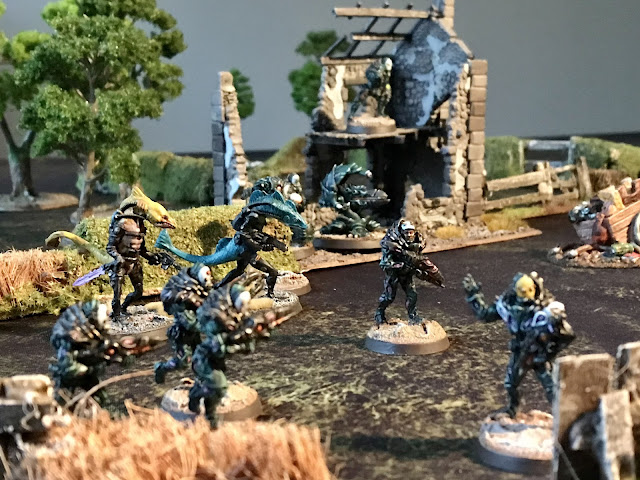
+ The picture at the top is one I took at the end of a test I ran through. I say test, rather than game, as it was very much a case of trying out the mechanics. With any new game, it's easy to make assumptions based on other games you've played, and when the core concept – skirmish warfare – is so similar to other games that I've played (various editions of 40k of course, but also Infinity, AT-43, Kill Team, Warmachine – even Epic), I wanted to make sure I was getting things right. +

+ To help highlight a couple of points, I have added some comparisons to various other games below. Let me be clear that this sort-of-review is not a 'which game is better' bash between BtGoA and 40k. Largely that's because I think that's a bit of a pointless exercise – after all, you can like both tea and coffee for different reasons – but also because I think games need to stand on their own feet. +

+ For me, a big part of the appeal of the game is the fantastic lore, but we're concentrating on the ruleset here. +


***

+ Initial impression +

+ I ran a game of three Isorian units – a human Phase Squad, a Tsan Ra phase squad and a plasma cannon – against two Concord Combined Command (C3) squads. Basically everything I had painted for the C3, and just large enough to see how moving, shooting and so forth worked with the order dice system. +

+ I ran through the test in about an hour, with a bit of flicking back and forth in the rulebook. I've been getting quietly enthused about the game for a few weeks, and immersing myself – even found myself listening to podcasts about the subject, which I very rarely do – so I was half-expecting to have built it up a bit too much and feeling a bit deflated afterwards. Happily, this wasn't the case. +

+++

+ Postives +

+ Consideration for players +

+ All wargames rely on players collaborating to make a good game, and I sometimes think designers get a bit lost in the bushes and lose sight of that. Rather than trying to tighten the bolts on everything in a sisyphean attempt to account for every single possible interaction, Beyond the Gates of Antares leans into this, and makes a lot of small but sensible decisions to help collaboration and minimise unnecessary reference during the game. viz.:
  • Weapon ranges are taken from the closest figures, then abstracted for the squad. It's a neat way of ensuring you don't have to measure each figure in turn.
    • The small squad sizes and coherency distances prevent this from causing too many oddities.
  • The Order Dice and reaction mechanics ensure that both players are engaged and entertained, with meaningful decisions to make throughout.
  • Traditionally vague elements – such as how area terrain and buildings work – are provided for. 
    • The simple note that 'these rules are assuming an area of roughly 8 x 8in' goes a long way to help players decided where and how their figures interact with large forests, or whether you can fairly count a couple of intervening thin hedges as a single thick one within the spirit of the rules.
    • Buildings are likewise simply 'occupied' by units, rather than having to work out the precise placement of figures inside an enclosed building. Like area terrain, you're given a guideline size for a standard building, and larger buildings are subdivided.
+ These are, in the main, fairly subtle things, but they're illustrations of how refined the core engine is, and how it's geared towards how playing a game in the real world works. There's a real understanding of what actually happens when two or more people play a game. The 'crunch' of the rules works like a good butler: unobtrusive, but helping the enjoyment to run smoothly without getting in the way. +

+++

+ Intuitive +

+ Once you've got the key actions – movement, shooting etc. – under your belt, the rest flows smoothly. Close combat, for example, is not really a separate set of mechanics, but a variation on shooting. Weaponry likewise all shares a common set of mechanics, and are distinguished largely by subtleties within the stat lines rather than special rules and exceptions. +

+ There's not a huge amount to remember: rather than unique for each faction, a lot of the weaponry is shared across the game – there are just three or four small arms, for example. Likewise, with the minor proviso of multi-order dice (MOD) units, everything from infantry to vehicles to drones works with the same core mechanics. Even how MOD units work is summed up in a few paragraphs that are aimed more towards clarifying how existing rules interact than introducing new ones. +

+ There are special rules, of course. The differentiation possible within the staline – even given the greater freedom of a D10-based system over a D6-based system – is minimal, but the special rules and exceptions are largely intuitive. By that I mean that, even taking into context the slightly fantastical nature of far future spacemen, things work roughly as you'd imagine. There aren't many mental jumps and rules exceptions in (say) moving across a marsh; and you can hide on one side of a hedge – but not the side nearer the enemy! It's a very common sense ruleset. +

+++

+ Turn structure +

+ The Order Dice mechanic is a definite plus point for me. It's so elegant! You put a die in the bag for every unit, then draw them out (blind) one at a time. If it's your colour, you place the die next to the unit with the order you want uppermost, then activate your unit. Rather than the other player then taking an activation, you draw another. This can result in a string of activations for one side or the other, which I feel would add a lot to the tension and fun of the game – adding a bit of random chance without feeling unfair. After all, if your opponent has a string of lucky draws, you'll be in a better position to make a more daring counterattack, knowing that he or she has a lesser likelihood of drawing dice later. +

+ Besides this clever variation on alternating activation, the game also flows beautifully from turn to turn as a result. There's no end phase or interruption to remember, nor anything to track, because you'll either have dice in the bag or not. Again, it's a subtle thing, but it's another example of reducing the mental load: rather than having to bear in mind how the mechanics work, you're free to concentrate on the interactions of models on the table. + 

+++

+ D10s +

+ This isn't a paean to funny-shaped dice. The poor old D6 gets a lot of criticism for not being granular enough, or not allowing enough variation, but by and large I've found systems that use different dice (or worse, proprietary dice – I'm looking at you, ill-fated Warcaster) don't really do much with the change to more sides besides using it to spread the probabilities more finely, or simply use it as a novelty. (As an aside, Infinity deserves a thumbs-up for a genuinely innovative use of the D20; though personally I found it a bit cumbersome to implement in-game.) +

+ I was therefore a bit leery of a D10-based system, but I was pleased to see BtGoA actually does something fun with it – and that's include a critical success and critical fail mechanic. These vary from place to place, but generally if you roll a 1 there's an advantage, and if you roll a 10 something bad has happened. +

+ In tune with the intuitive and considerate comments above, these tend not to be completely new mechanics, but rather to do things that already exist in the rules: taking an additional pin marker, for example; or allowing you, rather your opponent, to pick where the shot hits. Where your heavy weapons miss critically, they temporarily run out of ammo/overheat – but rather than giving that a new rule, you simply turn their order dice to the Down order. That last one is a good example of the interconnectedness of the mechanics; and how the clean rules can give such complexity. +

+ Some results are unique: a critical success on moving through terrain will create a path for others to follow for the rest of the game, for example. Hitting a Ghar battlesuit with a critical success will strike its plasma reactor(!); while missing critically with a plasma cannon represents the weapon overheating (well, 'fading') temporarily. These minor advantages (and setbacks) are all flavourful and interesting, and make fishing for 1s fun. +

+ A secondary point is that a D10 system has a greater ability to meaningfully balance modifiers than a D6-based system. That allows range, cover and conditions to add complexity to those few weapons we mentioned earlier, preventing them feeling samey. +

+++

+ Psychology +

+ One of my favourite bits of Epic: Armageddon is the blast marker mechanic. When you're shot at, your formation sustains a blast marker that reduces your ability to reply. More are added for casualties or other traumatic events, and eventually even a massive formation can be rendered combat-ineffective by sufficient markers. +

+ Besides offering a great visual – the formations under fire make it obvious to an onlooker where the action is heating up – the mechanic neatly and smoothly encapsulates the psychology of warfare. Your forces might not necessarily be dead or injured, but your soldiers are too preoccupied with staying alive to return fire. +

+ BtGoA has a similar mechanic, with pin markers being placed when unit come under effective fire – that is, they hit. Even if the weapon fails to hurt them, your forces will be slightly more edgy than if they're fired at but the shots go wide. Pin markers are deleterious to your ability to issue orders, to your soldiers accuracy, and if they build up to equal your units' command ability, the unit is broken and removed. +

+ It's a neat and (dare I say?) realistic way of representing how people react under fire. A unit might not sustain any casualties, but if they're put in a stressful enough situation, they'll break and run. Equally, if well led and reassured, a unit can be whittled down and still be returning fire effectively. +

+ It works beautifully here; subtly different from Epic: Armageddon's mechanic, but retaining all the visual appeal and ensuring psychology and leadership – historically amongst the most important values in a military – plays a prominent role in the game. +

+++

+ Short musical interlude + 

+ Phew! Lots of words. Let's take a short intermission to look at some models, shall we? I gave myself the challenge to paint my Isorians over the Christmas break... and predictably failed to do so. Nevertheless, it's worth persevering – after all, failing a self-imposed challenge should simply spur you on, not make you feel bad. The perfect's the enemy of the good, after all (Just ask Ferrus Manus). +

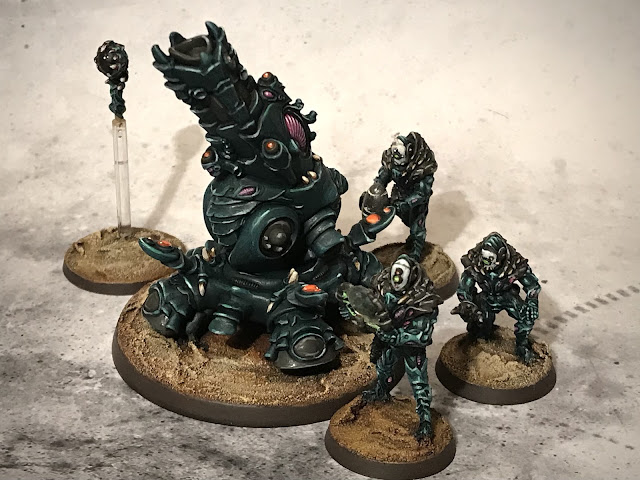
+ To that end, I've been plunging on with the Isorians, and polished off the X-Howitzer (a giant mortar) and spotter drones. You can see them all below. +


+ I just can't get all that excited to paint tanks and machineries of war, so I'm always quietly relieved with crew-served weaponry – more interesting figures to develop, and they're often in cool poses. +

+ Here, the three crew members are carrying a variety of spotting, loading and firing equipment. I added a small circle of plastic (cut from a blister pack) to the spotter's equipment, giving the impression of a transparent screen. A couple of dabs of green ink and superglue created some holographic blips on the screen. +

+ The unit as it would typically appear in-game, with just one spotter drone. +


+++

+ Negatives +

+ Ease of use +

+ It's not all rosy. The discursive nature of the writing means that the rulebook is hiding a rather elegant game within it. That's not to say it's obtuse – simply that the rulebook is written in quite a conversational tone. Anyone familiar with older rulesets like Rogue Trader or 2nd edition Warhammer 40,000 will be familiar with the style, where slight asides or background touches creep into the 'crunch' of the game, making the text longer and more discursive. +

+ As a point of comparison, modern 40k has handy bullet points and, crucially, an index – much better for quickly finding references during a game. Familiarity with a system will probably go a long way to resolve this, but even in the little test game I played I found myself thinking 'now, I'm fairly sure I read that somewhere...' and flicking back and forth in the rulebook 'til I found things. +

+++

+ Uniformity +

+ I've noted the stripped-back nature of the units and weapons as an positive feature above, but the flip side of that is just how similar things are. I ummed and ahhed about whether to list this in the negatives, but decide that lack of options is probably a bad thing, on balance. However, this is likely a matter of taste – if (like me) you like your sci-fi wargames being what amounts to WWII in costume, rather than giant over-the-top stuff – you'll appreciate the fact that your soldiers are basically identical to the opponents. Consider:
  • An Algoryn Armoured Infantry warrior is naturally tough, so has a Resistance (Res) value of 6, boosted to 7 by his armour. +
  • An Isorian Phase Trooper has base Resistance of 5, boosted by his Phase Armour to 7 (at mid-range)
  • A Concord soldier has base resistance of 5, and his Hyperlight armour boosts that at mid-range to *drum roll* a value of... 7.
+ In fairness, there are differences, but they're fairly subtle, and the test I played didn't really highlight them. Perhaps the difference between the underlying body and armour type does become clearer in larger games, or with more experience. +

+ Secondly, everyone moves the same basic distance. Like Epic: Armageddon, you can pick orders that trade off the option to shoot to move twice, or even three times. This would be fine – except for the fact that then there are special rules for Fast and Slow units that are an exception to this. Why not just include a movement stat that would account for this? Despite what I've said above about clarity and consideration, there are still odd bits like this here and there. +

+ Finally, table size. 6 x 4ft is assumed as the basic table size, and you're encouraged to have a bigger space. One of the things I like best about 9th ed. 40k and modern games like Kill Team is the realisation that most people play on their dining tables or equivalents – considerably smaller than 6 x 4ft. As far as I can see, there's no scaling for table size based on game size in Beyond the Gates of Antares, so whether you're playing a 500pt game or a 3,000pt game, you'll be using the same real estate. That's a shame from a visual point of view: the car parks that modern 40k can be are ameliorated when you're encouraged to play on bigger boards for bigger games, and on the other end of the scale, the twenty-five or so figures I had in my test looked positively lost on the board. +

+ In fairness, I'm not really sure what could be done to fix this, beyond a drop in scale. The weapon ranges are much longer than 40k, and while not infinite, as in Kill Team, most of them may as well be. That in itself is quite nice – even a pistol can reach out to 30in with a lucky shot – so perhaps table size is a necessary evil. Still, I'd like to see some consideration placed on it for second edition, to scale better. +

+ Gaps +

+ The conversational structure of the rulebook has its downsides as well as its upsides – and one of them is that the summaries in the rulebook don't include into on which units are heavy weapons. Since that's not a statistic or special rule, you're left to simply know that (for example) a plasma cannon is a light support weapon (and thus eligible to move and fire), while a mag cannon is a heavy weapon (and thus not). I understand that there's been a PDF released since to clarify this, which adds headings, so it's good that Warlord's on top of stuff like that. +

+++

+ Summary +

+ I guess that my initial conclusion is that Beyond the Gates of Anatares isn't revolutionary so much as a very satisfying refinement of existing concepts. It incorporates some unique and innovative ideas that build well on what works, rather than being changes for the sake of change. +

+ Most recent games I've played – with the notable exception of the explicitly  veteran-gamer-courting Adeptus Titanicus (AT) – seem to have leaned into making a game that aims to competes with computer gaming: very abstract systems that get you going in just a few pages, but that are then layered with additions, exceptions and mechanics to create a satisfying complexity. In contrast, both BtGoA and AT give the reader a heavy read to get through, with interlinked  and interreliant concepts. It either all hangs together, or it doesn't. +

+ As an illustration, there are layers to 40k. You can play with the addition of the Crusade rules; of strategems; of secondary objectives... there are lots of modules that attach to the core game to let you customise it. BtGoA is, in contrast, a clean and complete system. Whether that means that it's ultimately less satisfying is obviously beyond the scope of the little test game I played, but I think it's worth highlighting that I enjoyed the process, and could feel my brain whirring on how the game would scale up in interesting ways; and how that in turn would add complexity on the tabletop, rather than in mental load (see below). +

+ On the rulebook's text style, I think it's likely a taste thing. The downside of bullets and clarity (and yes, I do think there's a downside) is that it can give a false impression of how 'clear' tabletop wargaming can be. Any wargamer will be familiar with situations in which it's not quite clear how far something is, or how certain outlier rules interact. The more roundabout style of Beyond the Gates of Antares carries explicit notes that it's not one of millimetres and exactitude. +

+ The label narrative gaming often comes with a slight sense that the rule engine can be 'let off', and be a bit rough around the edges or vague. Let me make it clear that, from my initial impressions at least, I don't think that's the case with Beyond the Gates of Antares. +

+ Where present, the additional text seems to be aimed at clarifying the intent behind the rules. It sometimes goes beyond what's necessary, but from my point of view at least, it's quite nice to have the writer explain that 'this doesn't do that, because I wanted to give this impression/avoid unnecessary rolling'. +

+ It is, at root, unabashedly aimed at what we can euphemistically call 'more mature' gamers – a ruleset to chew and mull over. I'm happy to report that it remains very intuitive: the complexity plays out on the table, with the rules, once absorbed, not getting in the way of the game. +

+++

+ Mental load +

+ This isn't directly related to It's not something that had really struck me until recently, but a lot of games I play have quite a lot of what I term 'mental load': abstract stuff to remember. 40k's a good example of a game with increasing amount of mental load: there are multiple levels of non-visual, non-tactile elements to remember, from army special rules to stratagems to objectives and exceptions to exceptions. It's claggy, even slightly stressful, and it take focus away from actually concentrating on what's happening on the board – the fun bit of being an armchair general. +

+ Even Kill Team, which I think is a brilliant game with lots of innovative ideas that work well, has quite a few ongoing 'blind' effects and rules to bear in mind. BtGoA has very little of this; there seems to be an absolute minimum of book-keeping. +

+ Part of this, of course, is down to this being a very small game.

+ All adds up to make a satisfying game, with few heads-scratching moments – though I reserve judgement on that, given that this was a very small test game. I have heard that some armies (like the Ghar) have a lot of exceptions to the basic rules, so perhaps the BtGoA ruleset was flattered by my use of two fundamantally similar forces, the Concord Combined Command (C3) and Isorian Senatex. +

+++

+ Bonus tracks +

+ Like the end of a 90s hard rock CD, you've read through the whole article... and at the end you've found the bonus tracks. Hopefully better than the 'hilarious' outtakes of the singer burping or the drummer's poorly-indulged twenty-minute solo, here are some models:


+ The Concord Combined Commend doesn't care what colour (or shape) you are; all panhumanity – and a few aliens – can sit in its ranks. I rather like the big-brained Vyess panhuman morphs, so will be integrating some of them into my C3 force. An example is above. +

+ ...and speaking of C3, I have a copy of the starter set, Strike on Kara Nine streaking its way across Antares to me. I won't be touching it until the Isorians are done, but I'd like to use it to do a buildalong. If you're interested in joining in, please let me know! +


Thursday, December 9

inload: Beyond the Gate of Antares

+ Joining the Concord Combined Command +

The PanHuman Concord is one of the two great panhuman, most technologically advanced factions of Antarean space, the other being it’s ‘parent’, now known as the Isorian Shard or Senatex. The Concord is a society of both human and machine sentience bound together by integrated machine intelligence or IMTel. It is in practically every respect a utopian society in which humans are free to devote their lives to chosen endeavours entirely free of compulsion, or the necessity of toil and unwanted responsibilities. The IMTel anticipates the needs of each and provides a benevolent governance to all within its reach.
From the Gates of Antares Nexus [+noosphericinloadlink embedded+]

+ I'll be honest, the above read like gibberish when I first looked into what the models I was painting were. On the other hand, it was intriguing gibberish – the sort of gibberish I remember from reading the Warhammer Fantasy Battle or Rogue Trader manuals for the first time when I was still in single chronodigits. In answer to the unasked question, yes, I did want to read more. +

+ As I understand things, in the Beyond the Gates of Antares (BTGoA) universe, there is no need to be welcomed to the IMTel (the Integrated Machine Intelligence) that benevolently oversees the PanHuman Concord faction, as once you're in it, you become part of it. +

+ All across the (colossally huge number of) worlds of the setting, the planets and ships are mostly immersed in a soup of nano-machines that infest the materials around you and the very air you breathe. So far, so dystopian; but as you read more into it, it's all surprisingly – refreshingly – neutral. Far from there being a centralised robot hivemind, it seems more of an extended internet with a very accurate set of algorithms. Most humans require implants to integrate – much like an on-board internet browser – and the IMTel itself is a gestalt of their thoughts and experiences together with the colossal number of machine intelligences (and aliens) that make up day-to-day society. Y'know, an actual hive or swarm mind, with no single controlling intelligence. +

'Driven by the collective desires, needs and anxieties of its citizens, the IMTel of a world simply does what is best for everyone.'

'Taking everything into the balance, the IMTel is unable to make mistakes'
[Beyond the Gates of Antares rulebook]

+ The rulebook's narrative 'voice of god' mostly plays the above straight – for the members of the PanHuman Concord, the largest of these sort of societies, and one of the prime movers of the game background, the life of most members appears utopian. Fortunately, however there are a lot of those very British smirks at authority in the rulebook – mostly in the little bits of colour text and in-universe quotes – that make it clear there's very definitely more than one point of view... +

+ That's not to say, however, that the PanHuman Concord is evil, either. One of the things I'm finding very appealing is the fact that while you could just as easily base your Concord Combined Command, or C3, (the military arm of the PanHuman Concord) army that leans towards a Matrix-like local IMTel, with humans largely subjugated and exploited; or a more neutral one that plays around with the themes of Aldous Huxley's Brave New World; or a genuinely optimistic Star Trek-like post-scarcity society. +

+ For a game ostensibly about recreating fictional future war, then, the background raised some very interesting implications of questions about how the IMTel tallies up with freedoms and liberties; of how a benevolent dictator's intentions marry up with the messiness of real life – and more besides. In short, it's a very rich setting – and that's within just one faction. +

+++

+ Show me the models +

+ Well, quite. +

PanHuman Concord Strike Squad

+ Starting as a simple palette cleanser between other projects, I've enjoyed painting these models. I put my thoughts on building them in an earlier inload [+noosphericinloadlink embedded+]. In terms of colour scheme, I used a similar approach for my Lamb's World Guard, but wanted to include some more eye-catching visual 'pop' – something usually outside my wheelhouse for regular  puny hu-mans. +

+ With the scheme decided, I looked at techniques. I probably wouldn't have opted for edge highlighting for these figures (given their size, it's easy to make them look crude and blocky, which didn't fit with the background) except for the fact that the models I'm most excited about for the setting – the creepy biomechanical Isorians – have much more organic shapes, and I want to contrast the two styles. Since the Isorians won't allow for edge highlighting, it seemed okay to use it here sparingly. +

+ Being quite slight, the figures painted up quickly. I got the squad of eight completed in two evenings' work. The detail's sharp enough, though there are a few softer areas that required a bit of head scratching on whether to add an edge highlight or not. +

WIP shot – after one evening's painting.

+ The group above show the basic scheme. Granite-grey hard armour and weapon casings, and desert yellow for most of the remainder. I've added a few patches of camouflage to the helm and upper arms, on a whim more than anything planned. It adds a little visual interest. +


+ In terms of other colours, I've used a blue-grey for the visors and sights,  hints of gold as metallics, and flashes of purple, green and orange for accents. Using all the secondary colours gives a balanced, unthreatening palette, and keeping the accents small helps to ensure they don't overwhelm the overall scheme. +

+ The group above show three members with plasma rifles and one with a plasma lance – a specialist weapon. I've marked it out with a different colour glow – quite refreshing to colour code things on a whim after many years of working out what colour X 'should be'. I think the scheme's got a nice semi-realistics/semi-fantasy feel that fits for me. +

Test figure

+ The final scheme varies little from the test figure above. I substituted gold for silver on the test figure, and changed the gold plate above the visor in favour of extending the camouflage area. +

+ I'm not really intending to do a giant army of C3 for gaming. These were fun, but I think I'd like to explore some of the other factions. Isorians were the ones that had the biggest vissceral appeal to me, and I've got a few on order. Given that I'm unlikely to find anyone local or in the PCRC (my gaming group) to spontaneously pick up the game, I thought it'd be nice to have a squad or two of each for small games. That way, if I manage to twist any of my friend's arms, I've got little preset forces to play with – a bit more like a boardgame than a full tabletop wargaming experience. +

+ It was with that in mind that I opted for a desert basing scheme. It allows them to be folded into my Lamb's World Imperial Guard army if it never takes off – but more pertinently, the light-coloured bases will contrast wonderfully with my planned Isorian scheme. +

Other half of the squad

+ The green icons above the heart mark rank. The 'First' (leader) has a little triangle to hint at the C3 (see what I did there?), the others a largely abstract sigil of dots and a line. +

+ Although I say the squad is finished, it's worth noting that BtGoA includes lots of drones – little flitting machine intelligences that enhance your squads in various ways. I think they're a nice way to differentiate these spacemen with laser guns from my lower-tech Imperial Guard armies, so I'm planning to paint up a few – they come on the same sprues, so it's just a case of building 'em. +

+++

+ Making my own army +

+ Part of the appeal of the game is its largely blank slate nature. Despite a hiatus caused by events in the real world, the background is continuing to be expanded and built. There's lots of space to build and develop the story as you wish to. +

+ Indeed, there are a huge number of open doors even within one faction's background. The Concord is a colossal place – millions of worlds – but it's not a monolithic culture. Because of the nature of its integrated technology,  the 'future internet' requires physical interaction – world to spacecraft, spacecraft to world – in order to stay roughly aligned. +

+ Extended isolation from other Concord worlds sees the local IMTel evolve slightly to better serve its own needs, just like a geographically isolated animal species will start to evolve away from a common ancestor. You need continual interpollination to prevent these 'shards' (as the individual groups – worlds, factions, even military squads – are called) from diverging too far. Small divergences are gradually diluted away when meeting again but, to reiterate, there's not a central government or centralised leader that decides. Instead, integration, development and agreement is unconsciously decided upon by the involved IMTel shards until a compromise is reached. +

Worlds can protect themselves against Concord nanospore by not allowing their technology to interface with it, but the Concord technology enjoys the advantage of total integration, allowing it to overcome resistance given time. The surest defence against contamination comes in the form of nanites called nanophages designed to identify and destroy unrecognised intruder nanospore. Ultimately, if sufficient Concord nanospore can be generated to become a self-sustaining shard, they will inevitably overcome any planetary defence and form a nanosphere, after which the world effectively becomes part of the PanHuman Concord.

So, perhaps the worlds of the Determinate have good reason to fear the IMTel civilisations. The IMTel itself is devoid of ambition and malice yet is intolerant and pitiless. Although IMTel technology is highly prized, contact with the IMTel nations is risks absorption: it is safest to acquire it through intermediaries such as the Freeborn who are capable of sterilising the technologies attachment to its parent IMTel.
[Beyond the Gates of Antares rulebook]

+ Background-wise, that's intriguing and full of depth to explore. In terms of tabletop gaming, it sets up some good opportunities for fighting! And on that note, here are a couple more shots. +


Tuesday, January 25

+ inload: Algoryn AI review +

+ Algoryn Armoured Infantry + 

+ Incident Team Gorun +

+ Strike on Kara Nine – the starter set for Beyond the Gates of Antares, which I found on eBay going for a song. I'll do a proper write-up/review of this at some point, but having broken into the box last night, I couldn't resist getting stuck in on some modelling. +


+ Model-wise, the set contains two sprues of Concord Combined Command Strike Troopers – you can see my thoughts on those in this inload [+noosphericinloadlink embedded+] – and fifteen Algoryn Armoured Infantry, or 'AI'. Let's have a look at the latter.+

+++

+ About the Algoryn +

+ The Spill is an in-universe term used to refer to regions that aren't controlled by one of the three major powers (viz. the Panhuman Concord, the Isorian Senatex and the Vorl Domination) – essentially, all the other minor groups that occupy the systems accessible through the Gates of Antares. +

+ Some of these forces are tiny; single system or even planets with pre-spaceflight civilisations. Others, while small relative to the big players, are powerful and vigorous. The Algoryn Prosperate are a good example of the latter: they are the largest and amongst the most advanced minor civilisations. +


+ Ruling over a cooperative league of planets that includes other non-Algoryn panhumans and a few non-human species, the Algoryn are burly and powerful panhuman morphs (that is, they evolved from human stock in the earlier ages of Antares, rather than being aliens). As with almost all advanced groups in the Beyond the Gates of Antares setting, the Algoryn use advanced 'nanospore' technology that permeates their worlds and society, allowing for what amounts to a hyper-advanced communications system being accessible everywhere – a sort of 'space internet'. +

+ Alas, the reason the Concord and Isorian Senatex are so successful is that they have perfected dominant nanospore technology that inherently overruns and overrides  local versions. For this reason, the Algoryn are paranoid about their society being overtaken by either of the big human factions, and are willing to got to war – even destroy their own worlds – to avoid contamination and subsumation within either faction. +

+ The Algoryn have a regimented and militarised society in which all Algoryn serve, partially as a result of their history and partially as a result of their siege mentality. This is useful: not only does it allow them to compete militarily with the enormous C3 and Senatex (who only deploy a tiny proportion of their society), but it also means that they are well set to  but many of their systems are unfortunately accessible to the violent, aggressive and backwards Ghar. +

+ Caught between these two dire threats – one low-tech and the other hyper-advanced – the Algoryn have settled into a limited middle ground. Where the C3 or Senatex deploy sentient machine intelligences [+Appendnote edit: I use this rather clunky term rather than 'Artificial Intelligence' to avoid confusion with the Armoured Infantry.+] to pilot their drone-tanks – the Algoryn are all too aware that their less advanced technology can be overwhelmed by the C3 or Senatex's nanospore. As a result, the Algoryn use machine intelligences to assist and support Algoryn pilots and crew, rather than autonomously. +

+++

+ Algoryn Armoured Infantry mini-review +

+ Two (mostly) unconverted Algoryn AI +

+ Theoretical: Overview +

+ First impressions of the sprue were positive. As with the C3 sprue, the Algoryn Armoured Infantry sprue is hard plastic and contains five Algoryn soldiers plus a little drone. The troopers are substantially bulkier than the very slight C3 troops, which gives them a bit more presence. Their aggressive culture comes across in the hard angles and deep recesses of the armour – they still look advanced, but also threatening. I particularly like the crested helm, which evoked elements of Predator and Halo while still looking quite distinctive. +

+++

+ The good, the bad and the ugly +

+ Lacking the big fire support drone on the C3 sprue, the Algoryn sprue has more options. As well as the mag guns (solid-shot, reliable rifles) shown on the models here, there are a couple of mag repeaters (shorter-ranged mag guns that kick out more shots), and two micro x-launchers – a special weapon like a grenade launcher. It's nice to have the variety and options here. Apart from anything else, it allows the sprue to pull double duty for the Armoured Infantry squads, which are primarily armed with mag guns, and – if you have spares from another set – Assault squads, which are armed with mag repeaters. +

+ You get enough helms to equip everyone uniformly, along with two optional bare heads for a bit of variety: an improvement on the Concord sprue's lone unhelmed variants. There's a paired gesturing arm and pistol-wielding set. As with the C3, that's about it for options – and as there, I think it would have been nice to have had a couple of pouches or pieces of technology for some variety and interest. Comparing the Gates of Antares sprues with Warlord's own Bolt Action sprues shows that the latter have loads of pouches and bags and water bottles – even characterful little things like swords. Perhaps this is low-hanging fruit for a future upgrade set? +

+ Anyway, that's a minor complaint. The big problem I have with this sprue is the poses. I'm not sure what the sculptor was going for, and whether the limitations of plastic moulding caused compromises, but the legs are in very peculiar postures. This stock shot from the Warlord Games website shows what I mean:
+ The running legs (bottom half, right of centre line) are fine, but the others are very odd. They're not completely awful – they'd work perfectly fine for a dynamic individual pose – but the two odd half-lunges poses on the left really jump out. In a force where these poses are likely to be repeated three or four times, it'll end up looking like a gymnastics contest. Perhaps if there had been some arms that complemented the poses they might work better, but the arms are in fairly simple cradling/aiming postures. A final fault with these legs is that they're leaning to the right. Had they been leaning the other way, it might have made for a more convincing braced aiming pose or similar. Just a shame that these weren't replaced with kneeling legs or something similar:  a real missed opportunity +

+ The walking set on the bottom left is – again – perfectly serviceable, but a bit pigeon-toed, with the trailing leg pressed hard against the waist. It's not an unnatural position, but would be uncomfortable – and I suspect it's a compromise of keeping the legs as single pieces . +

+ It's my biggest complaint of what is otherwise a rather nice set of clean, simple and characterful figures with just enough detail to be rewarding for painting. Fortunately, the material means that the postures are relatively easily solved, as you can see in the 'Practical' section that follows below. + 

+++

+ It's a pity about the questionable poses, as it's my only real complaint about the kit. The detail is crisp and clear, and all the parts fit together nicely. While I'd have liked some more options, that's an unfillable bucket – it's always nice to have more otions! There are improvements over the C3 sprue, too: the arm/shoulder joins are flat and, as a result, there's much less 'swim'. Secondly, the heads are aligned facing forwards, so there's no mouldline running down this focal point. +

+ Indeed, in terms of mouldlines, these are beautifully clean. Perhaps I was lucky to get an early batch, but there's little blurring or flash on the sprues I have. The kit has some nice deep detail, so I think these should be both fun and relatively easy to paint – great for beginners. They are definitely a good choice for this starter set. +

+ If you're building them stock, the poses might not be a problem, but if you're planning on building multiple kits, then I suggest either sharpening your conversion skills to avoid repetition, or kitbashing them with the Algoryn Command Squad sprue shown below. This looks to have some more conventional poses (though the uppermost ones on the right look to be a mirror of the pigeon-toed pose on the Armoured Infantry sprue) – and I think in combination, they'll combine to make some really interesting variety. +


+ I've ordered a set to double-check the mix-and-match potential, but I'm anticipating the joins being seamless. I'll come back to this review when I have the Command sprue in hand to put them into context, but I certainly think that the legs are the weak point of the standard Armoured Infantry sprue, and letting down what's otherwise a nice little kit. +


+++

+ Practical +

+ When assembling, I couldn't resist making a few subtle tweaks. I've banged on about the legs above, but the other change I did was to add a neckpiece. The heads seemed to sit quite low in the chest, and I wanted to make them look slightly more upright and noble than the stock pose. Fortunately, the sprue includes little circular bits that I assume are something to do with getting the die in place. +


+ I carefully trimmed one of these off for each assembled body (the torsos are two-part), aiming to get a circular disc of plastic. By the nature of the material, a straight cut across will cause the disc to curve slightly, giving a slight 'dishing'. You can just about see what I mean in the picture above. The torso at the back has the neckpiece in place, while the foremost one has the neckpiece just to the right of it, ready to be glued in. +


+ A neutral posture on this one, to show how they look. This is using the bottom left set of legs – the ones I suggested looked a bit pigeon-toed. Perhaps surprisingly, they required the most conversion work. I trimmed both legs off at the hips, being careful to cut through the soft armour and leaving the plates intact as possible. I then cut more discs (like the neck pieces above) from the sprue and cut these in half to give 'D'-shaped pieces. I used these to pack out both hips, creating a wedge that turns the legs outwards from the groin. The curve of the 'D'-shape simulates the undersuit detailing elsewhere, so I don't think there's really much need to do any greenstuff work here. +


+ Another repose, this time using the less extended lunge pose (middle one on the left of the sprue). I think this one's my favourite, giving a nice 'combat prowl' impression. It's also the simplest conversion; little more than cutting the model's left leg (right of picture) off and removing the foot. These were then replaced at a different angle. +


+ And finally, the one that I most dreaded, the extended lunge. Again, I trimmed away the model's extended leg and carefully cut away the foot before replacing both at a new angle. This required a little stand of rubble to be built up – I used sprue (pictured) while the glue set, but will take them all off these temporary bases for painting. +

+++